
Browse "Things"
-
Article
Domestic Service (Caregiving) in Canada
Domestic work refers to all tasks performed within a household, specifically those related to housekeeping, childcare and personal services for adults. These traditionally unpaid household tasks can be assigned to a paid housekeeper (the term caregiver is preferred today). From the early days of New France, domestic work was considered a means for men and women to immigrate to the colony (see History of Labour Migration to Canada). In the 19th century, however, domestic service became a distinctly female occupation (see Women in the Labour Force). From the second half of the 19th century until the Second World War, in response to the growing need for labour in Canadian households, British emigration societies helped thousands of girls and women immigrate to Canada (see Immigration to Canada). In 1955, the Canadian government launched a domestic-worker recruitment program aimed at West Indian women (see West Indian Domestic Scheme). In 2014 the government lifted the requirement for immigrant caregivers to live with their employer to qualify for permanent residence — a requirement that put domestic workers in a vulnerable position. (See also Canadian Citizenship; Immigration Policy in Canada).
"https://d3d0lqu00lnqvz.cloudfront.net/media/media/3f5cab82-83b8-449c-a7f1-2bfff8549915.jpg" // resources/views/front/categories/view.blade.php
https://d3d0lqu00lnqvz.cloudfront.net/media/media/3f5cab82-83b8-449c-a7f1-2bfff8549915.jpg
-
Article
Domestic Silver
As little domestic silver has survived, it is difficult to determine how much was made in the colony. Silver, obtained by melting coins or existing silver articles, was always in short supply.
"https://d3d0lqu00lnqvz.cloudfront.net/media/media/fec91f00-043b-46b7-a62b-a6ecef8a20a5.jpg" // resources/views/front/categories/view.blade.php
https://d3d0lqu00lnqvz.cloudfront.net/media/media/fec91f00-043b-46b7-a62b-a6ecef8a20a5.jpg
-
Article
Dominican University College
Established in Ottawa in 1900, the Dominican University College (formerly the Dominican College of Philosophy and Theology) was recognized in 1909 as a centre of higher learning of the Order of Preachers (Dominicans) in Canada.
"https://d3d0lqu00lnqvz.cloudfront.net/media/media/9d9998e0-7ab5-46ed-95e8-81a98459aa7e.jpg" // resources/views/front/categories/view.blade.php
https://d3d0lqu00lnqvz.cloudfront.net/media/media/9d9998e0-7ab5-46ed-95e8-81a98459aa7e.jpg
-
Article
Dominion of Canada
Dominion of Canada is the country’s formal title, though it is rarely used. It was first applied to Canada at Confederation in 1867. It was also used in the formal titles of other countries in the British Commonwealth. Government institutions in Canada effectively stopped using the word Dominion by the early 1960s. The last hold-over was the term Dominion Day, which was officially changed to Canada Day in 1982. Today, the word Dominion is seldom used in either private or government circles. This article is a full-length entry about the Dominion of Canada. For a plain-language summary, please see Dominion of Canada (Plain-Language Summary).
"https://d3d0lqu00lnqvz.cloudfront.net/media/media/143f8587-f938-4cf1-bdc2-c441d02dc962.jpg" // resources/views/front/categories/view.blade.php
https://d3d0lqu00lnqvz.cloudfront.net/media/media/143f8587-f938-4cf1-bdc2-c441d02dc962.jpg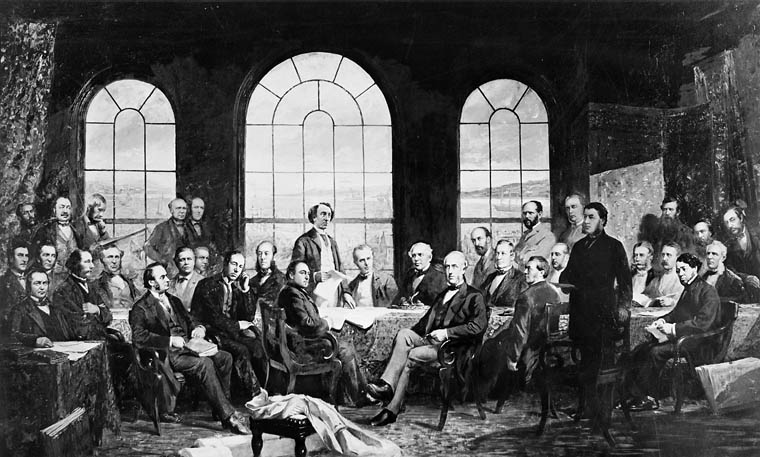
-
Article
Dominion Arsenal
Dominion Arsenal, the first government cartridge and shell factory and proofing facility, established 1882 at Québec to provide the Canadian Militia with ammunition.
"https://thecanadianencyclopedia.ca/images/tce_placeholder.jpg?v=e9dca980c9bdb3aa11e832e7ea94f5d9" // resources/views/front/categories/view.blade.php
https://thecanadianencyclopedia.ca/images/tce_placeholder.jpg?v=e9dca980c9bdb3aa11e832e7ea94f5d9
-
Article
Dominion College of Music/Collège de musique Dominion
Dominion College of Music/Collège de musique Dominion. Founded in Montreal in 1894 by J. Edgar Birch, Percival J. Illsley, and Horace Reyner, among others, it was incorporated in 1895 and became affiliated the same year with Bishop's University.
"https://thecanadianencyclopedia.ca/images/tce_placeholder.jpg?v=e9dca980c9bdb3aa11e832e7ea94f5d9" // resources/views/front/categories/view.blade.php
https://thecanadianencyclopedia.ca/images/tce_placeholder.jpg?v=e9dca980c9bdb3aa11e832e7ea94f5d9
-
Article
Dominion Corset
Dominion Corset, formally known as the Dominion Corset Company Ltd., was a manufacturer of women’s undergarments based in Quebec City. The company was founded by Georges-Élie Amyot and Léon Dyonnet in October 1886. For nearly a century, Dominion Corset was one of the largest manufacturers of women’s undergarments in Canada and employed many thousands of women. (See also Clothing Industries; Women in the Labour Force.) Its principal factory in Quebec City, now known as La Fabrique, has been preserved and listed as a National Historic Site due to its historical and architectural value.
"https://d3d0lqu00lnqvz.cloudfront.net/dominioncorset/dominioncorsetbanq.jpg" // resources/views/front/categories/view.blade.php
https://d3d0lqu00lnqvz.cloudfront.net/dominioncorset/dominioncorsetbanq.jpg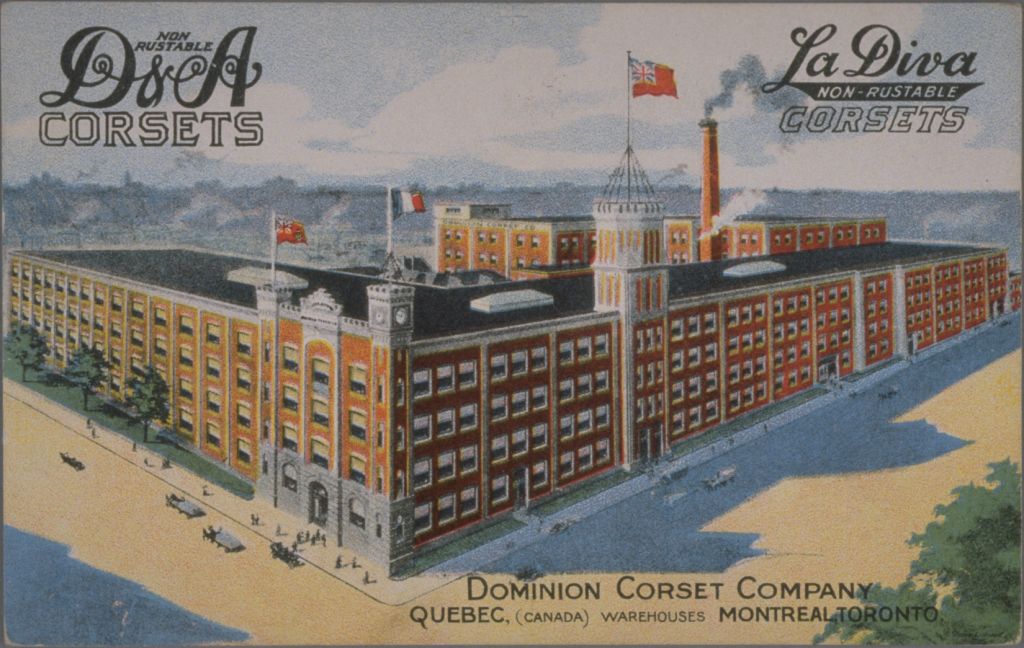
-
Article
Dominion Lands Act
The Dominion Lands Act was a federal law that received royal assent on 14 April 1872. It allowed for lands in Western Canada to be granted to individuals, colonization companies, the Hudson’s Bay Company, railway construction, municipalities and religious groups. The Act set aside land for First Nations reserves. Métis lands were organized by the government outside the Dominion Lands Act, using the scrip system. The Act also set aside lands for what would become National Parks (1883). The Dominion Lands Act devised specific homestead policies to encourage settlement in the West. It covered eligibility and settlers’ responsibilities, and outlined a standard measure for surveying and subdividing land. Some 1.25 million homesteads were made available over an expanse of about 80 million hectares — the largest survey grid in the world. The Act was repealed in 1930, when lands and resources were transferred from the federal government to the provinces of Manitoba, Saskatchewan and Alberta. From 1870 to 1930, roughly 625,000 land patents were issued to homesteaders. As a result, hundreds of thousands of settlers poured into the region.
"https://d3d0lqu00lnqvz.cloudfront.net/media/media/45847956-16b4-43b7-b79d-e6ba45b9c9f4.jpg" // resources/views/front/categories/view.blade.php
https://d3d0lqu00lnqvz.cloudfront.net/media/media/45847956-16b4-43b7-b79d-e6ba45b9c9f4.jpg
-
Article
Dominion of Canada (Plain-Language Summary)
The title “Dominion of Canada” was first applied to Canada at Confederation in 1867. It was also used to describe other countries in the Commonwealth. The federal government stopped using the word Dominion by the early 1960s. The last hold-over was the term Dominion Day. It was changed to Canada Day in 1982. Today, the word Dominion is seldom used to describe Canada. This article is a plain-language summary of the Dominion of Canada. If you are interested in reading about this topic more in depth, please see our full-length entry, Dominion of Canada.
"https://d3d0lqu00lnqvz.cloudfront.net/media/media/143f8587-f938-4cf1-bdc2-c441d02dc962.jpg" // resources/views/front/categories/view.blade.php
https://d3d0lqu00lnqvz.cloudfront.net/media/media/143f8587-f938-4cf1-bdc2-c441d02dc962.jpg
-
Article
Dominion Organ and Piano Co.
Dominion Organ and Piano Co. Instrument manufacturer. Although the date has not been substantiated, the firm was probably founded in 1870 in Oshawa as (A.M.) Darley and (William) Robinson, later called the Oshawa Organ and Melodeon Manufacturing Co.
"https://thecanadianencyclopedia.ca/images/tce_placeholder.jpg?v=e9dca980c9bdb3aa11e832e7ea94f5d9" // resources/views/front/categories/view.blade.php
https://thecanadianencyclopedia.ca/images/tce_placeholder.jpg?v=e9dca980c9bdb3aa11e832e7ea94f5d9
-
Article
Dominion Police
The Dominion Police was originally a small protective force organized by the federal government in 1868 to guard the Parliament Buildings in Ottawa following the assassination of Thomas D'Arcy McGee.
"https://thecanadianencyclopedia.ca/images/tce_placeholder.jpg?v=e9dca980c9bdb3aa11e832e7ea94f5d9" // resources/views/front/categories/view.blade.php
https://thecanadianencyclopedia.ca/images/tce_placeholder.jpg?v=e9dca980c9bdb3aa11e832e7ea94f5d9
-
Article
Dominion Securities Inc
Dominion Securities Inc began business as an investment dealer in 1901. Commencing in the early 1970s expansion of its operations accelerated significantly, through both internal growth and mergers with several other prominent Canadian investment dealers.
"https://thecanadianencyclopedia.ca/images/tce_placeholder.jpg?v=e9dca980c9bdb3aa11e832e7ea94f5d9" // resources/views/front/categories/view.blade.php
https://thecanadianencyclopedia.ca/images/tce_placeholder.jpg?v=e9dca980c9bdb3aa11e832e7ea94f5d9
-
Article
Dominion Stores Limited/Les Supermarchés Dominion Ltée
Dominion Stores Limited/Les Supermarchés Dominion Ltée, with head offices in Toronto, is a Canadian food distributor and merchandiser incorporated in 1919. The company was so named from 1976 to 1986, when it adopted the name Domgroup Ltd.
"https://thecanadianencyclopedia.ca/images/tce_placeholder.jpg?v=e9dca980c9bdb3aa11e832e7ea94f5d9" // resources/views/front/categories/view.blade.php
https://thecanadianencyclopedia.ca/images/tce_placeholder.jpg?v=e9dca980c9bdb3aa11e832e7ea94f5d9
-
Article
Domtar Inc
Domtar Inc is a Canadian manufacturer of paper products with headquarters in Montréal. Founded in 1929 as the Dominion Tar and Chemical Company Ltd to acquire the assets of a former business of the same name, the company became Domtar Ltd in 1965 and adopted its present name in 1977.
"https://thecanadianencyclopedia.ca/images/tce_placeholder.jpg?v=e9dca980c9bdb3aa11e832e7ea94f5d9" // resources/views/front/categories/view.blade.php
https://thecanadianencyclopedia.ca/images/tce_placeholder.jpg?v=e9dca980c9bdb3aa11e832e7ea94f5d9
-
Article
Doric Club
Founded in Montréal in March 1836, the Doric Club was a radical paramilitary group formed in opposition to the Patriote party. Organized by Adam Thom, a Scottish-born francophobe, the club called upon the loyal British population of Lower Canada to unite and defend British interests in the face of the Patriote threat by any means necessary. The group was opposed by a similar paramilitary Patriote group called the Société des Fils de la liberté, which led to a violent confrontation on the streets of Montréal on 6 November 1837. The group disbanded after the start of the Canadian Rebellion, when many of its members joined volunteer militias organized by Sir John Colborne.
"https://d3d0lqu00lnqvz.cloudfront.net/media/media/7a77283a-b2fa-4168-9143-0bbf287ebc65.jpg" // resources/views/front/categories/view.blade.php
https://d3d0lqu00lnqvz.cloudfront.net/media/media/7a77283a-b2fa-4168-9143-0bbf287ebc65.jpg