
Browse "People"
-
Article
Sir William Pepperrell
Sir William Pepperrell, commander in chief of New England forces at LOUISBOURG (b at Kittery Point, Maine 27 June 1696; d there 6 July 1759).
"https://thecanadianencyclopedia.ca/images/tce_placeholder.jpg?v=e9dca980c9bdb3aa11e832e7ea94f5d9" // resources/views/front/categories/view.blade.php
https://thecanadianencyclopedia.ca/images/tce_placeholder.jpg?v=e9dca980c9bdb3aa11e832e7ea94f5d9
-
Article
Sir William Phips
Sir William Phips, adventurer, colonial governor (b near Kennebec, Maine 2 Feb 1650/51; d at London, Eng 18 Feb 1694/95).
"https://thecanadianencyclopedia.ca/images/tce_placeholder.jpg?v=e9dca980c9bdb3aa11e832e7ea94f5d9" // resources/views/front/categories/view.blade.php
https://thecanadianencyclopedia.ca/images/tce_placeholder.jpg?v=e9dca980c9bdb3aa11e832e7ea94f5d9
-
Article
Sir William Price
Sir William Price, lumber merchant, manufacturer (b at Talca, Chile 30 Aug 1867; d at Kenogami, Qué 2 Oct 1924). The grandson of William PRICE, young Price was educated at private schools in Québec and England before entering the family firm, Price Bros and Company, in 1886.
"https://thecanadianencyclopedia.ca/images/tce_placeholder.jpg?v=e9dca980c9bdb3aa11e832e7ea94f5d9" // resources/views/front/categories/view.blade.php
https://thecanadianencyclopedia.ca/images/tce_placeholder.jpg?v=e9dca980c9bdb3aa11e832e7ea94f5d9
-
Article
Sir William Ralph Meredith
Sir William Ralph Meredith, lawyer, judge, politician, educator, public servant (born 31 March 1840 in Westminster Township, Upper Canada; died 21 August 1923 in Montreal, QC). William Ralph Meredith had a long tenure as the opposition leader in the Ontario legislature, leading the provincial Conservatives to five consecutive defeats between 1879 and 1894 (see Conservative Party). His findings while conducting the Meredith Commission on workmen’s compensation between 1910 and 1913 resulted in reforms to labour legislation that formed the basis of Canada’s modern workers’ compensation system, which follows the “Meredith Principles.”
"https://d3d0lqu00lnqvz.cloudfront.net/sirwilliamralphmeredith/williamralphmeredith.jpg" // resources/views/front/categories/view.blade.php
https://d3d0lqu00lnqvz.cloudfront.net/sirwilliamralphmeredith/williamralphmeredith.jpg
-
Article
Sir William Stephenson
At the beginning of WWII, Stephenson was placed in charge of British Security Co-ordination (counterespionage) in the Western Hemisphere, with headquarters in New York C (where the telegraphic address was INTREPID - later popularized as Stephenson's code name).
"https://d3d0lqu00lnqvz.cloudfront.net/media/media/7d01a06d-ff68-48a9-ad16-69db7e329c58.jpg" // resources/views/front/categories/view.blade.php
https://d3d0lqu00lnqvz.cloudfront.net/media/media/7d01a06d-ff68-48a9-ad16-69db7e329c58.jpg
-
Article
Sir William Tyrone Guthrie
Sir William Tyrone Guthrie, stage director, producer (b at Tunbridge Wells, Eng 2 July 1900; d at Newbliss, County Monaghan, Ire 15 May 1971). The great-grandson of the 19th-century actor Tyrone Power, he made his stage debut as
"https://d3d0lqu00lnqvz.cloudfront.net/TCEImages/7dc0335b-cda9-471c-a891-6e0dbd332894.jpg" // resources/views/front/categories/view.blade.php
https://d3d0lqu00lnqvz.cloudfront.net/TCEImages/7dc0335b-cda9-471c-a891-6e0dbd332894.jpg
-
Article
Sir William Vaughan
Sir William Vaughan, colonial promoter, author (b at Carmarthen, Wales 1575; d at Llangyndeyrn, Wales Aug 1641). Vaughan was one of the earliest advocates of Newfoundland as a practical and economically suitable place for English settlement.
"https://thecanadianencyclopedia.ca/images/tce_placeholder.jpg?v=e9dca980c9bdb3aa11e832e7ea94f5d9" // resources/views/front/categories/view.blade.php
https://thecanadianencyclopedia.ca/images/tce_placeholder.jpg?v=e9dca980c9bdb3aa11e832e7ea94f5d9
-
Article
Sir Willoughby Garnons Gwatkin
Sir Willoughby Garnons Gwatkin, soldier (b in Eng 11 Aug 1859; d at Twickenham, Eng 2 Feb 1925). Educated at King's College, Cambridge, and commissioned in the British army in 1882, Gwatkin was permanently seconded to Canada in 1911.
"https://thecanadianencyclopedia.ca/images/tce_placeholder.jpg?v=e9dca980c9bdb3aa11e832e7ea94f5d9" // resources/views/front/categories/view.blade.php
https://thecanadianencyclopedia.ca/images/tce_placeholder.jpg?v=e9dca980c9bdb3aa11e832e7ea94f5d9
-
Article
Sister Gilberte Villeneuve
Gilberte Villeneuve, registered nurse, teacher, director of psychiatric care, hospital manager, superior of the Sisters of Providence community, great builder and mayor of Ville Gamelin (born 1 September 1917 in Loretteville, QC; died 4 April 2020 in Montreal, QC). As a nurse specializing in mental illness, she devoted her career to understanding, caring for and treating this serious brain disorder. As a caregiver, she also served the poor, the needy and the underprivileged, providing them with love and understanding.
"https://d3d0lqu00lnqvz.cloudfront.net/TCE_placeholder.png" // resources/views/front/categories/view.blade.php
https://d3d0lqu00lnqvz.cloudfront.net/TCE_placeholder.png
-
Article
Sister Marie-Stéphane
Sister Marie-Stéphane (b Hélène Côté). Teacher, composer, b St-Barthélémy, Que, 9 Jan 1888, d Montreal 9 Aug 1985; D MUS (Montreal) 1936. She began musical studies at five with her elder sister and continued them in her parish convent.
"https://thecanadianencyclopedia.ca/images/tce_placeholder.jpg?v=e9dca980c9bdb3aa11e832e7ea94f5d9" // resources/views/front/categories/view.blade.php
https://thecanadianencyclopedia.ca/images/tce_placeholder.jpg?v=e9dca980c9bdb3aa11e832e7ea94f5d9
-
Article
Sitting Bull
Sitting Bull (Tatanka Iyotake in the Lakota language, meaning literally “Buffalo Bull Who Sits Down”), Hunkpapa Lakota Sioux chief (born in 1831; died 15 December 1890 at Standing Rock, South Dakota). Sitting Bull led the Dakota (Sioux) resistance against US incursion into traditional territory. After the most famous battle at Little Big Horn, in which General George Custer’s forces were completely annihilated, Sitting Bull left the United States for the Cypress Hills in Saskatchewan. Sitting Bull symbolized the conflict between settlers and Indigenous culture over lifestyles, land and resources.
"https://d3d0lqu00lnqvz.cloudfront.net/media/media/489163d3-1f7a-4bc5-9623-49010f3ab5da.jpg" // resources/views/front/categories/view.blade.php
https://d3d0lqu00lnqvz.cloudfront.net/media/media/489163d3-1f7a-4bc5-9623-49010f3ab5da.jpg
-
Article
Six Brown Brothers
Six Brown Brothers. Vaudeville and musical comedy act in the forefront of the introduction of the saxophone into North American popular music.
"https://thecanadianencyclopedia.ca/images/tce_placeholder.jpg?v=e9dca980c9bdb3aa11e832e7ea94f5d9" // resources/views/front/categories/view.blade.php
https://thecanadianencyclopedia.ca/images/tce_placeholder.jpg?v=e9dca980c9bdb3aa11e832e7ea94f5d9
-
Article
Six Nations of the Grand River
Six Nations of the Grand River, Ontario, is the common name for both a reserve and a Haudenosaunee First Nation. The reserve, legally known as Six Nations Indian Reserve No. 40, is just over 182 km2, located along the Grand River in southwestern Ontario. As of February 2026, the nations that make up Six Nations of the Grand River have a combined registered population of 29,942 members, with 12,895 members living on-reserve. Six Nations is the largest First Nations reserve in Canada by population, and the second largest by size. There are several individual communities within the reserve, the largest of which is Ohsweken. (See also Reserves in Ontario.) Six Nations is home to the six individual nations that form the Hodinöhsö:ni’ Confederacy (Haudenosaunee). These nations are the Kanyen’kehaka (Mohawk), Onyota’a:ka (Oneida), Onöñda’gega’ (Onondaga), Gayogohono (Cayuga), Onöndowága’ (Seneca) and Skaru:reh (Tuscarora).
"https://d3d0lqu00lnqvz.cloudfront.net/media/new_article_images/SixNations/SixNationsPowwow.jpg" // resources/views/front/categories/view.blade.php
https://d3d0lqu00lnqvz.cloudfront.net/media/new_article_images/SixNations/SixNationsPowwow.jpg
-
Article
Sixties Scoop (Plain-Language Summary)
The term “Sixties Scoop” refers to the large numbers of Indigenous children who were taken from their homes (scooped) throughout the 1960s. Most of these children were adopted by non-Indigenous families in Canada and the United States. The “Sixties Scoop” has left a lasting legacy on the children, families and communities involved. This article is a plain-language summary of the Sixties Scoop. If you are interested in reading about this topic more in depth, please see our full-length entry, Sixties Scoop.
"https://d3d0lqu00lnqvz.cloudfront.net/media/media/9fee628e-1ce5-4c82-9ebb-d5b2764b09c4.jpg" // resources/views/front/categories/view.blade.php
https://d3d0lqu00lnqvz.cloudfront.net/media/media/9fee628e-1ce5-4c82-9ebb-d5b2764b09c4.jpg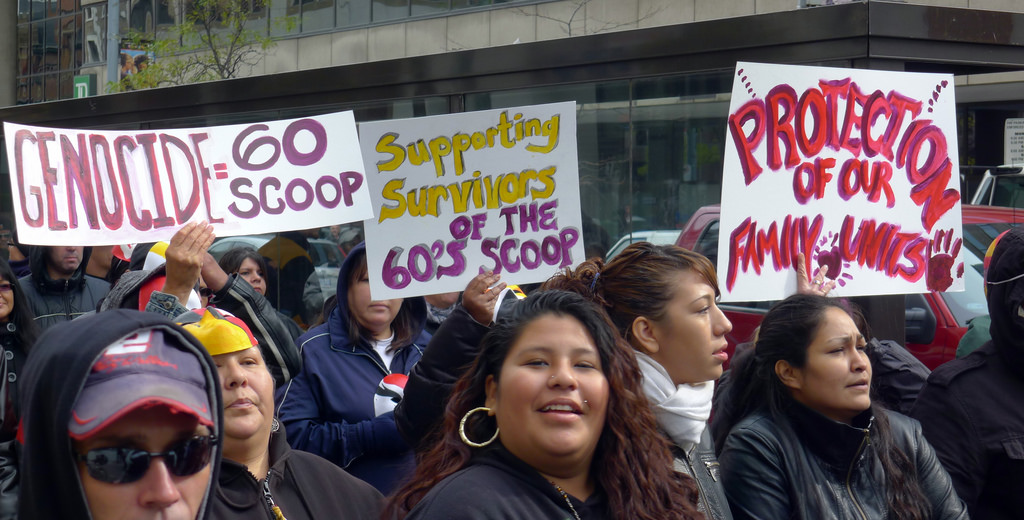
-
Article
Skip Beckwith
Skip Beckwith (born Charles Frederick Pearson), bassist, musical director, arranger, composer, producer, born 1 October 1939 in Sydney, NS; died 31 July 2019 in Lunenberg, NS). He notably worked as the musical director of internationally-renowned Canadian singer Anne Murray from 1969 to 1975.
"https://thecanadianencyclopedia.ca/images/tce_placeholder.jpg?v=e9dca980c9bdb3aa11e832e7ea94f5d9" // resources/views/front/categories/view.blade.php
https://thecanadianencyclopedia.ca/images/tce_placeholder.jpg?v=e9dca980c9bdb3aa11e832e7ea94f5d9