Share on Facebook
 Share on X
 Share by Email
 Share on Google Classroom
The Treaty of Versailles is the name given to the document stipulating the peace terms imposed on Germany by the Allied victors of the First World War. It was signed on 28 June 1919. According to the terms of the treaty, Germany was responsible for the war and had to pay heavy reparations, among other conditions. The Treaty of Versailles included plans for the League of Nations, of which Canada would be a member. Canada had separate representation at the conference where the treaty was negotiated, marking an important stage in the gradual movement toward Canadian independence from Great Britain.

Peace Terms
The peace terms of 28 June 1919 were drawn up at the Paris Peace Conference and signed near the French capital at Versailles. Under the terms of the treaty, Germany accepted responsibility for the war. It also had to pay heavy financial reparations to the Allies. In addition, the German government was forced to surrender about 10 percent of its prewar territory in Europe and all its overseas colonies. The Rhineland was demilitarized as well. Moreover, the treaty limited the size of the German army and navy. It also prohibited German manufacture of submarines, tanks, airplanes and poison gas. The treaty contributed to German resentment in the period following the war.
The Treaty of Versailles also included plans for the formation of the League of Nations. Although American President Woodrow Wilson was a strong proponent of the League, the US Senate voted against joining it. Canada, however, was a founding member.
Canada Asserts Itself on the World Stage
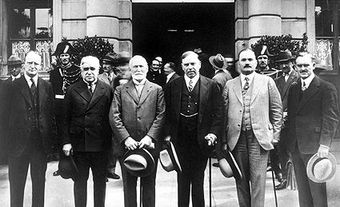
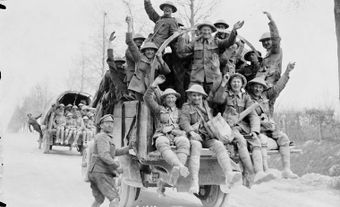
Canada had little impact on the final shape of the treaty, but Prime Minister Sir Robert Borden led a successful and historic fight for separate Dominion representation at the peace conference, and separate signatures on the treaty. He believed passionately that Canada, with 60,000 war dead, had paid the price of such recognition. This increased Canada's prestige and the opportunities for making its views known.
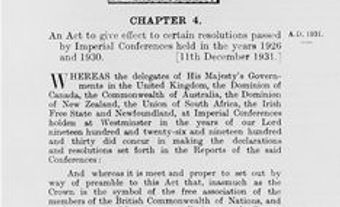
However, when it came to signing the treaty, the British prime minister did so for the entire empire, the Dominions included (Canada, Australia, New Zealand and South Africa). This reduced the importance of their hard-won individual signatures — which appeared on the document, but in indented version: the names of their countries appearing under that of the British Empire.
Canada's involvement reflected the ambiguity of its position in the world. Canada remained subordinate to Britain, in fact and in the perception of other nations, but its emerging international personality had been recognized.
The treaty also made provision for a League of Nations, where Canada would have its own membership, providing another vehicle for the advancement of the country’s national status.