Share on Facebook
 Share on X
 Share by Email
 Share on Google Classroom
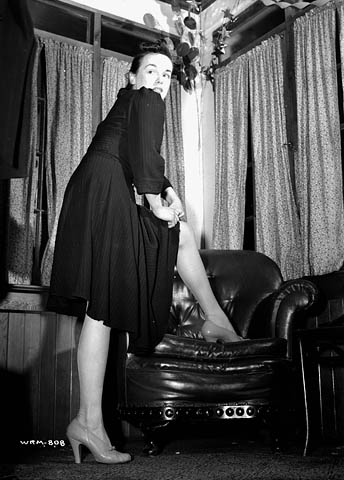
Nylon was patented in 1938 and became commercially available in 1939. The fabric quickly became popular among consumers, particularly women, replacing silk as the fabric of choice for stockings. During the Second World War, the fabric was in high demand for military products such as parachutes, tents and shoelaces. This led to strict control of nylon by Canada’s Wartime Industries Control Board. Women either did without nylon stockings, painting their legs instead, or purchased them on the black market. After the war, demand for nylon stockings skyrocketed.
Nylon Development and Production
Nylon was patented after 11 years of development by American-headquartered chemical company DuPont. DuPont was awarded a patent in 1938, and nylon made its debut for commercial purposes at the New York World’s Fair of 1939 to 1940. Newspapers reported on the exciting new fabric and positioned Canada as being well suited for nylon production as a country rich in the necessary raw materials, namely “coal, water and air.” Import records from 1939 show a marked increase in the demand for “artificial silk” products (likely rayon and nylon) and, in 1942, Canada began nylon yarn production.
The most popular consumer application for nylon fabric was as a replacement for silk in women’s hosiery. Compared to silk, nylon was durable and resistant to pests, mould and mildew and represented exciting new advancements in synthetic fibre technology.
International Relations and Silk Boycotts
The demand for nylon was also related to international events. Until 1941, Canada maintained mutually beneficial trade with Japan—a major silk producer—despite that country’s aggressive expansion in the Asian theatre. In particular, Canada continued to supply Japan with metals suitable for use in weapons construction, which sparked controversy among Canadians.
Organizations such as the League of Nations Society in Canada and the Canadian League for Peace and Democracy called for national boycotts of Japanese goods. Grassroots boycotts in Vancouver also gained attention, as some became vehicles for demonstrations against Japanese Canadians. Some women in Canada and the United States boycotted silk stockings, preferring alternative fabrics that were domestically manufactured.
The impact of Canadian grassroots boycotts is unclear. Trade between Canada and Japan grew between the 1935–36 and 1937–38 fiscal years but declined in 1938–39. According to records from the Department of Trade and Commerce, silk imports to Canada had declined in value by 1939, whereas artificial silk thread imports grew significantly, particularly from the United States. After Japan’s attack on Pearl Harbor in 1941, Prime Minister William Lyon Mackenzie King enacted trade embargoes on the country, further affecting the supply of silk.
Military Applications for Nylon
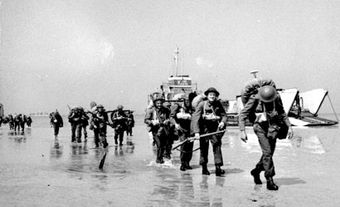
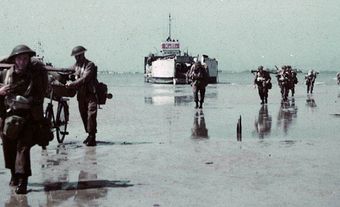
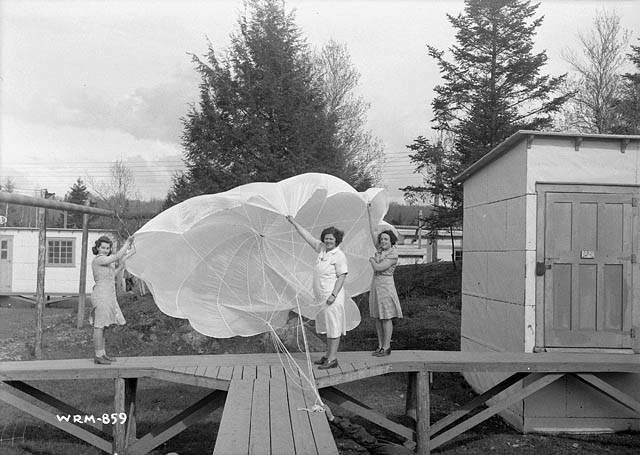
Nylon hosiery became commercially scarce in 1942. Due to nylon’s strength, elasticity, light weight and resistance to pests, mould and mildew, it quickly became critical to the Allied war effort. After the U.S. declared war on Japan in 1941, silk was difficult to access. Mass amounts of nylon were, therefore, required to construct parachutes, tarps, tents, netting, rope and shoelaces for troops abroad. In 1940, approximately 90 per cent of DuPont’s nylon was manufactured for hosiery; by 1942, nearly all nylon was redirected to the war effort.
Women’s Hosiery and the Wartime Industries Control Board
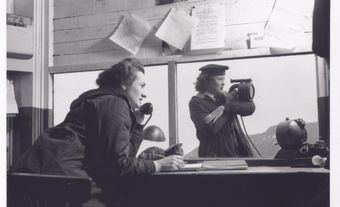
Unlike the United Kingdom and some Commonwealth nations, Canadians did not ration clothing and fabric with coupons from ration books. Instead, the manufacturing and distribution of nylon was strictly regulated by Canada’s Wartime Industries Control Board. At times, the board would restrict or remove certain products altogether from consumer markets to redirect raw materials to the war effort.
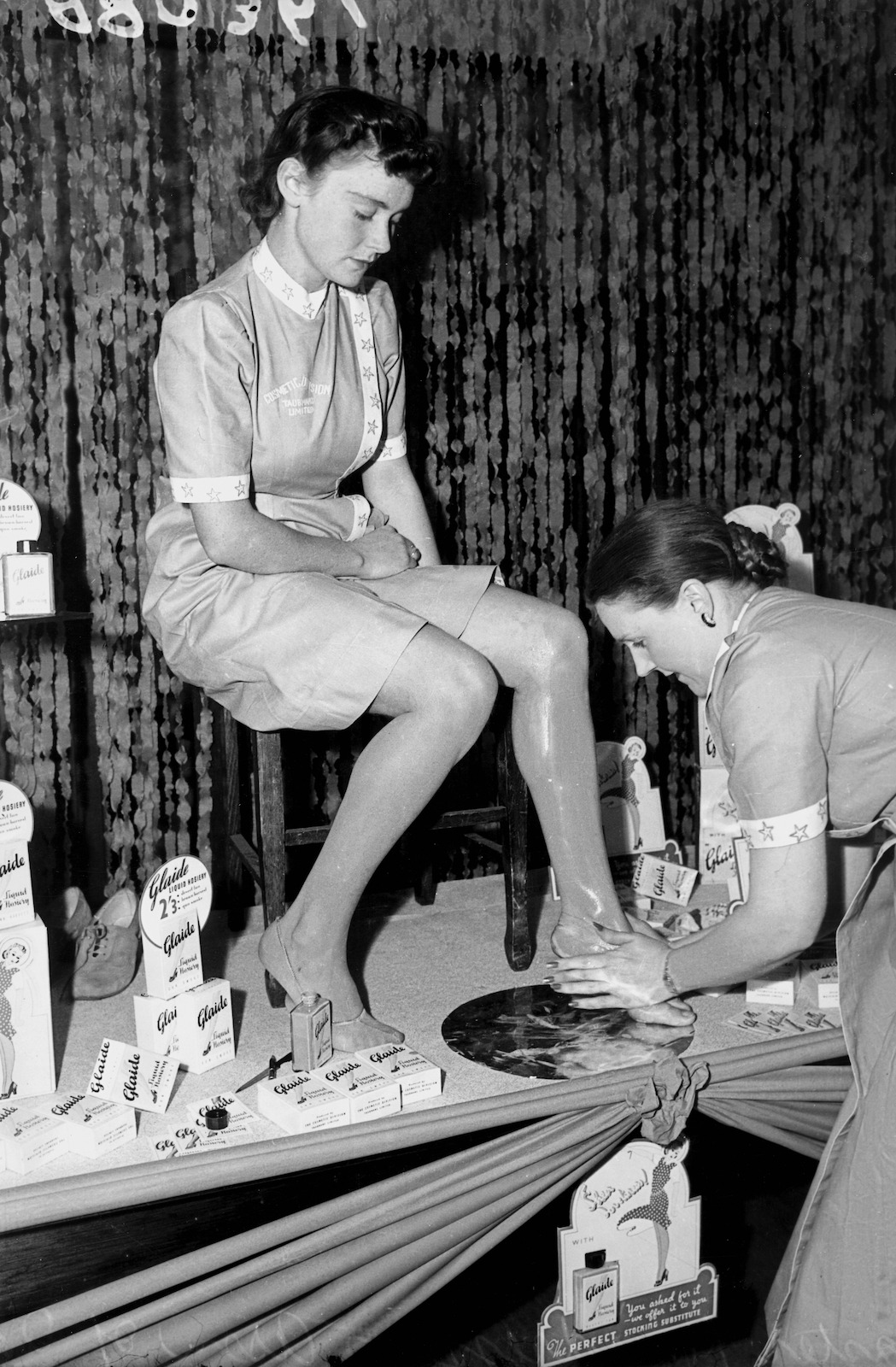
As a result, nylon hosiery was hard to find in legitimate shops and, although price ceilings were implemented by the government, prices were impacted by scarcity and inflation. Canadian women found creative ways to do without stockings, applying liquid hosiery—a tan-coloured body paint—and using eyebrow pencils to draw on “seams.” This could be done at home or at department stores, which provided application services. Improvised versions of this used gravy browning, tea or iodine to colour the legs, and seams could be drawn on by hand or with a guiding tool.
Black-Market Stockings
For some women, black markets were the answer to sourcing hard-to-find hosiery. The black market was especially active in Western Canada, particularly Alberta, where many felt that the Wartime Prices and Trade Board was unfairly regulating prices. Black markets were unregulated and unaffected by government price ceilings, so hosiery there was sold at excessively high prices, proving to be extremely profitable for sellers.
Nylon Riots
After the war, nylon stockings became available commercially once again. They were very popular, with nylon riots famously erupting in several locations across the United States. Canadian shopkeepers prepared for similar unrest. One shopkeeper in Vancouver even put up barricades in anticipation of unruly crowds. However, while Canadian women came out in enthusiastic droves to buy nylons, their crowd behaviour was less explosive, with no recorded injuries or violent incidents.
Nylon hosiery production increased, and nylon became the preferred fabric choice for hosiery by many Canadian and American women, replacing silk permanently. While nylon stockings remained fashionable long after the war, they were eventually replaced by pantyhose in the 1960s due to ease of wear.