
Browse "Things"
-
Article
Tiktaalik
Tiktaalik is a genus of lobe-finned (sarcopterygian) fish from the Devonian Period found on Ellesmere Island, Nunavut, in Canada’s Arctic Archipelago. A single species is known of Tiktaalik, T. roseae, which lived approximately 385 million years ago. The species was named in 2006 in two articles that described several articulated specimens. These articles set off a storm in the popular press. Titkaalik represents a clear and important evolutionary step in the journey of animals onto land. Click here for definitions of key terms used in this article.
"https://d3d0lqu00lnqvz.cloudfront.net/tiktaalik/Tiktaalik-Model.jpg" // resources/views/front/categories/view.blade.php
https://d3d0lqu00lnqvz.cloudfront.net/tiktaalik/Tiktaalik-Model.jpg
-
Memory Project Archive
Tilmon Arsenault (Primary Source)
Tilmon Arsenault served during the Second World War. Please be advised that Memory Project primary sources may deal with personal testimony that reflect the speaker’s recollections and interpretations of events. Individual testimony does not necessarily reflect the views of the Memory Project and Historica Canada.
"https://d3d0lqu00lnqvz.cloudfront.net/TilmonArsenault/Arsenault_T_5b (1 sur 1).jpg" // resources/views/front/categories/view.blade.php
https://d3d0lqu00lnqvz.cloudfront.net/TilmonArsenault/Arsenault_T_5b (1 sur 1).jpg.jpg)
-
Article
Tim Hortons
Tim Hortons is a Canadian restaurant chain known for its coffee, doughnuts and connection to Canada’s national identity. Its namesake, Toronto Maple Leafs defenceman Tim Horton (1930–74), founded the business with Montreal businessman Jim Charade. The first Tim Hortons doughnut franchise opened in Hamilton, Ontario, in May 1964. Since then, Tim Hortons has become Canada’s largest restaurant chain. As of September 2023, it operates 3,874 stores across the country and 1,827 stores internationally. In 1995, American fast-food chain Wendy’s bought Tim Hortons in a partnership that lasted until 2006. In 2014, the chain was again purchased by a foreign company, this time by Brazilian firm 3G Capital, known for its ownership of Burger King. Despite foreign ownership, Tim Hortons remains a Canadian cultural phenomenon.
"https://d3d0lqu00lnqvz.cloudfront.net/media/media/60daff5b-d059-488d-8b82-bddb82e54a10.jpg" // resources/views/front/categories/view.blade.php
https://d3d0lqu00lnqvz.cloudfront.net/media/media/60daff5b-d059-488d-8b82-bddb82e54a10.jpg
-
Macleans
Tim Hortons Investors Awaiting U.S. Market
To its most devoted fans, grabbing a Tim Hortons double-double on the way to work is almost a religious experience. The Church of Tim's, as it's only-somewhat-jokingly called, has such a firm grip on the Canadian psyche even the clergy are prone to bouts of envy.This article was originally published in Maclean's Magazine on March 24, 2008
"https://thecanadianencyclopedia.ca/images/tce_placeholder.jpg?v=e9dca980c9bdb3aa11e832e7ea94f5d9" // resources/views/front/categories/view.blade.php
https://thecanadianencyclopedia.ca/images/tce_placeholder.jpg?v=e9dca980c9bdb3aa11e832e7ea94f5d9
-
Article
Timber Axe
Two basic types of axe were used in the early 19th-century eastern forest industry. The more common poll axe had a single, fan-shaped cutting edge, a narrow head weighing 1.5-2.5 kg, and a hickory or maple handle. It was used for felling, scoring and lopping branches off fallen trees.
"https://d3d0lqu00lnqvz.cloudfront.net/media/media/cec78fec-e5dd-4380-bdb0-41072ce95e26.jpg" // resources/views/front/categories/view.blade.php
https://d3d0lqu00lnqvz.cloudfront.net/media/media/cec78fec-e5dd-4380-bdb0-41072ce95e26.jpg
-
Article
Timber Duties
Timber Duties First imposed in the 18th century to provide revenue, Britain's tariffs on imported wood were an integral component of the 19th-century British North American TIMBER TRADE.
"https://thecanadianencyclopedia.ca/images/tce_placeholder.jpg?v=e9dca980c9bdb3aa11e832e7ea94f5d9" // resources/views/front/categories/view.blade.php
https://thecanadianencyclopedia.ca/images/tce_placeholder.jpg?v=e9dca980c9bdb3aa11e832e7ea94f5d9
-
Article
Timber Slide
A timber slide is a water-filled chute or runway built to carry “cribs” of timber around rapids and waterfalls. (See also Raft). Similar devices for individual pieces of wood were called “flumes.” Timber slides contributed to the growth of the timber industry in the 19th century (see Timber Trade Industry).
"https://d3d0lqu00lnqvz.cloudfront.net/timbertrade/timberslidedukeandduchess.jpg" // resources/views/front/categories/view.blade.php
https://d3d0lqu00lnqvz.cloudfront.net/timbertrade/timberslidedukeandduchess.jpg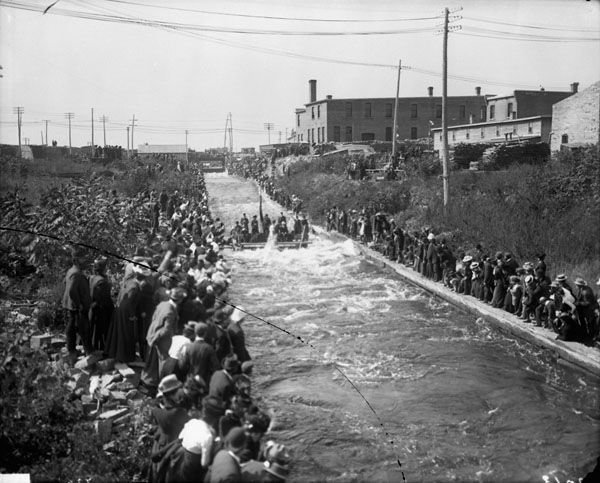
-
Article
Timber Trade History
Wood was the staple of Canadian trade for much of the 19th century. Fueled by European demand, the timber trade brought investment and immigration to eastern Canada, fostered economic development, and transformed the regional environment far more radically than the earlier exploitation of fish and fur (see Fisheries; Fur Industry). It encouraged exploration, the building of towns and villages, and the opening of roads. While a great resource for Canada, timber also contributed at times to economic instability. Over the course of the industry’s history, weather conditions, commercial uncertainties and imperfect market intelligence produced wide fluctuations in the demand for—and the price of—wood.
"https://d3d0lqu00lnqvz.cloudfront.net/timbertradehistory/lumbercamp.jpg" // resources/views/front/categories/view.blade.php
https://d3d0lqu00lnqvz.cloudfront.net/timbertradehistory/lumbercamp.jpg
-
Article
Time
Precise timekeeping helped establish and develop Canada. For the past 2 centuries, Canadian exploration, mapping, navigation and transportation have exploited state-of-the-art precise time systems.
"https://thecanadianencyclopedia.ca/images/tce_placeholder.jpg?v=e9dca980c9bdb3aa11e832e7ea94f5d9" // resources/views/front/categories/view.blade.php
https://thecanadianencyclopedia.ca/images/tce_placeholder.jpg?v=e9dca980c9bdb3aa11e832e7ea94f5d9
-
Article
Time Dissemination
Accurate TIME is disseminated or distributed by telecommunication systems to end users across Canada. Time and frequency references, traceable within stated limits to recognized standards, are available in Canada by ground and satellite based radio, television and telephone.
"https://thecanadianencyclopedia.ca/images/tce_placeholder.jpg?v=e9dca980c9bdb3aa11e832e7ea94f5d9" // resources/views/front/categories/view.blade.php
https://thecanadianencyclopedia.ca/images/tce_placeholder.jpg?v=e9dca980c9bdb3aa11e832e7ea94f5d9
-
Article
Time Zones in Canada
There are six time zones in Canada covering four and a half hours. From west to east, these time zones are: Pacific, Mountain, Central, Eastern, Atlantic and Newfoundland. From the first Sunday in November to the second Sunday in March, these zones are referred to as standard time zones and may be abbreviated as PST, MST, CST, etc. From the second Sunday in March to the first Sunday in November, most of Canada follows daylight saving time. During this summer period, the time zones may be abbreviated as PDT, MDT, CDT, etc. The boundaries of the standard time zones are not necessarily the same as those of the corresponding daylight saving time zones. Boundaries shift because some municipalities choose not to participate in daylight saving time or to remain in it year-round. Saskatchewan follows CST year-round, and, as of 2020, Yukon follows PDT, also known as Yukon Standard Time, year-round. As of summer 2026, British Columbia will also remain in PDT year-round, now simply called Pacific time.
"https://d3d0lqu00lnqvz.cloudfront.net/media/new_article_images/TimeZones/NewTimeZonesEN.jpg" // resources/views/front/categories/view.blade.php
https://d3d0lqu00lnqvz.cloudfront.net/media/new_article_images/TimeZones/NewTimeZonesEN.jpg
-
Article
Tip O’Neill Award
The James “Tip” O’Neill Award is presented annually to the Canadian baseball player of the year. The winner is chosen by a committee that is organized by the Canadian Baseball Hall of Fame and Museum. The committee reviews that year’s statistics for all Canadian players and announces the winner in early December. The award is named in honour of James “Tip” O’Neill, a Major League Baseball (MLB) star from the 19th century who is often considered Canada’s Babe Ruth. Larry Walker, who first won the award as a 20-year-old in Double-A, received the award nine times — more than any other player. Joey Votto won it seven times. Justin Morneau and Jason Bay won it three times. Eric Gagné and Josh Naylor received it twice. Daniel Brabant is the only amateur player to win the award.
"https://d3d0lqu00lnqvz.cloudfront.net/James_Edward__Tip__O-Neill-_Left_Field-_St._Louis_Browns-_from_the_Old_Judge_series_N172_for_Old_Judge_Cigarettes_MET_DP846088.jpg" // resources/views/front/categories/view.blade.php
https://d3d0lqu00lnqvz.cloudfront.net/James_Edward__Tip__O-Neill-_Left_Field-_St._Louis_Browns-_from_the_Old_Judge_series_N172_for_Old_Judge_Cigarettes_MET_DP846088.jpg
-
Article
Tipi
Tipis are cone-shaped dwellings that many Plains Indigenous peoples used to live in until the mid-1800s. Today, tipis retain cultural significance and are sometimes constructed for special functions. (See also Architectural History of Indigenous Peoples in Canada.)
"https://d3d0lqu00lnqvz.cloudfront.net/media/media/f27bf121-03aa-46b5-bbf3-fb07424e8037.jpg" // resources/views/front/categories/view.blade.php
https://d3d0lqu00lnqvz.cloudfront.net/media/media/f27bf121-03aa-46b5-bbf3-fb07424e8037.jpg
-
Article
Titanic
The Royal Mail Ship (RMS) Titanic was a British luxury passenger liner that sank on its maiden transatlantic voyage. At approximately 11:40 p.m. on 14 April, 1912, about 740 km south of Newfoundland, Titanic’s starboard (right) side scraped along an iceberg. The collision ruptured several watertight compartments. Water poured in, but the first lifeboat was not launched until an hour later. Approximately two-thirds of the liner’s passengers and crew died. Titanic’s sinking was one of the worst marine disasters in history and remains firmly embedded in popular culture today.
"https://d3d0lqu00lnqvz.cloudfront.net/media/media/69692e90-db50-4679-992f-989cebf24a69.jpg" // resources/views/front/categories/view.blade.php
https://d3d0lqu00lnqvz.cloudfront.net/media/media/69692e90-db50-4679-992f-989cebf24a69.jpg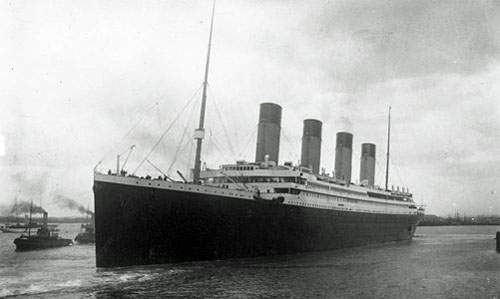
-
Macleans
Titanic Tourism Boom
For good or ill, the City of Halifax seems inextricably linked to the tragic April 14, 1912, sinking of the RMS Titanic, which saw 1,522 souls succumb to icy Atlantic waters.This article was originally published in Maclean's Magazine on June 1, 1998
"https://thecanadianencyclopedia.ca/images/tce_placeholder.jpg?v=e9dca980c9bdb3aa11e832e7ea94f5d9" // resources/views/front/categories/view.blade.php
https://thecanadianencyclopedia.ca/images/tce_placeholder.jpg?v=e9dca980c9bdb3aa11e832e7ea94f5d9