
Browse "Things"
-
Macleans
Swissair 111 Aftermath
This article was originally published in Maclean’s magazine on September 21, 1998. Partner content is not updated. Dear Sir: This little stuffed toy whose label identified it as a Lion King was retrieved Friday, Sept. 4. It was carefully washed with the hope that it may provide some family member with solace as a tangible connection with the child to whom it belonged.
"https://thecanadianencyclopedia.ca/images/tce_placeholder.jpg?v=e9dca980c9bdb3aa11e832e7ea94f5d9" // resources/views/front/categories/view.blade.php
https://thecanadianencyclopedia.ca/images/tce_placeholder.jpg?v=e9dca980c9bdb3aa11e832e7ea94f5d9
-
Macleans
Swissair 111 Tragedy
This article was originally published in Maclean’s magazine on September 14, 1998. Partner content is not updated. The 60 residents of Peggy's Cove, N.S., have few lessons to learn when it comes to either nature's beauty - or its sometimes terrible power.
"https://thecanadianencyclopedia.ca/images/tce_placeholder.jpg?v=e9dca980c9bdb3aa11e832e7ea94f5d9" // resources/views/front/categories/view.blade.php
https://thecanadianencyclopedia.ca/images/tce_placeholder.jpg?v=e9dca980c9bdb3aa11e832e7ea94f5d9
-
Article
Swissair Flight 111
Swissair Flight 111 crashed in the sea off Peggy’s Cove, NS on 2 September 1998, while on a scheduled flight from New York to Geneva, Switzerland. All 229 passengers and crew were killed. It was the second-deadliest air accident to occur in Canada. An investigation by Canada’s Transportation Safety Board determined that a fire, sparked by arcing in the MD-11 aircraft’s electrical system, resulted in a catastrophic failure of the plane’s main operating systems.
"https://d3d0lqu00lnqvz.cloudfront.net/media/media/8122a415-1cbe-4b48-bc05-965d8805ee42.jpg" // resources/views/front/categories/view.blade.php
https://d3d0lqu00lnqvz.cloudfront.net/media/media/8122a415-1cbe-4b48-bc05-965d8805ee42.jpg
-
Article
Sydney Steel Corporation
The government, faced with a socially unacceptable shutdown, formed a CROWN CORPORATION to keep the industry alive. The plant consists of 2 small blast furnaces and several basic open-hearth furnaces, with an annual raw-steel capacity of about 910 000 tonnes.
"https://d3d0lqu00lnqvz.cloudfront.net/media/media/de26e0a9-50cb-48be-bf77-273aa9c599f6.jpg" // resources/views/front/categories/view.blade.php
https://d3d0lqu00lnqvz.cloudfront.net/media/media/de26e0a9-50cb-48be-bf77-273aa9c599f6.jpg
-
Article
Sylliboy Case
Mi’kmaq Grand Chief Gabriel Sylliboy is believed to be the first to use the 1752 Peace and Friendship Treaty to fight for Canada’s recognition of treaty rights. In his court case, R. v. Sylliboy (1928), he argued that the 1752 treaty protected his rights to hunt and fish, but he lost the case and was subsequently convicted. In 1985, when the Supreme Court of Canada ruled in R. v. Simon — another case concerning Mi’kmaq hunting rights — it found that the 1752 treaty did in fact give Mi’kmaq people the right to hunt on traditional territories. This judgment vindicated both Sylliboy and James Simon of the 1985 case. In 2017, almost 90 years after his conviction, Sylliboy received a posthumous pardon and apology from the Government of Nova Scotia.
"https://d3d0lqu00lnqvz.cloudfront.net/media/media/47dd689f-e49f-4d3f-830c-ad60dbca0a48.jpg" // resources/views/front/categories/view.blade.php
https://d3d0lqu00lnqvz.cloudfront.net/media/media/47dd689f-e49f-4d3f-830c-ad60dbca0a48.jpg
-
Collection
Symbols and Emblems of Canada
Canadian emblems include the national coat of arms and flag, as well as other national symbols such as the beaver and the maple leaf. Each Canadian province and territory has been granted or has adopted emblems that represent its sovereignty and identity. These emblems are coats of arms, flags, flowers, trees, mammals, birds, fish, minerals and tartans, amongst others. Through symbolism, they express the features of a province or territory, and its inhabitants: history, geography,...
"https://d3d0lqu00lnqvz.cloudfront.net/symbolsandemblems/The_Canadian_flag_flying_alongside_the_flags_of_all_provinces_and_territories.jpg" // resources/views/front/categories/view.blade.php
https://d3d0lqu00lnqvz.cloudfront.net/symbolsandemblems/The_Canadian_flag_flying_alongside_the_flags_of_all_provinces_and_territories.jpg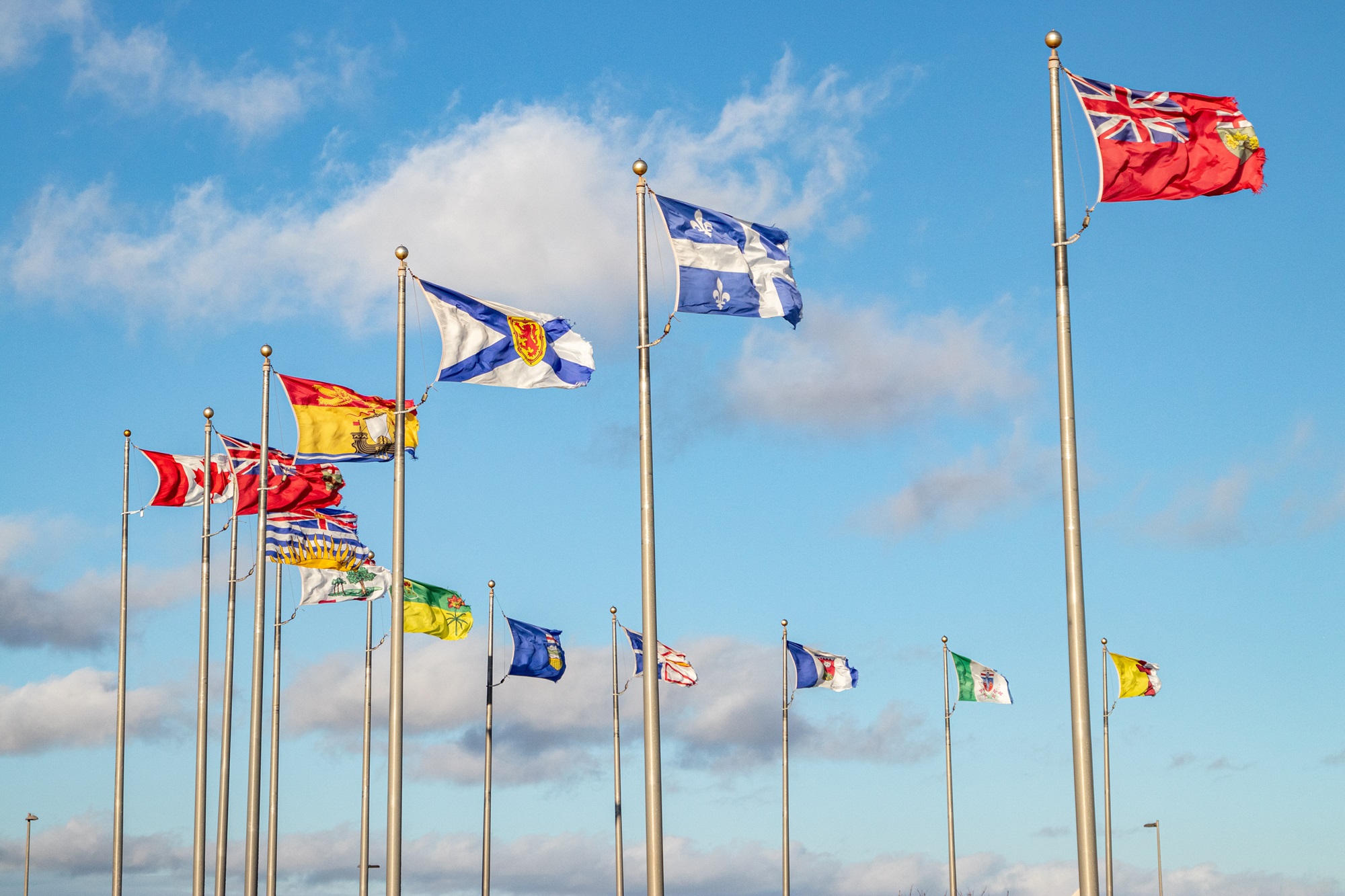
-
Article
Symbols of Authority
One of the earliest signs of authority (the right to enforce obedience) was probably a wooden club, in which symbolism grew directly out of practical application: the humble club became both an instrument by which power was exercised and (consequently) a symbol of authority.
"https://thecanadianencyclopedia.ca/images/tce_placeholder.jpg?v=e9dca980c9bdb3aa11e832e7ea94f5d9" // resources/views/front/categories/view.blade.php
https://thecanadianencyclopedia.ca/images/tce_placeholder.jpg?v=e9dca980c9bdb3aa11e832e7ea94f5d9
-
Article
Synagogues
According to Jewish law, a synagogue is defined as any place where 10 men can gather for worship and study. Tradition holds that the synagogue was established to provide an alternative for those who were unable to travel to the temple in Jerusalem.
"https://d3d0lqu00lnqvz.cloudfront.net/media/media/3cdd3a26-f43a-47c9-a723-6bb582abdab7.jpg" // resources/views/front/categories/view.blade.php
https://d3d0lqu00lnqvz.cloudfront.net/media/media/3cdd3a26-f43a-47c9-a723-6bb582abdab7.jpg
-
Article
Synchrotron
A synchrotron is a source of brilliant light that acts like a giant microscope to allow matter to be seen at the atomic level. Synchrotron light is millions of times brighter than sunlight and millions of times more intense than conventional X-rays.
"https://thecanadianencyclopedia.ca/images/tce_placeholder.jpg?v=e9dca980c9bdb3aa11e832e7ea94f5d9" // resources/views/front/categories/view.blade.php
https://thecanadianencyclopedia.ca/images/tce_placeholder.jpg?v=e9dca980c9bdb3aa11e832e7ea94f5d9
-
Article
Trade Unionism and Globalization
The major transformations that have occurred in trade between countries have caused major changes in the way that the various social actors organize to express their views and defend their interests.
"https://thecanadianencyclopedia.ca/images/tce_placeholder.jpg?v=e9dca980c9bdb3aa11e832e7ea94f5d9" // resources/views/front/categories/view.blade.php
https://thecanadianencyclopedia.ca/images/tce_placeholder.jpg?v=e9dca980c9bdb3aa11e832e7ea94f5d9
-
Article
Eaton's
Founded in 1869, the T. Eaton Company Ltd., commonly known as Eaton’s, was an iconic Canadian department store with a retail presence in every province, at its height. From its beginnings as a retail store in Toronto to its eventual bankruptcy and absorption into its long-time rival, Sears Canada, Eaton’s significantly shaped Canadian shopping. The Eaton’s name and legacy persist today, from Toronto’s Eaton Centre to the red bricks incorporated into the facade of Winnipeg’s Canada Life Centre (formerly the MTS Centre), a reminder of the former Eaton’s store that stood on the site for so long.
"https://d3d0lqu00lnqvz.cloudfront.net/media/media/50f4533a-b542-45bb-9cf8-b28c23601702.jpg" // resources/views/front/categories/view.blade.php
https://d3d0lqu00lnqvz.cloudfront.net/media/media/50f4533a-b542-45bb-9cf8-b28c23601702.jpg
-
Article
Taber Child
In 1961, fragments of a human infant skull from were recovered from the banks of the Oldman River near Taber, Alberta.
"https://thecanadianencyclopedia.ca/images/tce_placeholder.jpg?v=e9dca980c9bdb3aa11e832e7ea94f5d9" // resources/views/front/categories/view.blade.php
https://thecanadianencyclopedia.ca/images/tce_placeholder.jpg?v=e9dca980c9bdb3aa11e832e7ea94f5d9
-
Macleans
Taber Shootings
The Canadian Encyclopedia is home to over 2,300 articles originally published in Maclean's magazine between 1994 and 2014, including this one. Readers should note that these are works of journalism — not encyclopedic entries — and therefore their tone and style differs from articles found elsewhere on our website. Similarly, we’ve archived them as they were first published, meaning that unlike encyclopedic entries, these articles aren’t updated to reflect current events. Our hope is that they might provide insight into the issues and events that mattered to Canadians during a 20-year period. The full Maclean’s archive is available here. This article in particular was published on 10 May, 1999.
"https://thecanadianencyclopedia.ca/images/tce_placeholder.jpg?v=e9dca980c9bdb3aa11e832e7ea94f5d9" // resources/views/front/categories/view.blade.php
https://thecanadianencyclopedia.ca/images/tce_placeholder.jpg?v=e9dca980c9bdb3aa11e832e7ea94f5d9
-
Article
Table Hockey
Table hockey (also called rod hockey, board hockey, bubble hockey and stick hockey) is a tabletop toy that emulates the game of ice hockey. It is intended for two players, though it can accommodate more. Originally designed as a game for the children of its inventor, Donald H. Munro, table hockey has grown to become internationally popular. Though invented in Canada, it has become particularly popular in Sweden. There is also competitive league play with an international governing body, as well as professional table hockey tournaments with cash prizes.
"https://d3d0lqu00lnqvz.cloudfront.net/1024px-2_WTHL.jpg" // resources/views/front/categories/view.blade.php
https://d3d0lqu00lnqvz.cloudfront.net/1024px-2_WTHL.jpg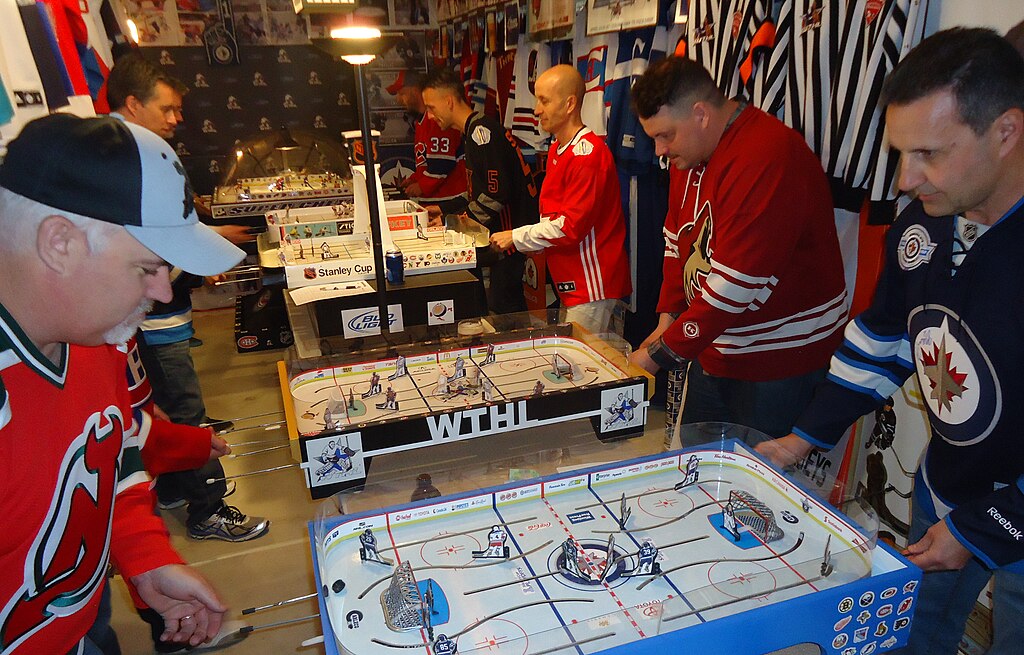
-
Article
Table Tennis
Table tennis is played by 2 (singles) or 4 (doubles) players, normally indoors. Opponents face each other and hit the ball with a racquet, alternately, over a 6-inch (15.25 cm) net stretched midway across a 9 x 5 ft (274 cm x 152.5 cm) table.
"https://thecanadianencyclopedia.ca/images/tce_placeholder.jpg?v=e9dca980c9bdb3aa11e832e7ea94f5d9" // resources/views/front/categories/view.blade.php
https://thecanadianencyclopedia.ca/images/tce_placeholder.jpg?v=e9dca980c9bdb3aa11e832e7ea94f5d9