
Browse "Things"
-
Collection
Royal Canadian Air Force
On 1 April 2024, the Royal Canadian Air Force (RCAF) will mark its 100th anniversary. Canada didn't have its own air force during the First World War, although more than 20,000 Canadians served in a British Empire flying service. After the war, Canada established an Air Board to develop aviation policy, leading to a Canadian Air Force or “flying militia” that used wartime flyers and surplus British aircraft. On 1 April 1924, the air service...
"https://d3d0lqu00lnqvz.cloudfront.net/media/media/6a823326-afa8-474e-a4e7-8b72b9a5dd53.jpg" // resources/views/front/categories/view.blade.php
https://d3d0lqu00lnqvz.cloudfront.net/media/media/6a823326-afa8-474e-a4e7-8b72b9a5dd53.jpg
-
Article
Royal Canadian Institute
The Royal Canadian Institute is now the oldest surviving scientific society in Canada. It was founded in 1849 by a small group of civil engineers, architects and surveyors led by Sir Sandford FLEMING.
"https://thecanadianencyclopedia.ca/images/tce_placeholder.jpg?v=e9dca980c9bdb3aa11e832e7ea94f5d9" // resources/views/front/categories/view.blade.php
https://thecanadianencyclopedia.ca/images/tce_placeholder.jpg?v=e9dca980c9bdb3aa11e832e7ea94f5d9
-
Article
Royal Canadian Legion
The Royal Canadian Legion is a non-profit, national organization that serves Canadian war veterans and their families and lobbies government on their behalf. It is best known for selling poppies every fall and organizing Remembrance Day ceremonies across the country. In recent decades, the Legion has struggled with declining membership, due in large part to the loss of Second World War and Korean War veterans. In July 2026, Canada Post released a stamp marking the organization’s 100th anniversary.
"https://d3d0lqu00lnqvz.cloudfront.net/media/media/c8863b07-985b-49e7-aa96-3ee336735d4d.jpg" // resources/views/front/categories/view.blade.php
https://d3d0lqu00lnqvz.cloudfront.net/media/media/c8863b07-985b-49e7-aa96-3ee336735d4d.jpg
-
Article
Royal Canadian Mint
The Royal Canadian Mint is a Crown corporation since 1 April 1969. From 1858 to 1907 Canadian coins were struck at the Royal Mint in London and the Heaton Mint of Birmingham, both in England. On 2 January 1908, the Ottawa Branch of Britain's Royal Mint officially opened.
"https://d3d0lqu00lnqvz.cloudfront.net/media/media/bc71e340-f5ed-4737-ab93-f5c01058e39c.jpg" // resources/views/front/categories/view.blade.php
https://d3d0lqu00lnqvz.cloudfront.net/media/media/bc71e340-f5ed-4737-ab93-f5c01058e39c.jpg
-
Article
Royal Canadian Mounted Police (RCMP)
The Royal Canadian Mounted Police (RCMP) is Canada’s national police force – providing an array of services from municipal policing to national security intelligence gathering. The "Mounties" have a long and proud history dating back to Confederation and the opening of the Canadian West. Despite a series of scandals in recent decades, the RCMP remains one of Canada's most iconic national institutions.
"https://d3d0lqu00lnqvz.cloudfront.net/media/media/a48dc193-a25c-41ad-ae4c-c8b4fc18563e.jpg" // resources/views/front/categories/view.blade.php
https://d3d0lqu00lnqvz.cloudfront.net/media/media/a48dc193-a25c-41ad-ae4c-c8b4fc18563e.jpg
-
Article
Royal Canadian Naval Air Branch
The Royal Canadian Naval Air Branch was established in 1945 and disbanded upon unification of the Canadian Armed Forces in 1968. During that period, the Royal Canadian Navy (RCN) operated a succession of three aircraft carriers: HMC Ships Warrior, Magnificent and Bonaventure. The ability to exercise air power at sea was fundamental to the RCN’s core role of anti-submarine warfare (ASW) against the Cold War Soviet submarine fleet. As the nature of that threat evolved, the RCN Air Branch underwent a nearly continuous process of adaptation to incorporate new equipment and tactics, with increasingly higher performance aircraft and supporting equipment.
"https://d3d0lqu00lnqvz.cloudfront.net/RCNAirBranch/Bonaventure_-_Banshees.jpg" // resources/views/front/categories/view.blade.php
https://d3d0lqu00lnqvz.cloudfront.net/RCNAirBranch/Bonaventure_-_Banshees.jpg
-
Article
Royal Canadian Naval Air Service (RCNAS)
The Royal Canadian Naval Air Service (RCNAS) was formed during the closing months of the First World War to help counter the German U-boat threat on Canada’s East Coast. It was disbanded after only three months of existence. A Canadian naval air service was not created again until after the Second World War.
"https://d3d0lqu00lnqvz.cloudfront.net/RCNAS/HS-2L-1876.jpg" // resources/views/front/categories/view.blade.php
https://d3d0lqu00lnqvz.cloudfront.net/RCNAS/HS-2L-1876.jpg
-
Article
Royal Canadian Navy
Canada's navy has defended Canadian interests in home waters and overseas since the early 20th century — despite often struggling for ships and resources under sometimes neglectful governments. The navy was a vital part of Canada's contribution to the Second World War, including the Battle of the Atlantic and the Allied invasions of Italy and Normandy. In the decades since, the navy has served consistently around the globe with the United Nations and NATO, while protecting sovereignty on Canada's three coasts.
"https://d3d0lqu00lnqvz.cloudfront.net/NavalServiceCanada1911Poster.jpg" // resources/views/front/categories/view.blade.php
https://d3d0lqu00lnqvz.cloudfront.net/NavalServiceCanada1911Poster.jpg
-
Article
Royal Canadian Regiment
The Royal Canadian Regiment (RCR) is one of three permanent, regular army infantry regiments of the Canadian Armed Forces. The regimental headquarters is in Petawawa, Ontario. Consisting of three battalions and a reserve battalion, the RCR has a proud history of military service dating back to 1863.
"https://d3d0lqu00lnqvz.cloudfront.net/RCR/RCR_Italy.jpg" // resources/views/front/categories/view.blade.php
https://d3d0lqu00lnqvz.cloudfront.net/RCR/RCR_Italy.jpg
-
Article
Royal Commission Inquiry into Civil Rights
The Royal Commission Inquiry into Civil Rights was an investigation into the status of civil rights in Ontario. It was commissioned by the Government of Ontario in 1964. It was completed in 1971. Chaired by judge James Chalmers McRuer, it was also known as the McRuer Commission of 1971. Its final report totalled 2,281 pages and included 976 suggested legal reforms. The inquiry was highly influential. It prioritized ideas of fairness, accessibility and equity within the justice system. It also led to reforms in other branches of government to protect those principles. It was an important precursor to the Charter of Rights and Freedoms.
"https://d3d0lqu00lnqvz.cloudfront.net/Photograph_of_James_C._McRuer_16953287526.jpg" // resources/views/front/categories/view.blade.php
https://d3d0lqu00lnqvz.cloudfront.net/Photograph_of_James_C._McRuer_16953287526.jpg
-
Article
Royal Commission of Inquiry on Constitutional Problems
The Royal Commission of Inquiry on Constitutional Problems (Tremblay Commission) was appointed by the Québec government under chairman Mr Justice Thomas Tremblay
"https://thecanadianencyclopedia.ca/images/tce_placeholder.jpg?v=e9dca980c9bdb3aa11e832e7ea94f5d9" // resources/views/front/categories/view.blade.php
https://thecanadianencyclopedia.ca/images/tce_placeholder.jpg?v=e9dca980c9bdb3aa11e832e7ea94f5d9
-
Article
Royal Commission of Inquiry on Education in the Province of Quebec (Parent Commission)
The Royal Commission of Inquiry on Education in the Province of Quebec (1961–64) had a major impact on the structure of the Quebec school system. It recommended the adoption of new pedagogical methods as well as the creation of new structures, namely the Ministry of Education, comprehensive schools, CEGEPs (Collèges d’enseignement général et professionnel; General and professional teaching colleges) and the Université du Québec network.
"https://d3d0lqu00lnqvz.cloudfront.net/media/new_article_images/CommissionParent/commission_parent_1961_50.gif" // resources/views/front/categories/view.blade.php
https://d3d0lqu00lnqvz.cloudfront.net/media/new_article_images/CommissionParent/commission_parent_1961_50.gif
-
Article
Royal Commission on Aboriginal Peoples
The Royal Commission on Aboriginal Peoples was a Royal Commission established in 1991. It was created in the wake of the Kanesatake Resistance (Oka Crisis). The commission’s report was the product of extensive research and community consultation. It was a broad survey of historical and contemporary relations between Indigenous (then called Aboriginal) and non-Indigenous peoples in Canada. The report made several recommendations. The majority of these recommendations were not fully implemented. However, it is significant for the scope and depth of research.
"https://d3d0lqu00lnqvz.cloudfront.net/RoyalComissionAboriginalPeoples/RCAP.jpg" // resources/views/front/categories/view.blade.php
https://d3d0lqu00lnqvz.cloudfront.net/RoyalComissionAboriginalPeoples/RCAP.jpg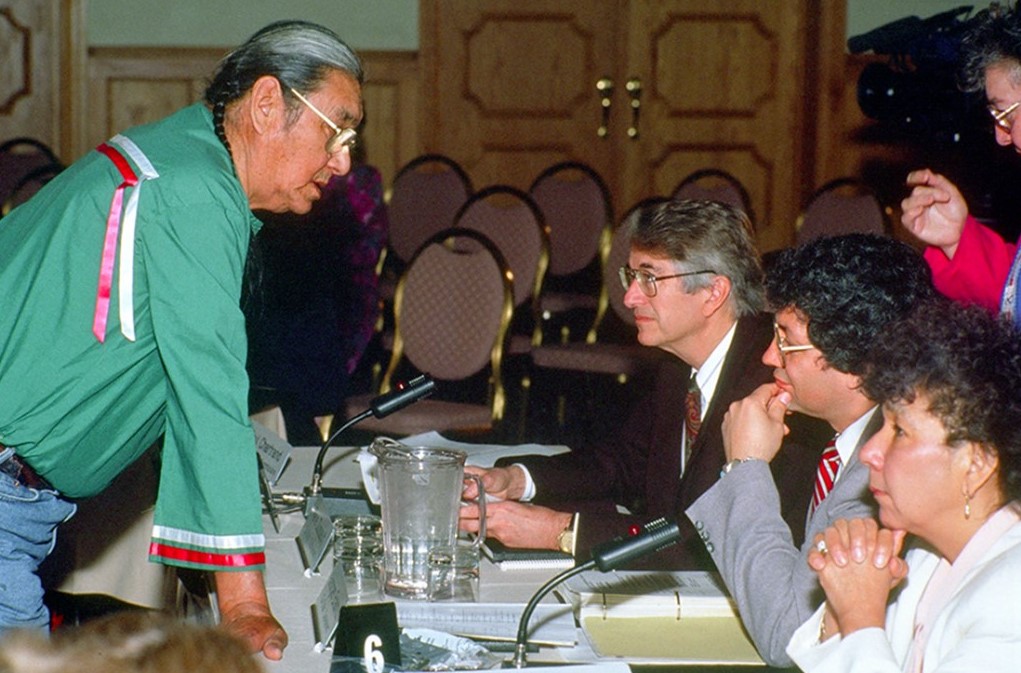
-
Article
Royal Commission on Banking and Finance
Banking and Finance, Royal Commission onBanking and Finance, Royal Commission on (Porter Commission), established 1961 (after the governor of the Bank of Canada, James COYNE, had publicly disagreed with the federal government's economic policies), to examine and to make recommendations for the improvement of "the structure and methods of operations of the Canadian financial system, including the banking and monetary system and the institutions and processes involved in the flow of funds through the capital...
"https://thecanadianencyclopedia.ca/images/tce_placeholder.jpg?v=e9dca980c9bdb3aa11e832e7ea94f5d9" // resources/views/front/categories/view.blade.php
https://thecanadianencyclopedia.ca/images/tce_placeholder.jpg?v=e9dca980c9bdb3aa11e832e7ea94f5d9
-
Article
Royal Commission on Bilingualism and Biculturalism
One of the most influential commissions in Canadian history, the Royal Commission on Bilingualism and Biculturalism (1963–69) brought about sweeping changes to federal and provincial language policy. The commission was a response to the growing unrest among French Canadians in Quebec, who called for the protection of their language and culture, and opportunities to participate fully in political and economic decision making. The commission's findings led to changes in French education across the country, and the creation of the federal department of multiculturalism and the Official Languages Act.
"https://d3d0lqu00lnqvz.cloudfront.net/media/media/74f42cfb-9915-4a55-b62d-28b95a2c107f.jpg" // resources/views/front/categories/view.blade.php
https://d3d0lqu00lnqvz.cloudfront.net/media/media/74f42cfb-9915-4a55-b62d-28b95a2c107f.jpg