
Browse "Things"
-
Article
Manitoba Research Council
The Manitoba Research Council (MRC) was established by an Act of the Manitoba legislature in 1963. In 1971, after a period of inactivity, MRC began to provide technical assistance to industry and small research grants to university and business scientists.
"https://thecanadianencyclopedia.ca/images/tce_placeholder.jpg?v=e9dca980c9bdb3aa11e832e7ea94f5d9" // resources/views/front/categories/view.blade.php
https://thecanadianencyclopedia.ca/images/tce_placeholder.jpg?v=e9dca980c9bdb3aa11e832e7ea94f5d9
-
Article
Manitoba Schools Question
The struggle over the rights of francophones in Manitoba to receive an education in their mother tongue and their religion is regarded as one of the most important “school crises” in Canadian history, with major short-term and long-term consequences.
"https://d3d0lqu00lnqvz.cloudfront.net/media/media/dac5f4d4-aeed-4832-95cc-eab7b95bcc6e.jpg" // resources/views/front/categories/view.blade.php
https://d3d0lqu00lnqvz.cloudfront.net/media/media/dac5f4d4-aeed-4832-95cc-eab7b95bcc6e.jpg
-
Article
Manitou
An Algonquian word meaning "mysterious being," or simply "mystery," that represents the unknown power of life and the universe.
"https://thecanadianencyclopedia.ca/images/tce_placeholder.jpg?v=e9dca980c9bdb3aa11e832e7ea94f5d9" // resources/views/front/categories/view.blade.php
https://thecanadianencyclopedia.ca/images/tce_placeholder.jpg?v=e9dca980c9bdb3aa11e832e7ea94f5d9
-
Article
Manitoulin Island Treaty 1836
On 9 August 1836, the Odawa and Ojibwe signed the Manitoulin Island Treaty. This treaty is also referred to as Treaty 45 or the Bond Head Treaty. In signing the document, both the Odawa and Ojibwe agreed to Sir Francis Bond Head’s requested proposal that they would “relinquish [their] respective Claims to these Islands, and make them the Property (under your Great Father's control) of all Indians whom he shall allow to reside on them?” The Manitoulin Island Treaty formed part of Head’s efforts to open more lands for settlement. Part of this included relocating First Nations people in Upper Canada to Manitoulin Island (see also First Nations in Ontario). It also served to remove and isolate First Nations people. Head argued this was meant to allow for their “civilization” or “extinction” away from the negative influences of settlers.
"https://thecanadianencyclopedia.ca/images/tce_placeholder.jpg?v=e9dca980c9bdb3aa11e832e7ea94f5d9" // resources/views/front/categories/view.blade.php
https://thecanadianencyclopedia.ca/images/tce_placeholder.jpg?v=e9dca980c9bdb3aa11e832e7ea94f5d9
-
Article
Manitoulin Island Treaty 1862
The Manitoulin Island Treaty of 1862 was signed on 6 October 1862. The treaty sought to open approximately 23,000 islands within the Manitoulin Island chain for European Canadian settlement and resource extraction. It is also known as the McDougall Treaty or Treaty 94. The document saw the creation of five reserves under the treaty terms. The people residing on Manitoulin Island’s eastern peninsula refused to participate in the treaty process. This refusal led to Wiikwemkoong’s lands remaining unceded (see Wiikwemkoong Unceded Territory). As a result, those lands are governed by the terms of the 1836 Manitoulin Island Treaty.
"https://d3d0lqu00lnqvz.cloudfront.net/media/new_article_images/Wiikwemkong/Wiikwemkong.jpg" // resources/views/front/categories/view.blade.php
https://d3d0lqu00lnqvz.cloudfront.net/media/new_article_images/Wiikwemkong/Wiikwemkong.jpg
-
Macleans
Manley's 2003 Budget
YOU COULDN'T BLAME John Manley for not seeing it coming. He rises in the House of Commons making like a department-store Santa handing out goodies like there's no tomorrow - yet everybody's mad at him.This article was originally published in Maclean's Magazine on March 3, 2003
"https://thecanadianencyclopedia.ca/images/tce_placeholder.jpg?v=e9dca980c9bdb3aa11e832e7ea94f5d9" // resources/views/front/categories/view.blade.php
https://thecanadianencyclopedia.ca/images/tce_placeholder.jpg?v=e9dca980c9bdb3aa11e832e7ea94f5d9
-
Article
Mann v the Queen
A. Mann had been charged in 1966 with careless driving pursuant to a provincial highway traffic Act.
"https://thecanadianencyclopedia.ca/images/tce_placeholder.jpg?v=e9dca980c9bdb3aa11e832e7ea94f5d9" // resources/views/front/categories/view.blade.php
https://thecanadianencyclopedia.ca/images/tce_placeholder.jpg?v=e9dca980c9bdb3aa11e832e7ea94f5d9
-
Macleans
Manning's United Alternative
Preston Mannings patience is wearing thin. Six months after the Reform leader launched his bid to unite his party with Conservatives - and anyone else willing to take on the Liberals - he is getting tired of hearing about all the problems he faces in forging such a coalition.This article was originally published in Maclean's Magazine on November 23, 1998
"https://thecanadianencyclopedia.ca/images/tce_placeholder.jpg?v=e9dca980c9bdb3aa11e832e7ea94f5d9" // resources/views/front/categories/view.blade.php
https://thecanadianencyclopedia.ca/images/tce_placeholder.jpg?v=e9dca980c9bdb3aa11e832e7ea94f5d9
-
Article
Mantid
Mantids are carnivorous insects of the order Mantodea, known for their prayer-like posture. Mantids are most closely related to cockroaches and termites. There are about 2,400 species worldwide, most of which are found in the tropics. Only three species are found in Canada: the European mantis (Mantis religiosa), the Chinese mantid (Tenodera aridifolia) and the ground mantid (Litaneutriaminor). Of these three species only the ground mantid, found in southern British Columbia, is native. Although mantis is sometimes used to refer to the entire group, most entomologists prefer to use that word for members of the genus Mantis.
"https://d3d0lqu00lnqvz.cloudfront.net/Mantid/ChineseMantid.jpg" // resources/views/front/categories/view.blade.php
https://d3d0lqu00lnqvz.cloudfront.net/Mantid/ChineseMantid.jpg
-
Article
Manufacturing in Canada
Manufacturing is a critical component of Canada’s economy. The production, sale and distribution of finished products contribute to consumer and labour markets, and secure Canada’s position as an economic leader among developed nations. (See also Industry in Canada.) Major, medium-sized and small manufacturers produce goods used by Canadians and contribute to the revenue gained from the export of goods to other countries. Since the early 2000s, the manufacturing sector in Canada has declined significantly in response to changes in the global economy and fewer regulatory controls over Canadian products (see Free Trade; Globalization). The composition and structure of the Canadian manufacturing industry is transitioning in response to these changes, aiming to produce new goods that are in greater demand.
"https://d3d0lqu00lnqvz.cloudfront.net/manufacturingincanada/montrealcottons.jpg" // resources/views/front/categories/view.blade.php
https://d3d0lqu00lnqvz.cloudfront.net/manufacturingincanada/montrealcottons.jpg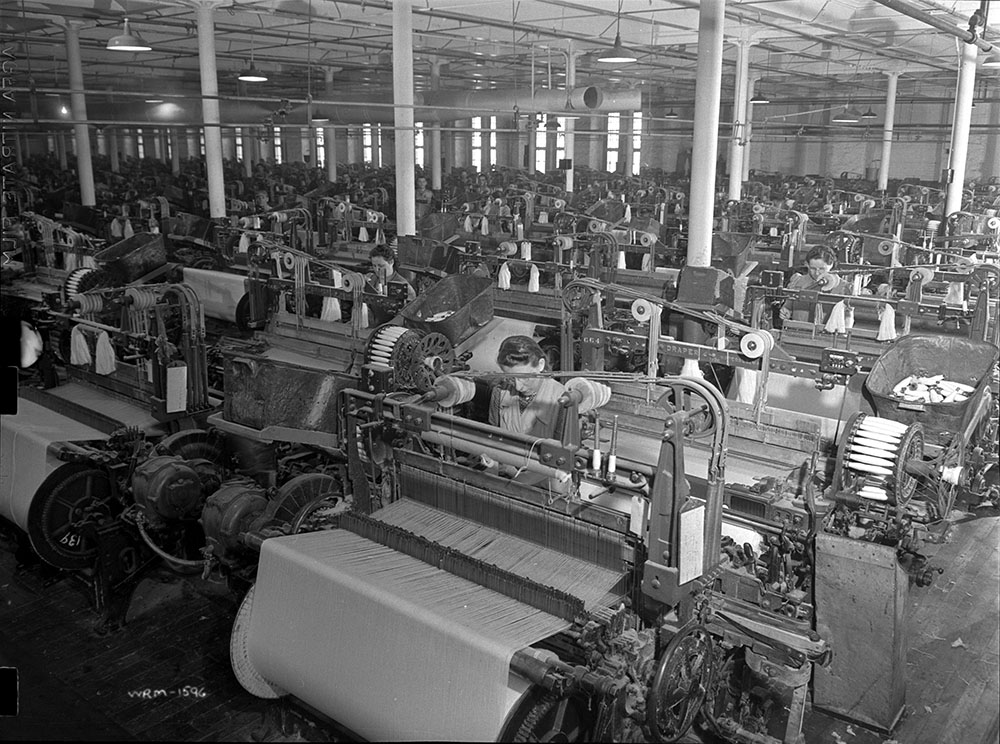
-
Article
Manulife Financial Corporation
Manulife Financial Corporation, based in Toronto, is Canada’s largest insurance company and one of the largest in the world. Its principal operations are located in Canada, the United States and Asia. Manulife offers life, health and income insurance protection, as well as annuities and wealth and asset management. It was founded in 1887 as Manufacturers Life Insurance Company Inc. Canada’s first prime minister, Sir John A. MacDonald, was also the company’s first president. Manulife is a public company that trades on the Toronto, New York and Philippine stock exchanges under the symbol MFC and on the Stock Exchange of Hong Kong as 945. In 2018, Manulife registered $39 billion in revenue and $4.8 billion in profit and held $1.1 trillion in assets. The company employs more than 34,000 people, who serve nearly 28 million customers.
"https://d3d0lqu00lnqvz.cloudfront.net/media/media/6a06c7db-0c6b-48d7-94c7-8131822ab382.jpg" // resources/views/front/categories/view.blade.php
https://d3d0lqu00lnqvz.cloudfront.net/media/media/6a06c7db-0c6b-48d7-94c7-8131822ab382.jpg
-
Article
Maple Trees in Canada
Maples are trees and shrubs in the genus Acer, previously classified within the maple family Aceraceae, but now placed by some taxonomists in Sapindaceae (Soapberry family), which also includes horse chestnut (Aesculus hippocastaneum). There are approximately 150 species of maple around the world, most in the temperate zone of the Northern Hemisphere, and the majority native to eastern Asia. Ten maple species are native to Canada, perhaps the best known being sugar maple (Acer saccharum) of eastern Canada and the northeastern United States. The Canadian flag displays a stylized maple leaf, and maple is Canada’s official arboreal emblem. Maples are not only important to Canada symbolically, they are also ecologically and economically significant.
"https://d3d0lqu00lnqvz.cloudfront.net/media/home-page-images/Douglas-maple.jpg" // resources/views/front/categories/view.blade.php
https://d3d0lqu00lnqvz.cloudfront.net/media/home-page-images/Douglas-maple.jpg
-
Article
Maple Leaf Foods Inc
Maple Leaf Foods Inc, with head offices in Toronto, is the largest Canadian producer of food products.
"https://thecanadianencyclopedia.ca/images/tce_placeholder.jpg?v=e9dca980c9bdb3aa11e832e7ea94f5d9" // resources/views/front/categories/view.blade.php
https://thecanadianencyclopedia.ca/images/tce_placeholder.jpg?v=e9dca980c9bdb3aa11e832e7ea94f5d9
-
Article
Maple Syrup Industry
Canada is the world’s leading producer and exporter of maple products, accounting for 75 per cent of the global market. In 2020, Canadian producers exported over 61 million kg of maple products, with a value of $515 million. The province of Quebec is by far the largest producer, representing 96.4 per cent of Canadian product exports. Maple syrup and maple sugar products are made by boiling down the sap of maple trees. World production of maple syrup and sugar is mainly limited to the Maple Belt, the hardwood forest stretching from the midwestern United States through Ontario, Quebec and New England and into New Brunswick, Nova Scotia and Prince Edward Island; however, British Columbia, Manitoba and Saskatchewan also produce some syrup.
"https://d3d0lqu00lnqvz.cloudfront.net/media/media/sugar-bush.jpg" // resources/views/front/categories/view.blade.php
https://d3d0lqu00lnqvz.cloudfront.net/media/media/sugar-bush.jpg
-
Article
Marathon
Marathon, Ontario, incorporated as a town in 1988, population 3,273 (2016 c), 3,353 (2011 c). The Town of Marathon is located in northern Ontario on Lake Superior, 296 km east of Thunder Bay.
"https://d3d0lqu00lnqvz.cloudfront.net/media/media/a364de6c-8814-45b4-b744-80d158f117c5.jpg" // resources/views/front/categories/view.blade.php
https://d3d0lqu00lnqvz.cloudfront.net/media/media/a364de6c-8814-45b4-b744-80d158f117c5.jpg