
Browse "Things"
-
Article
Labour Law
Labour law governs collective bargaining and industrial relations among employers, their unionized employees and trade unions. In Canada a distinction is commonly made between labour law narrowly defined in this way and employment law, the law of individual employment relationships, comprising the common law of master and servant and supervening statutory enactments governing the workplace. In England, labour law describes both, and of course a close relationship exists between them. In most provinces these matters are covered in separate statutes, but the Canada Labour Code is Parliament's major enactment governing the workplace for industries within federal jurisdiction, and regulates labour standards and occupational health and safety.
"https://d3d0lqu00lnqvz.cloudfront.net/labourhistoryquiz.jpg" // resources/views/front/categories/view.blade.php
https://d3d0lqu00lnqvz.cloudfront.net/labourhistoryquiz.jpg
-
Article
Labour Market
The labour market is a generalized concept denoting the interaction between the supply (number of persons available for work) and the demand (number of jobs available) and the wage rate.
"https://thecanadianencyclopedia.ca/images/tce_placeholder.jpg?v=e9dca980c9bdb3aa11e832e7ea94f5d9" // resources/views/front/categories/view.blade.php
https://thecanadianencyclopedia.ca/images/tce_placeholder.jpg?v=e9dca980c9bdb3aa11e832e7ea94f5d9
-
Article
Labour Mediation
Labour mediation embraces a variety of processes for resolving disputes between employers and trade unions in the organized sector of the labour market.
"https://thecanadianencyclopedia.ca/images/tce_placeholder.jpg?v=e9dca980c9bdb3aa11e832e7ea94f5d9" // resources/views/front/categories/view.blade.php
https://thecanadianencyclopedia.ca/images/tce_placeholder.jpg?v=e9dca980c9bdb3aa11e832e7ea94f5d9
-
Article
Labour Organization
The first labour organizations in Canada appeared in the early 19th century, but their growth and development really occurred in the early decades of the 20th century. During most of the 19th century labour unions were local, sporadic and short-lived.
"https://thecanadianencyclopedia.ca/images/tce_placeholder.jpg?v=e9dca980c9bdb3aa11e832e7ea94f5d9" // resources/views/front/categories/view.blade.php
https://thecanadianencyclopedia.ca/images/tce_placeholder.jpg?v=e9dca980c9bdb3aa11e832e7ea94f5d9
-
Article
Labour Party
That workers should have political representatives of their own class has been a recurrent theme in Canadian labour history, but no one organization has provided a permanent home for this idea. Many union leaders have preferred to advance their cause through established political parties. Also, acceptance of trade unionists and hybrid candidates by the major parties inhibited the formation of independent labour parties. (See National Union Centrals; Trade Unionism and Globalization; Confederation of National Trade Unions.)
"https://d3d0lqu00lnqvz.cloudfront.net/media/media/1795c31c-d8da-4c0e-9495-7c1faa47e330.jpg" // resources/views/front/categories/view.blade.php
https://d3d0lqu00lnqvz.cloudfront.net/media/media/1795c31c-d8da-4c0e-9495-7c1faa47e330.jpg
-
Article
Labour Policy
Labour policy includes policies concerned with relations between employers and employees and those concerned with the employment, training and distribution of workers in the LABOUR MARKET.
"https://thecanadianencyclopedia.ca/images/tce_placeholder.jpg?v=e9dca980c9bdb3aa11e832e7ea94f5d9" // resources/views/front/categories/view.blade.php
https://thecanadianencyclopedia.ca/images/tce_placeholder.jpg?v=e9dca980c9bdb3aa11e832e7ea94f5d9
-
Article
Labour Relations
Labour relations refers to the relations between employers and employees. They are affected by a number of factors, including labour organizations, collective bargaining, labour market, government policy, the structure of the economy, labour law and technological change.
"https://d3d0lqu00lnqvz.cloudfront.net/media/media/deaaaf0f-2d04-4ae8-8391-d6255fe2a78a.jpg" // resources/views/front/categories/view.blade.php
https://d3d0lqu00lnqvz.cloudfront.net/media/media/deaaaf0f-2d04-4ae8-8391-d6255fe2a78a.jpg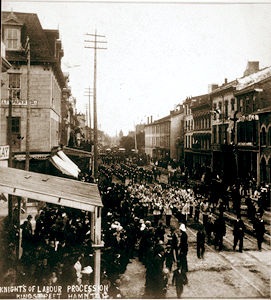
-
Article
Labrador Archaic
The distinctive tools and weapons of the Labrador Archaic people included narrow spear or dart points with a stemmed base for hafting, flaked stone knives and, in some cases, small scrapers for preparing hides.
"https://thecanadianencyclopedia.ca/images/tce_placeholder.jpg?v=e9dca980c9bdb3aa11e832e7ea94f5d9" // resources/views/front/categories/view.blade.php
https://thecanadianencyclopedia.ca/images/tce_placeholder.jpg?v=e9dca980c9bdb3aa11e832e7ea94f5d9
-
Article
Labrador Boundary Dispute
The territorial limit between Québec and Newfoundland in the Labrador peninsula, at over 3500 km long, is the longest interprovincial boundary. It has not yet been surveyed and marked on the ground.
"https://thecanadianencyclopedia.ca/images/tce_placeholder.jpg?v=e9dca980c9bdb3aa11e832e7ea94f5d9" // resources/views/front/categories/view.blade.php
https://thecanadianencyclopedia.ca/images/tce_placeholder.jpg?v=e9dca980c9bdb3aa11e832e7ea94f5d9
-
Article
Labrador Retriever
The Labrador retriever is one of four remaining Canadian dog breeds (see also Dogs in Canada). Its history begins at the turn of the 16th century on the island of Newfoundland. Here, its ancestors were retrievers of fish and game. The breed was further developed in England in the 19th century to assist in hunting. With a friendly temperament, the Labrador retriever is popular not only as a working dog but also as a family dog. In Canada, the Labrador has been the most popular dog for more than 25 years.
"https://d3d0lqu00lnqvz.cloudfront.net/LabradorRetriever/ChocolateLab.jpg" // resources/views/front/categories/view.blade.php
https://d3d0lqu00lnqvz.cloudfront.net/LabradorRetriever/ChocolateLab.jpg
-
Article
Labrador Tea
Labrador tea (Ledum groenlandicum and Ledum palustre), also called Hudson's Bay or Indian tea, is a shrub of the heath family (Ericaceae).
"https://thecanadianencyclopedia.ca/images/tce_placeholder.jpg?v=e9dca980c9bdb3aa11e832e7ea94f5d9" // resources/views/front/categories/view.blade.php
https://thecanadianencyclopedia.ca/images/tce_placeholder.jpg?v=e9dca980c9bdb3aa11e832e7ea94f5d9
-
Article
Labyrinth
Labyrinth (1967) was a multi-chamber installation that was the undisputed hit of EXPO 67 and the crowning achievement of the NATIONAL FILM BOARD OF CANADA (NFB).
"https://thecanadianencyclopedia.ca/images/tce_placeholder.jpg?v=e9dca980c9bdb3aa11e832e7ea94f5d9" // resources/views/front/categories/view.blade.php
https://thecanadianencyclopedia.ca/images/tce_placeholder.jpg?v=e9dca980c9bdb3aa11e832e7ea94f5d9
-
Article
Lac La Croix Indigenous Pony
The Lac La Croix Indigenous pony, also known as the Lac La Croix Indian pony or the Ojibwa pony, is thought to be the only existing breed of horse developed by Indigenous people in Canada. It takes its name from Lac La Croix First Nation in northwestern Ontario, where it was last found in the wild. Known in the Ojibwa language as bebezhigooganzhii or mishdatim (meaning “one big toenail”), it is a small, semi-feral horse that once lived in the wild and worked as a service animal — but is also considered a spirit animal — for the Ojibwa people of northwestern Ontario and northern Minnesota. Today, this friendly, all-purpose breed is used in equine therapy, Indigenous heritage programs and tourism. Conservation efforts in Canada and the United States strive to protect the breed, which is critically endangered.
"https://d3d0lqu00lnqvz.cloudfront.net/media/media/1ef4a37a-9a7a-430d-bb76-270783327204.jpg" // resources/views/front/categories/view.blade.php
https://d3d0lqu00lnqvz.cloudfront.net/media/media/1ef4a37a-9a7a-430d-bb76-270783327204.jpg
-
Article
Lac-Mégantic Rail Disaster
In the early morning of 6 July 2013, a runaway train hauling 72 tankers filled with crude oil derailed as it approached the centre of the town of Lac-Mégantic, Quebec. The tanker cars exploded and the oil caught fire, killing 47 people and destroying many buildings and other infrastructure in the town centre. The fourth deadliest railway disaster in Canadian history, the derailment led to changes in rail transport safety rules as well as legal action against the company and employees involved in the incident. Years after the derailment, re-building was still ongoing and many of the town’s residents continued to suffer from post-traumatic stress.
"https://d3d0lqu00lnqvz.cloudfront.net/media/new_article_images/Lac-Mégantic_Rail_Disaster/First responders.jpg" // resources/views/front/categories/view.blade.php
https://d3d0lqu00lnqvz.cloudfront.net/media/new_article_images/Lac-Mégantic_Rail_Disaster/First responders.jpg
-
Article
Lacewing
Lacewing is the common name for small, fragile insects of the 2 most common families (Chrysopidae, green lacewings; Hemerobiidae, brown lacewings) of order Neuroptera.
"https://d3d0lqu00lnqvz.cloudfront.net/media/media/e8007af8-8d70-4067-8d62-17a758d4bdc9.jpg" // resources/views/front/categories/view.blade.php
https://d3d0lqu00lnqvz.cloudfront.net/media/media/e8007af8-8d70-4067-8d62-17a758d4bdc9.jpg