
Browse "Things"
-
Article
Grand Theatre (London)
The original Grand Opera House opened amid a strong amateur and professional theatrical tradition on 8 September 1881 in the upper floors of the Masonic Temple in London, Ontario. At its peak in the 1890s, the 2,070-seat Grand was host to 100 companies and 300 performances annually. World-renowned artists, including Sarah Bernhardt, Lily Langtry and Ellen Terry and Canadians Clara Morris, Emma Albani and Henry Miller, performed in the classical melodramas of the time.
"https://d3d0lqu00lnqvz.cloudfront.net/Grand_Theatre_20120901_142842.jpg" // resources/views/front/categories/view.blade.php
https://d3d0lqu00lnqvz.cloudfront.net/Grand_Theatre_20120901_142842.jpg
-
Article
Grand Théâtre de Québec
Grand Théâtre de Québec. A building complex devoted to the performing arts, located in Quebec City at the corner of Claire-Fontaine St and René Lévesque Blvd E.
"https://thecanadianencyclopedia.ca/images/tce_placeholder.jpg?v=e9dca980c9bdb3aa11e832e7ea94f5d9" // resources/views/front/categories/view.blade.php
https://thecanadianencyclopedia.ca/images/tce_placeholder.jpg?v=e9dca980c9bdb3aa11e832e7ea94f5d9
-
Article
Grand Trunk Pacific Railway
The Grand Trunk Pacific Railway was a 4800 km system whose main line ran from Winnipeg via Melville and Edmonton to Prince Rupert, British Columbia.
"https://thecanadianencyclopedia.ca/images/tce_placeholder.jpg?v=e9dca980c9bdb3aa11e832e7ea94f5d9" // resources/views/front/categories/view.blade.php
https://thecanadianencyclopedia.ca/images/tce_placeholder.jpg?v=e9dca980c9bdb3aa11e832e7ea94f5d9
-
Article
Grand Trunk Railway of Canada
In late 19th Century, the Grand Trunk Railway of Canada was the major railroad in the Province of Canada (Ontario and Quebec), connecting Toronto to Montreal.
"https://d3d0lqu00lnqvz.cloudfront.net/media/media/f2fd266e-b4d2-42a3-8d88-e6e4166b1541.jpg" // resources/views/front/categories/view.blade.php
https://d3d0lqu00lnqvz.cloudfront.net/media/media/f2fd266e-b4d2-42a3-8d88-e6e4166b1541.jpg
-
Article
Grape
Vitis species are woody climbing vines that produce clusters of berries. There are about 60 Vitis species found mostly in temperate regions in the Northern Hemisphere. Vitis vinifera, the principal grape species cultivated for fine winemaking, is native to the Mediterranean and southwestern Asia. Several Vitis species are native to North America, from Canada to Mexico. In cultivation, V. vinifera wine grapes are commonly produced on grafted vines whose rootstocks were derived from North American species such as V. riparia and V. rupestris, which impart resistance to pests and tolerance to adverse soil conditions. Fruit-producing hybrids of V. vinifera and North American species were first developed for their resistance to the root aphid phylloxera. However, as many hybrids are more winter hardy than V. vinifera they are the most common cultivars planted in areas having cold winter climates. The quality of wines produced from hybrid cultivars is generally considered inferior to that from V. vinifera.
"https://d3d0lqu00lnqvz.cloudfront.net/media/media/55eb249c-1c46-4ed1-9490-224f6164762d.jpg" // resources/views/front/categories/view.blade.php
https://d3d0lqu00lnqvz.cloudfront.net/media/media/55eb249c-1c46-4ed1-9490-224f6164762d.jpg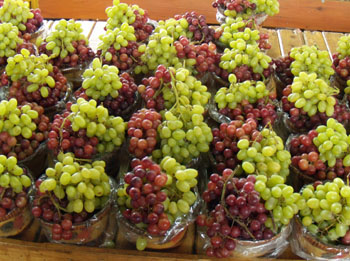
-
Article
Graphite
Graphite is one of the 4 allotropes of carbon. The other allotropes are Diamond, the fullerenes also known as "bucky balls" and amorphous carbon (charcoal, coke and carbon black). These allotropes of the same element carbon have very different crystal structures and physical properties. There are 2 types of graphite - natural and synthetic. Natural graphite is black with a sub-metallic lustre, feels greasy and stains the fingers. Graphite is found mainly in Metamorphic Rocks, most frequently in schist and as small crystals in impure marbles in association with other minerals.
"https://d3d0lqu00lnqvz.cloudfront.net/media/media/ccbf9884-f122-47b6-a979-572a2dfd24eb.jpg" // resources/views/front/categories/view.blade.php
https://d3d0lqu00lnqvz.cloudfront.net/media/media/ccbf9884-f122-47b6-a979-572a2dfd24eb.jpg
-
Article
Grasses
Emergence of GrasslandsGrasslands began to appear about 25 million years ago, changing the face of much of the world and providing food for grazing animals. Grasses and grazers evolved together. Grasses benefit because grazers control the growth of competing species and provide fertilizers.
"https://d3d0lqu00lnqvz.cloudfront.net/media/media/64128275-0625-4ef5-8669-b94e659285cb.jpg" // resources/views/front/categories/view.blade.php
https://d3d0lqu00lnqvz.cloudfront.net/media/media/64128275-0625-4ef5-8669-b94e659285cb.jpg
-
Article
Grasshopper
Grasshopper is the common name for straight-winged insects which, together with locusts, make up the order Orthoptera.
"https://thecanadianencyclopedia.ca/images/tce_placeholder.jpg?v=e9dca980c9bdb3aa11e832e7ea94f5d9" // resources/views/front/categories/view.blade.php
https://thecanadianencyclopedia.ca/images/tce_placeholder.jpg?v=e9dca980c9bdb3aa11e832e7ea94f5d9
-
Article
Gravity
Gravity, the fundamental physical property of attraction between all bodies, is here considered mainly as it relates to the study of the Earth.
"https://thecanadianencyclopedia.ca/images/tce_placeholder.jpg?v=e9dca980c9bdb3aa11e832e7ea94f5d9" // resources/views/front/categories/view.blade.php
https://thecanadianencyclopedia.ca/images/tce_placeholder.jpg?v=e9dca980c9bdb3aa11e832e7ea94f5d9
-
Article
Gray Ratsnake
The gray ratsnake (Pantherophis spiloides) is a non-venomous snake native to eastern North America. It is one of the largest snake species in North America. In Canada, the gray ratsnake is only found in southern Ontario, where it is restricted to two disjunct regions. Canadian populations are declining due to a variety of threats, including road mortality, habitat loss and intentional persecution by people. It is classified as a species at risk under Canada’s Species at Risk Act.
"https://d3d0lqu00lnqvz.cloudfront.net/grayratsnake/Gray-Ratsnake.jpg" // resources/views/front/categories/view.blade.php
https://d3d0lqu00lnqvz.cloudfront.net/grayratsnake/Gray-Ratsnake.jpg
-
Article
Gray Treefrog
The gray treefrog (Dryophytes versicolor, synonym Hyla versicolor) is a small to medium-sized treefrog native to Central and Northeastern North America. In Canada, they are found in New Brunswick, Quebec, Ontario, Manitoba and a small part of Eastern Saskatchewan. Gray treefrogs are well camouflaged; the scientific name versicolor means “changing colour” and refers to the frog’s ability to make their skin lighter or darker. Gray treefrogs have one of the loudest calls of any North American frog.
"https://d3d0lqu00lnqvz.cloudfront.net/graytreefrog/Crowley-Gray-Treefrog-Hyla-versicolor-9.jpg" // resources/views/front/categories/view.blade.php
https://d3d0lqu00lnqvz.cloudfront.net/graytreefrog/Crowley-Gray-Treefrog-Hyla-versicolor-9.jpg
-
Article
Grayling
Grayling is the common name for freshwater fishes of class Actinopterygii, family Salmonidae (salmon), subfamily Thymallinae (sometimes elevated to family rank). Graylings are most easily identified by their very large dorsal fins. The arctic grayling is the emblematic fish of the Northwest Territories.
"https://d3d0lqu00lnqvz.cloudfront.net/media/media/314cbf4b-4a1a-4131-87cd-c20f4d82c98c.jpg" // resources/views/front/categories/view.blade.php
https://d3d0lqu00lnqvz.cloudfront.net/media/media/314cbf4b-4a1a-4131-87cd-c20f4d82c98c.jpg
-
Article
Great Auk
The great auk (Pinguinus impennis), the largest and only flightless auk, is extinct. All auks are expert divers which swim underwater using their wings, but the great auk had flipper-like wings, too short for flight. It was the original penguin (true penguins are unrelated birds native to the Southern Hemisphere), and the largest recent member of the family Alcidae, probably weighing 5,500–8,000 g and stretching 65 cm long.
"https://d3d0lqu00lnqvz.cloudfront.net/media/media/007ecccd-3ff4-4c68-81c8-4416ce44836c.jpg" // resources/views/front/categories/view.blade.php
https://d3d0lqu00lnqvz.cloudfront.net/media/media/007ecccd-3ff4-4c68-81c8-4416ce44836c.jpg
-
Article
Great Awakening
Great Awakening, New England-based movement of religious revivalism and evangelical pietism which came to Nova Scotia in 1775 with Henry ALLINE's decision to preach; it subsequently spread across the Maritimes. The religious currents which produced it were international and at least a century old.
"https://thecanadianencyclopedia.ca/images/tce_placeholder.jpg?v=e9dca980c9bdb3aa11e832e7ea94f5d9" // resources/views/front/categories/view.blade.php
https://thecanadianencyclopedia.ca/images/tce_placeholder.jpg?v=e9dca980c9bdb3aa11e832e7ea94f5d9
-
List
Great Canadian Fauna
To celebrate its 30th anniversary, The Canadian Encyclopedia created 30 lists of 30 things that make us proud to be Canadian, from famous people and historic events, to iconic foods and influential artists.
"https://d3d0lqu00lnqvz.cloudfront.net/media/media/a7c708ef-3e7b-4890-a1ad-f637397985a6.jpg" // resources/views/front/categories/view.blade.php
https://d3d0lqu00lnqvz.cloudfront.net/media/media/a7c708ef-3e7b-4890-a1ad-f637397985a6.jpg