Browse "Science & Technology"
-
Article
Stem Cell Research
Stem cells are the body's "building blocks"; they are the cells from which all tissues and organs are derived. They have the ability to divide while still maintaining their identity, yet they can also develop into specialized cells in response to certain stimuli. They can be found in a wide range of tissues in mammals at different stages of development and in adult organisms in tissues like nerve, muscle and skin. Stem cells from adults have a more restricted range of development. In order to develop new treatments for specific conditions scientists must understand more about how cell differentiation is directed by biological signals. New methods need to be found to grow large numbers of desired cells and more scientific experimentation involving different types of stem cells is vital. It will take many years for research projects to provide sufficient knowledge about stem cells to make new treatments possible (see Medical Research).
"https://d3d0lqu00lnqvz.cloudfront.net/TCE_placeholder.png" // resources/views/front/categories/view.blade.php
https://d3d0lqu00lnqvz.cloudfront.net/TCE_placeholder.png
-
Article
Sterilization of Indigenous Women in Canada
The practice of sterilization arose out of the eugenics movement and has a long, often hidden history in Canada. Sterilization legislation in Alberta (1928–72) and British Columbia (1933–73) attempted to limit the reproduction of “unfit” persons, and increasingly targeted Indigenous women. Coerced sterilization of Indigenous women took place both within and outside existing legislation, and in federally operated Indian hospitals. The practice has continued into the 21st century. Approximately 100 Indigenous women have alleged that they were pressured to consent to sterilization between the 1970s and 2018, often while in the vulnerable state of pregnancy or childbirth.
"https://d3d0lqu00lnqvz.cloudfront.net/Nikawiy Nitanis.png" // resources/views/front/categories/view.blade.php
https://d3d0lqu00lnqvz.cloudfront.net/Nikawiy Nitanis.png
-
Article
Strategic Environmental Assessment
Strategic environmental assessment is the environmental assessment of policy, plan and program initiatives and their alternatives.
"https://thecanadianencyclopedia.ca/images/tce_placeholder.jpg?v=e9dca980c9bdb3aa11e832e7ea94f5d9" // resources/views/front/categories/view.blade.php
https://thecanadianencyclopedia.ca/images/tce_placeholder.jpg?v=e9dca980c9bdb3aa11e832e7ea94f5d9
-
Article
Stress
Stress was originally viewed as an overpowering external force acting upon individuals or objects. The mechanical engineer still uses the word in this sense, but human biologists have been less consistent in their terminology.
"https://d3d0lqu00lnqvz.cloudfront.net/media/media/aca57006-6f6c-42b9-9d64-c5610ad2da2b.jpg" // resources/views/front/categories/view.blade.php
https://d3d0lqu00lnqvz.cloudfront.net/media/media/aca57006-6f6c-42b9-9d64-c5610ad2da2b.jpg
-
Macleans
Structural problems
Retirements and declining immigrant participation have Canada facing a critical shortage of engineersThis article was originally published in Maclean's Magazine on September 16, 2013
"https://thecanadianencyclopedia.ca/images/tce_placeholder.jpg?v=e9dca980c9bdb3aa11e832e7ea94f5d9" // resources/views/front/categories/view.blade.php
https://thecanadianencyclopedia.ca/images/tce_placeholder.jpg?v=e9dca980c9bdb3aa11e832e7ea94f5d9
-
Article
Submersible
The Canadian government took delivery of a HYSUB 5000 ROV in 1987. Designed and manufactured by International Submarine Engineering (ISE) of Port Moody, BC, the HYSUB is an electrohydraulic submersible remotely operated vehicle, operating with 6 to 250 hp.
"https://d3d0lqu00lnqvz.cloudfront.net/media/media/a6265113-e1e0-404c-a66f-bc377ca940ff.jpg" // resources/views/front/categories/view.blade.php
https://d3d0lqu00lnqvz.cloudfront.net/media/media/a6265113-e1e0-404c-a66f-bc377ca940ff.jpg
-
Article
Sweat Lodge
Sweat lodges are heated, dome-shaped structures used by Indigenous peoples during certain purification rites and as a way to promote healthy living.
"https://d3d0lqu00lnqvz.cloudfront.net/media/media/1f3048e8-c0db-4b13-a5c8-c5c727b435fd.jpg" // resources/views/front/categories/view.blade.php
https://d3d0lqu00lnqvz.cloudfront.net/media/media/1f3048e8-c0db-4b13-a5c8-c5c727b435fd.jpg
-
Article
Synchrotron
A synchrotron is a source of brilliant light that acts like a giant microscope to allow matter to be seen at the atomic level. Synchrotron light is millions of times brighter than sunlight and millions of times more intense than conventional X-rays.
"https://thecanadianencyclopedia.ca/images/tce_placeholder.jpg?v=e9dca980c9bdb3aa11e832e7ea94f5d9" // resources/views/front/categories/view.blade.php
https://thecanadianencyclopedia.ca/images/tce_placeholder.jpg?v=e9dca980c9bdb3aa11e832e7ea94f5d9
-
Article
Taber Child
In 1961, fragments of a human infant skull from were recovered from the banks of the Oldman River near Taber, Alberta.
"https://thecanadianencyclopedia.ca/images/tce_placeholder.jpg?v=e9dca980c9bdb3aa11e832e7ea94f5d9" // resources/views/front/categories/view.blade.php
https://thecanadianencyclopedia.ca/images/tce_placeholder.jpg?v=e9dca980c9bdb3aa11e832e7ea94f5d9
-
Article
Talc
Talc is a mineral composed of 31.7% magnesium oxide (MgO), 63.5% silicon dioxide (SiO2) and 4.8% water. It is formed by the alteration of dolomite or ultramafic IGNEOUS rocks. A formula for pure talc would look like this: 3 dolomite + 4 quartz + 1 water = 1 talc + 3 calcite + 3 CO2.
"https://thecanadianencyclopedia.ca/images/tce_placeholder.jpg?v=e9dca980c9bdb3aa11e832e7ea94f5d9" // resources/views/front/categories/view.blade.php
https://thecanadianencyclopedia.ca/images/tce_placeholder.jpg?v=e9dca980c9bdb3aa11e832e7ea94f5d9
-
Article
Tantalum
Tantalum (Ta) is a grey, heavy, very hard metal with a high melting point. Tantalum is a chemical element with the chemical symbol Ta and atomic number 73. The name of this metal is derived from King Tantalus, a figure in Greek mythology. Due to its properties tantalum is used in the electronics industry.
"https://d3d0lqu00lnqvz.cloudfront.net/minerals/tantalum.jpg" // resources/views/front/categories/view.blade.php
https://d3d0lqu00lnqvz.cloudfront.net/minerals/tantalum.jpg
-
Article
Technical Education
From its origins in manual training "shop" and industrial arts, technical education has consisted of practical and applied subject matter that reflects the practices of current society.
"https://thecanadianencyclopedia.ca/images/tce_placeholder.jpg?v=e9dca980c9bdb3aa11e832e7ea94f5d9" // resources/views/front/categories/view.blade.php
https://thecanadianencyclopedia.ca/images/tce_placeholder.jpg?v=e9dca980c9bdb3aa11e832e7ea94f5d9
-
Macleans
Technical Marvels May Revolutionize Health Care
They're everywhere. Turn on the TV, pick up a newspaper or magazine, and the stories leap out: stem cells to heal the body's failing nervous system; transplanted wombs; the smaller-than-small world of nanotechnology; and yes, as in the previous story, the feverish quest for an artificial heart.This article was originally published in Maclean's Magazine on March 25, 2002
"https://thecanadianencyclopedia.ca/images/tce_placeholder.jpg?v=e9dca980c9bdb3aa11e832e7ea94f5d9" // resources/views/front/categories/view.blade.php
https://thecanadianencyclopedia.ca/images/tce_placeholder.jpg?v=e9dca980c9bdb3aa11e832e7ea94f5d9
-
Article
Telecommunications
Telecommunications is defined as the electronic communication of information over distance. In theory, this definition covers all forms of electronic communication and does not distinguish between different kinds of information: voice, data, text and video.
"https://thecanadianencyclopedia.ca/images/tce_placeholder.jpg?v=e9dca980c9bdb3aa11e832e7ea94f5d9" // resources/views/front/categories/view.blade.php
https://thecanadianencyclopedia.ca/images/tce_placeholder.jpg?v=e9dca980c9bdb3aa11e832e7ea94f5d9
-
Article
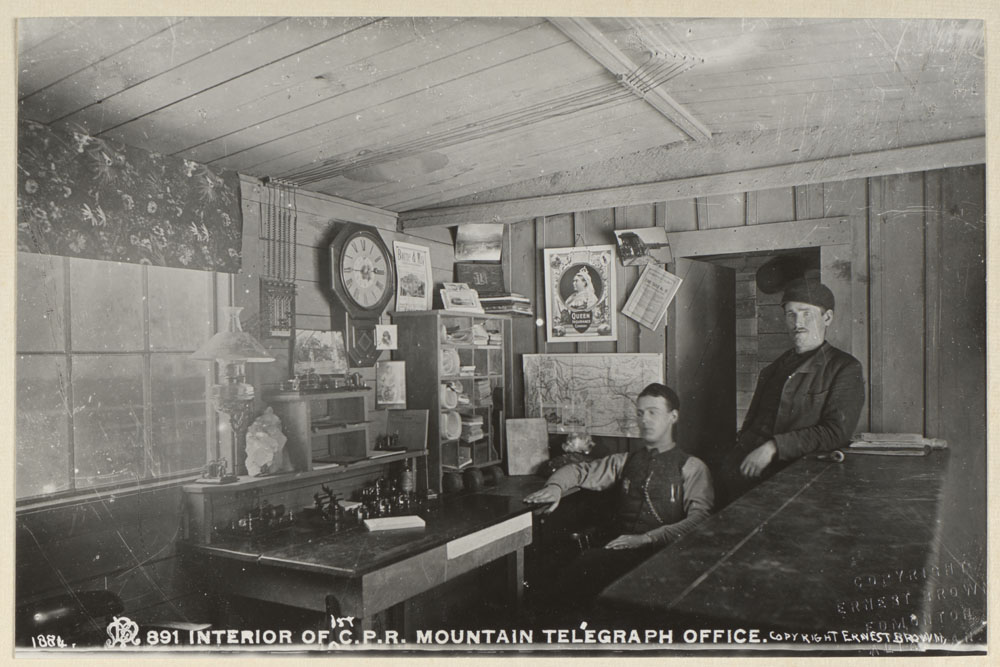
Telegraph
The telegraph (Gk, tele, meaning "far," and graphein,"to write") was conceived in 1837 in North America by Samuel Morse, and in Europe by the English partnership of William Cooke and Charles Wheatstone. It is a means of electrically transmitting encoded messages through the systematic opening and closing of electric circuits. The telegraph was introduced to Canada in 1846. (See also Telecommunications.)
"https://d3d0lqu00lnqvz.cloudfront.net/telegraph/cprtelegraphoffice.jpg" // resources/views/front/categories/view.blade.php
https://d3d0lqu00lnqvz.cloudfront.net/telegraph/cprtelegraphoffice.jpg