
Browse "Politics & Law"
-
Macleans
Ottawa's Ambitious Agenda to Expand Power
IT WASN'T QUITE what Paul MARTIN had promised. Instead of an uplifting exercise in televised democracy, his summit with the premiers lapsed into behind-closed-doors horse trading.This article was originally published in Maclean's Magazine on September 27, 2004
"https://thecanadianencyclopedia.ca/images/tce_placeholder.jpg?v=e9dca980c9bdb3aa11e832e7ea94f5d9" // resources/views/front/categories/view.blade.php
https://thecanadianencyclopedia.ca/images/tce_placeholder.jpg?v=e9dca980c9bdb3aa11e832e7ea94f5d9
-
Macleans
Ottawa's Pension Reform Plans
Barely five feet tall, firmly "over 65," Lillian Morgenthau can throw a political punch that would bring most politicians to their knees.This article was originally published in Maclean's Magazine on September 29, 1997
"https://thecanadianencyclopedia.ca/images/tce_placeholder.jpg?v=e9dca980c9bdb3aa11e832e7ea94f5d9" // resources/views/front/categories/view.blade.php
https://thecanadianencyclopedia.ca/images/tce_placeholder.jpg?v=e9dca980c9bdb3aa11e832e7ea94f5d9
-
Macleans
Ottawa's Referendum Strategy
On a day when Premier Jacques Parizeau and more than 1,000 of his closest sovereigntist friends were meeting for an occasion they deemed "historic," the man most of them consider Quebec's constitutional devil incarnate was less than 25 km away, doing his best to ignore them.This article was originally published in Maclean's Magazine on September 18, 1995
"https://thecanadianencyclopedia.ca/images/tce_placeholder.jpg?v=e9dca980c9bdb3aa11e832e7ea94f5d9" // resources/views/front/categories/view.blade.php
https://thecanadianencyclopedia.ca/images/tce_placeholder.jpg?v=e9dca980c9bdb3aa11e832e7ea94f5d9
-
Article
Padlock Act
The Padlock Act (Act Respecting Communistic Propaganda) was a 1937 Quebec statute empowering the attorney general to close, for one year, any building used for propagating "communism or bolshevism" (undefined).
"https://d3d0lqu00lnqvz.cloudfront.net/media/media/22180159-911b-4d85-94c5-fc2a39cd939d.jpg" // resources/views/front/categories/view.blade.php
https://d3d0lqu00lnqvz.cloudfront.net/media/media/22180159-911b-4d85-94c5-fc2a39cd939d.jpg
-
Article
Pamajewon Case
The Pamajewon case (1996) (also known as R. v. Pamajewon) was the first case in which First Nations in Canada argued an inherent right to self-government before the Supreme Court. Spearheaded by two Anishinaabe First Nations, Eagle Lake and Shawanaga, the claimants argued that the Indigenous right to self-government included a right to control gambling practices on reserves. The Supreme Court ruled that these First Nations did not have rights to high-stakes gaming under self-government.
"https://thecanadianencyclopedia.ca/images/tce_placeholder.jpg?v=e9dca980c9bdb3aa11e832e7ea94f5d9" // resources/views/front/categories/view.blade.php
https://thecanadianencyclopedia.ca/images/tce_placeholder.jpg?v=e9dca980c9bdb3aa11e832e7ea94f5d9
-
Article
Pan-Indianism
Pan-Indianism is a movement of Aboriginal resistance to domination and assimilation and is characterized primarily by political and religious expression and solidarity. Key historical figures include Pontiac and Handsome Lake.
"https://d3d0lqu00lnqvz.cloudfront.net/media/media/174cee51-4aca-4a67-ac60-f72697d35862.jpg" // resources/views/front/categories/view.blade.php
https://d3d0lqu00lnqvz.cloudfront.net/media/media/174cee51-4aca-4a67-ac60-f72697d35862.jpg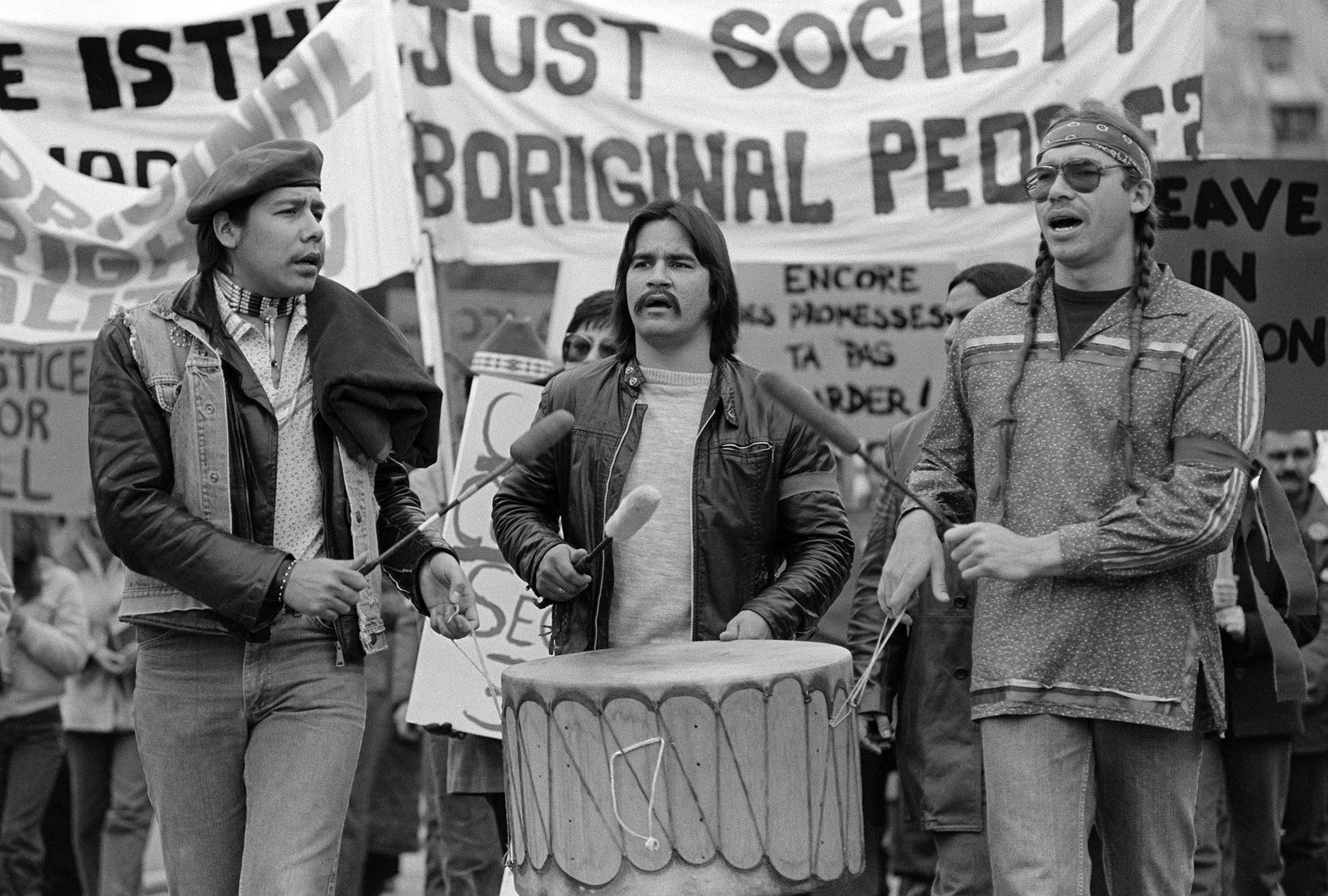
-
Macleans
Parents of Victims Speak
This article was originally published in Maclean’s magazine on October 16, 1995. Partner content is not updated.
"https://thecanadianencyclopedia.ca/images/tce_placeholder.jpg?v=e9dca980c9bdb3aa11e832e7ea94f5d9" // resources/views/front/categories/view.blade.php
https://thecanadianencyclopedia.ca/images/tce_placeholder.jpg?v=e9dca980c9bdb3aa11e832e7ea94f5d9
-
Article
Parliament
The term Parliament refers to the Crown, the House of Commons and the Senate. Together, these institutions create Canadian laws. Parliament has two branches: the executive (the Crown, prime minister and cabinet) and the legislative (the House of Commons and the Senate). This system is a blend of parliamentary democracy and constitutional monarchy. It is based on the Westminster tradition in Britain. Each of the Crown, Senate and Commons must agree with (assent to) a law before it is enacted. The government of the day derives its authority from the people who elected it. It is therefore a representative government, even though it acts in the name of the Crown — a largely symbolic institution. In formal terms, Parliament includes all three bodies. But in common usage, the legislative branch is often equated with Parliament.
"https://d3d0lqu00lnqvz.cloudfront.net/media/media/11551bec-a5f6-4e78-b101-265ddf7610cb.jpg" // resources/views/front/categories/view.blade.php
https://d3d0lqu00lnqvz.cloudfront.net/media/media/11551bec-a5f6-4e78-b101-265ddf7610cb.jpg
-
Article
Parliament Hill Attack
On 22 October 2014, Parliament and the National War Memorial in Ottawa were the targets of an unprecedented attack by a lone gunman. The shooter killed Corporal Nathan Cirillo, a ceremonial guard at the War Memorial, and then charged into Parliament, where he was shot to death inside. The attack raised questions about parliamentary security and sparked a national debate over the nature of terrorism.
"https://d3d0lqu00lnqvz.cloudfront.net/media/media/731e3daa-fce9-4322-8a2a-499deb109b52.jpg" // resources/views/front/categories/view.blade.php
https://d3d0lqu00lnqvz.cloudfront.net/media/media/731e3daa-fce9-4322-8a2a-499deb109b52.jpg
-
Macleans
Parliament Legislates End to Strike
While the two sides in the rail strike remained at loggerheads last week, the government moved quickly to end the dispute.This article was originally published in Maclean's Magazine on April 3, 1995
"https://d3d0lqu00lnqvz.cloudfront.net/media/media/629e4435-3bac-43fb-8d0d-e7676d4693a9.jpg" // resources/views/front/categories/view.blade.php
https://d3d0lqu00lnqvz.cloudfront.net/media/media/629e4435-3bac-43fb-8d0d-e7676d4693a9.jpg
-
Article
Canadian Parliamentary Press Gallery
The Canadian Parliamentary Press Gallery (CPPG) is a self-governing corporation that consists of accredited journalists who cover Parliament and other Ottawa-based governmental organizations and institutions.
"https://d3d0lqu00lnqvz.cloudfront.net/media/media/8981a05d-eeb8-4088-b564-b75deee61391.jpg" // resources/views/front/categories/view.blade.php
https://d3d0lqu00lnqvz.cloudfront.net/media/media/8981a05d-eeb8-4088-b564-b75deee61391.jpg
-
Macleans
Parrott's Killer Convicted
This article was originally published in Maclean’s magazine on April 26, 1999. Partner content is not updated. The porch at Peter and Lesley Parrott's farm northwest of Toronto overlooks rolling hills, a lawn of scattered daffodils and a heart-shaped flower bed adorned by a weeping crab-apple tree. The tree was planted on Sept. 28, 1995 - what would have been their daughter Alison's 21st birthday.
"https://thecanadianencyclopedia.ca/images/tce_placeholder.jpg?v=e9dca980c9bdb3aa11e832e7ea94f5d9" // resources/views/front/categories/view.blade.php
https://thecanadianencyclopedia.ca/images/tce_placeholder.jpg?v=e9dca980c9bdb3aa11e832e7ea94f5d9
-
Article
Parti bleu
Favouring an attitude known as la survivance and opposing the anticlerical and radical Parti rouge, the Parti bleu received the support of the Roman Catholic clergy, making it the most powerful political party in Canada East (Québec).
"https://d3d0lqu00lnqvz.cloudfront.net/media/media/3f9db44a-f917-48c9-8458-e59d308093bf.jpg" // resources/views/front/categories/view.blade.php
https://d3d0lqu00lnqvz.cloudfront.net/media/media/3f9db44a-f917-48c9-8458-e59d308093bf.jpg
-
Article
Parti canadien
Formed at the turn of the 19th century, the Parti canadien was an alliance of French Canadian deputies in the elected Legislative Assembly of Lower Canada (Québec). First led by Pierre-Stanislas Bédard, the party used the assembly as a forum to promote its authority in the colonial government. The Parti canadien was the first political party in Canadian history.
"https://d3d0lqu00lnqvz.cloudfront.net/media/media/fff11157-7177-4659-9035-c83489ea72d7.jpg" // resources/views/front/categories/view.blade.php
https://d3d0lqu00lnqvz.cloudfront.net/media/media/fff11157-7177-4659-9035-c83489ea72d7.jpg
-
Article
Parti national
The Parti national was a political party founded in 1871 by Québec Liberals including Honoré MERCIER and Louis Jetté. It unsuccessfully attempted to acquire the clerical support for liberalism that the PARTI ROUGE lacked. Mercier revived it in 1885 during the uproar over Louis RIEL's execution.
"https://thecanadianencyclopedia.ca/images/tce_placeholder.jpg?v=e9dca980c9bdb3aa11e832e7ea94f5d9" // resources/views/front/categories/view.blade.php
https://thecanadianencyclopedia.ca/images/tce_placeholder.jpg?v=e9dca980c9bdb3aa11e832e7ea94f5d9