
Browse "Politics & Law"
-
Editorial
Flag of Canada: Alternate Designs
The following article is an editorial written by The Canadian Encyclopedia staff. Editorials are not usually updated. A national flag is a simple, effective way of identifying a country and expressing its collective will and sovereignty. Its symbolism should be expansive, representing perspectives from across the country. But it should also be singular, offering a picture of unity. For almost a century, Canada did not fly a flag of its own. There were instead the Union Jack and the Canadian Red Ensign. They took turns flying above Parliament. But neither was distinctly Canadian, nor permanent. The issue of a new flag was raised in Parliament in 1925 and again in 1945. It was dropped both times due to a lack of consent. Some clung to tradition, and none could agree on a unifying symbol. When Prime Minister Lester B. Pearson re-opened the debate in 1964, he offered Canadians the chance to “say proudly to the world and to the future: ‘I stand for Canada.’” A joint committee of the Senate and House of Commons was assembled to decide on a suitable design. After months of vigorous debate, the final design was unfurled at Parliament Hill on 15 February 1965. The design process was open to the public. Thousands of suggestions were submitted. This article looks at 12 of those designs. It includes explanations for the symbols found in each. The designs express a vision for Canada, still young and still finding its mode of self-expression.
"https://d3d0lqu00lnqvz.cloudfront.net/media/media/1a5937f7-ad68-4cb9-8abf-ab518775c641.jpg" // resources/views/front/categories/view.blade.php
https://d3d0lqu00lnqvz.cloudfront.net/media/media/1a5937f7-ad68-4cb9-8abf-ab518775c641.jpg
-
Article
National Holidays
The derivation of the three Christian holidays needs no explanation. New Year's Day, January 1, marks the beginning of the new year.
"https://d3d0lqu00lnqvz.cloudfront.net/media/media/f16312ec-1fb2-4d48-83d0-bd3d93798aa2.jpg" // resources/views/front/categories/view.blade.php
https://d3d0lqu00lnqvz.cloudfront.net/media/media/f16312ec-1fb2-4d48-83d0-bd3d93798aa2.jpg
-
Article
National Party of Canada
The National Party of Canada was a short-lived federal political party created by Edmonton publisher Mel Hurtig in 1992. It was a left-leaning, progressive, economic nationalist party. It opposed free trade and ran 171 candidates in the 1993 federal election but won no seats. The party fell apart due to an internal dispute and lost its registered party status in 1997. (It should not be confused with the National Party, created by disaffected NDP members in the late 1970s, or the Canadian Nationalist Party, a white supremacist hate group.)
"https://d3d0lqu00lnqvz.cloudfront.net/National_Party_of_Canada.svg.png" // resources/views/front/categories/view.blade.php
https://d3d0lqu00lnqvz.cloudfront.net/National_Party_of_Canada.svg.png
-
Article
National Policy
The National Policy was a central economic and political strategy of the Conservative Party under Prime Minister John A. Macdonald, and many of his successors in high office. It meant that from 1878 until the Second World War, Canada levied high tariffs on foreign imported goods, to shield Canadian manufacturers from American competition.
"https://d3d0lqu00lnqvz.cloudfront.net/media/media/3d796db1-587b-4b83-b948-3074a8fe7e80.jpg" // resources/views/front/categories/view.blade.php
https://d3d0lqu00lnqvz.cloudfront.net/media/media/3d796db1-587b-4b83-b948-3074a8fe7e80.jpg
-
Article
National Policy (Plain-Language Summary)
The National Policy was a protectionist policy. It was a main focus of the Conservative Party for decades. It began under Prime Minister John A. Macdonald. It continued under many of his successors. Under the policy, Canada imposed high tariffs (taxes) on imported goods. This shielded manufacturers in Canada from US competition. The policy was in effect from 1878 until the Second World War. This article is a plain-language summary of the National Policy. If you would like to read about this topic in more depth, please see our full-length entry: National Policy.
"https://d3d0lqu00lnqvz.cloudfront.net/media/media/3d796db1-587b-4b83-b948-3074a8fe7e80.jpg" // resources/views/front/categories/view.blade.php
https://d3d0lqu00lnqvz.cloudfront.net/media/media/3d796db1-587b-4b83-b948-3074a8fe7e80.jpg
-
Article
Nationalism
Nationalism is the doctrine or practice of promoting the collective interests of a national community or STATE above those of individuals, regions or other nations.
"https://thecanadianencyclopedia.ca/images/tce_placeholder.jpg?v=e9dca980c9bdb3aa11e832e7ea94f5d9" // resources/views/front/categories/view.blade.php
https://thecanadianencyclopedia.ca/images/tce_placeholder.jpg?v=e9dca980c9bdb3aa11e832e7ea94f5d9
-
Article
Nationalist League
The Nationalist League, founded in Montréal 1 March 1903, during renewed British IMPERIALISM, increased anglophone aggressiveness towards Francophones and growing Canadian INDUSTRIALIZATION.
"https://d3d0lqu00lnqvz.cloudfront.net/media/media/04c5cf2b-940f-4410-b1a6-fa7105c8b99e.jpg" // resources/views/front/categories/view.blade.php
https://d3d0lqu00lnqvz.cloudfront.net/media/media/04c5cf2b-940f-4410-b1a6-fa7105c8b99e.jpg
-
Article
Nationalization
Nationalization is the takeover of ownership and control of a privately owned enterprise by the STATE.
"https://thecanadianencyclopedia.ca/images/tce_placeholder.jpg?v=e9dca980c9bdb3aa11e832e7ea94f5d9" // resources/views/front/categories/view.blade.php
https://thecanadianencyclopedia.ca/images/tce_placeholder.jpg?v=e9dca980c9bdb3aa11e832e7ea94f5d9
-
Article
Native People's Caravan
The Native People’s Caravan was a cross-country mobile protest that took place in 1974. Its main purpose was to raise awareness about the poor living conditions and discrimination experienced by Indigenous peoples in Canada. It travelled from Vancouver to Ottawa, where the subsequent occupation of a vacant warehouse on Victoria Island, near Parliament Hill, extended into 1975. The caravan brought various Indigenous groups together in protest of broken treaties, as well as a lack of government-supported education, housing and health care. As a result, meetings between Cabinet ministers and Indigenous leaders became more frequent. The protest is remembered as an important turning point in Indigenous activism in Canada.
"https://d3d0lqu00lnqvz.cloudfront.net/media/media/e9e4a925-a033-404d-9819-a3bb46fe9c8e.jpg" // resources/views/front/categories/view.blade.php
https://d3d0lqu00lnqvz.cloudfront.net/media/media/e9e4a925-a033-404d-9819-a3bb46fe9c8e.jpg
-
Article
Social Conditions of Indigenous Peoples in Canada
Social conditions, including health, income, education, employment and community, contribute to the well-being of all people. Among the Indigenous population in Canada (i.e., First Nations, Métis and Inuit peoples), social conditions have been impacted by the dispossession of cultural traditions, social inequities, prejudice and discrimination. Social conditions also vary greatly according to factors such as place of residence, income level, and family and cultural factors. While progress with respect to social conditions is being achieved, gaps between the social and economic conditions of Indigenous people and non-Indigenous people in Canada persist.
"https://d3d0lqu00lnqvz.cloudfront.net/media/media/1c9e6b76-0f75-4626-bf76-5325340c66dd.jpg" // resources/views/front/categories/view.blade.php
https://d3d0lqu00lnqvz.cloudfront.net/media/media/1c9e6b76-0f75-4626-bf76-5325340c66dd.jpg
-
Article
NATO (North Atlantic Treaty Organization)
The North Atlantic Treaty Organization (NATO) was created on 4 April 1949. It was Canada’s first peacetime military alliance. It placed the country in a defensive security arrangement with the United States, Britain, and Western Europe. (The other nine founding nations were France, Norway, Denmark, Belgium, Netherlands, Luxembourg, Portugal, and Italy.) During the Cold War, NATO forces provided a frontline deterrence against the Soviet Union and its satellite states. More recently, the organization has pursued global peace and security while asserting its members’ strategic interests in the campaign against Islamic terrorism. As of 2021, there were 30 member countries in NATO.
"https://d3d0lqu00lnqvz.cloudfront.net/media/new_article_images/NATO/Flag_of_NATO.svg" // resources/views/front/categories/view.blade.php
https://d3d0lqu00lnqvz.cloudfront.net/media/new_article_images/NATO/Flag_of_NATO.svg
-
Editorial
NATO: Canada's First Peacetime Military Alliance
The following article is an editorial written by The Canadian Encyclopedia staff. Editorials are not usually updated. On 4 April 1949, in the auditorium of the State Department on Washington's Constitution Avenue, the foreign ministers of Canada, the United States, the United Kingdom, France and eight other countries signed the North Atlantic Treaty.
"https://d3d0lqu00lnqvz.cloudfront.net/media/media/a8f651d1-144a-49a7-af14-dc0c180d3168.jpg" // resources/views/front/categories/view.blade.php
https://d3d0lqu00lnqvz.cloudfront.net/media/media/a8f651d1-144a-49a7-af14-dc0c180d3168.jpg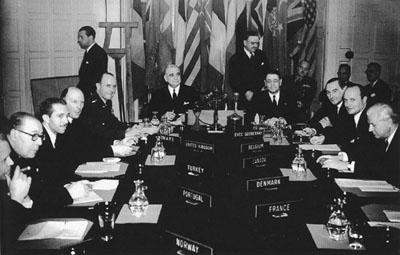
-
Macleans
N.B.'s New Premier
Long before New Brunswick Liberal cabinet minister Camille Thériault formally announced his bid for his party's - and the province's - top job on Jan. 26, his leadership ambitions were a badly kept secret.This article was originally published in Maclean's Magazine on May 11, 1998
"https://thecanadianencyclopedia.ca/images/tce_placeholder.jpg?v=e9dca980c9bdb3aa11e832e7ea94f5d9" // resources/views/front/categories/view.blade.php
https://thecanadianencyclopedia.ca/images/tce_placeholder.jpg?v=e9dca980c9bdb3aa11e832e7ea94f5d9
-
Article
New Brunswick and Confederation
New Brunswick became one of the founding members of the Dominion of Canada on 1 July 1867 when it joined Nova Scotia, Ontario and Quebec in Confederation. Arthur Hamilton Gordon, the lieutenant-governor of New Brunswick, helped organize the Charlottetown Conference (1–9 September 1864), where a federal union of British North American colonies was first discussed. By 1865, however, a majority in the New Brunswick legislature had swung against it. Albert Smith defeated pro-Confederation premier Samuel Tilley in a snap election that year. But the Fenian Raids in 1866 fueled New Brunswick’s sense of insecurity and increased support for Confederation. After Tilley’s party won another election in 1866, the legislature voted 38–1 in favour of Confederation.
"https://d3d0lqu00lnqvz.cloudfront.net/media/media/bb8000df-c2b6-4d69-821d-db39907e5078.jpg" // resources/views/front/categories/view.blade.php
https://d3d0lqu00lnqvz.cloudfront.net/media/media/bb8000df-c2b6-4d69-821d-db39907e5078.jpg
-
Macleans
New Distinct Society Law
This article was originally published in Maclean’s magazine on December 11, 1995. Partner content is not updated. As in the best of elaborately choreographed manoeuvres, it was, on the surface, disarmingly simple.
"https://thecanadianencyclopedia.ca/images/tce_placeholder.jpg?v=e9dca980c9bdb3aa11e832e7ea94f5d9" // resources/views/front/categories/view.blade.php
https://thecanadianencyclopedia.ca/images/tce_placeholder.jpg?v=e9dca980c9bdb3aa11e832e7ea94f5d9