
Browse "Nature & Geography"
-
Article
Provincial Floral Emblems
Floral emblems are generally selected from the flora of the country, nation, state, territory, or province they represent. Tradition dictates that the selected plant be popular and widely found throughout the region.
"https://d3d0lqu00lnqvz.cloudfront.net/Provincial-Floral-Emblems/provincial-floral-emblems-en.jpg" // resources/views/front/categories/view.blade.php
https://d3d0lqu00lnqvz.cloudfront.net/Provincial-Floral-Emblems/provincial-floral-emblems-en.jpg
-
Article
Pseudoscorpion
Pseudoscorpion and false-scorpion are the common names for tiny creatures in the class Arachnida, order Pseudoscorpiones (or Pseudoscorpionida).
"https://d3d0lqu00lnqvz.cloudfront.net/media/media/e9645241-0eeb-42fd-8aba-c143926ecddb.jpg" // resources/views/front/categories/view.blade.php
https://d3d0lqu00lnqvz.cloudfront.net/media/media/e9645241-0eeb-42fd-8aba-c143926ecddb.jpg
-
Article
Ptarmigan in Canada
Ptarmigan are distinguished from other members of the grouse subfamily by their all-white wings. Like other grouse, they are well adapted to cold environments, e.g., nostrils are hidden by feathers, body feathers have a long, downy aftershaft that increases insulation, and toes are feathered. Ptarmigan are the only birds with snow-white winter plumage. Summer plumage is mottled brown. The ptarmigan is the provincial game bird of Newfoundland and Labrador, and the rock ptarmigan is the territorial bird of Nunavut.
"https://d3d0lqu00lnqvz.cloudfront.net/media/media/e17af2d1-1e7f-4962-aef2-a774309f6e3f.jpg" // resources/views/front/categories/view.blade.php
https://d3d0lqu00lnqvz.cloudfront.net/media/media/e17af2d1-1e7f-4962-aef2-a774309f6e3f.jpg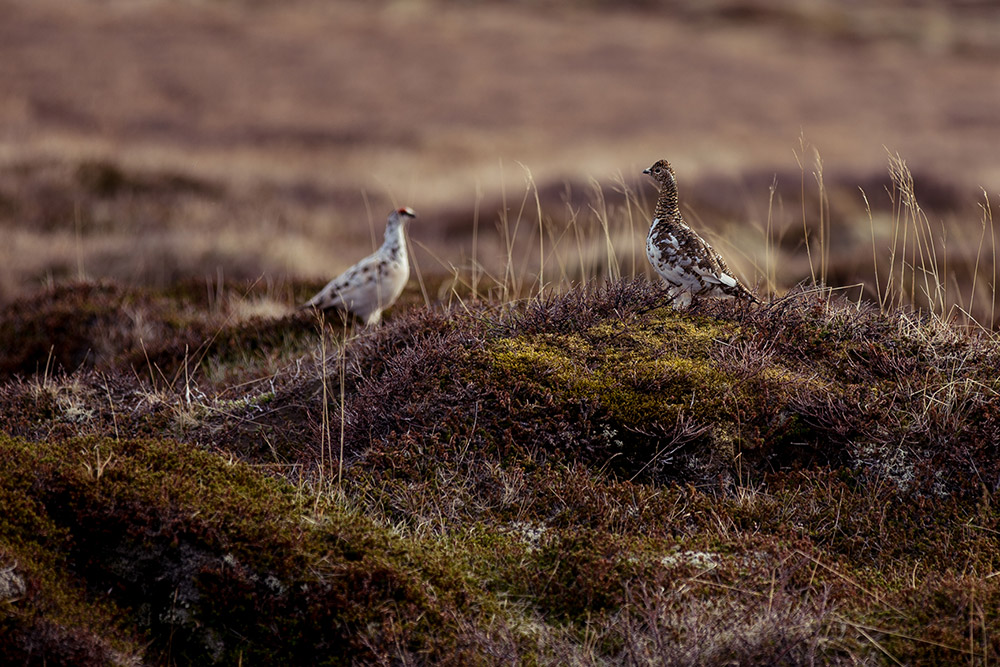
-
Article
Puffins in Canada
Puffin is a common name for three species of medium-sized seabirds of the Auk family. Most commonly, the name refers to the Atlantic puffin (Fratercula arctica), about 26–36 cm long, 460 g, with a wing span of 47–63 cm and a distinctive triangular bill, red with a bluish grey base. The Atlantic puffin is the provincial bird of Newfoundland and Labrador.
"https://d3d0lqu00lnqvz.cloudfront.net/media/media/cb1df95f-1dbb-4df1-90be-50eaee21f53c.jpg" // resources/views/front/categories/view.blade.php
https://d3d0lqu00lnqvz.cloudfront.net/media/media/cb1df95f-1dbb-4df1-90be-50eaee21f53c.jpg
-
Article
Pulse Crops
Pulse crops are members of the family Leguminosae or Fabaceae (see LEGUME). The term "pulse crops" generally refers to those plant species harvested primarily for dry seed that is used as both human food and animal feed.
"https://d3d0lqu00lnqvz.cloudfront.net/media/media/8e804f6a-faf5-40ac-966e-493d9162961b.jpg" // resources/views/front/categories/view.blade.php
https://d3d0lqu00lnqvz.cloudfront.net/media/media/8e804f6a-faf5-40ac-966e-493d9162961b.jpg
-
"https://thecanadianencyclopedia.ca/images/tce_placeholder.jpg?v=e9dca980c9bdb3aa11e832e7ea94f5d9" // resources/views/front/categories/view.blade.php
https://thecanadianencyclopedia.ca/images/tce_placeholder.jpg?v=e9dca980c9bdb3aa11e832e7ea94f5d9
-
Article
Quail
Quail is the name most commonly applied to an Old World species, Coturnix coturnix, of chickenlike birds.
"https://d3d0lqu00lnqvz.cloudfront.net/media/media/9db636ff-cae0-464f-ad48-190866eaeb66.jpg" // resources/views/front/categories/view.blade.php
https://d3d0lqu00lnqvz.cloudfront.net/media/media/9db636ff-cae0-464f-ad48-190866eaeb66.jpg
-
Article
Québec's Postglacial Seas
Between about 100 000 and 12 000 years ago, the whole area of Québec as well as a major part of the northern hemisphere was covered with a thick layer of ice. In the late PLEISTOCENE era, just over 12 000 years ago, Québec underwent a gradual warming of the atmosphere.
"https://d3d0lqu00lnqvz.cloudfront.net/media/media/e3cfe0fb-4ec8-418c-b14c-582f156d72a1.jpg" // resources/views/front/categories/view.blade.php
https://d3d0lqu00lnqvz.cloudfront.net/media/media/e3cfe0fb-4ec8-418c-b14c-582f156d72a1.jpg
-
Article
Queensnake
The queensnake (Regina septemvittata) is a small, non-venomous snake. In Canada, queensnakes are found in Southern Ontario. (See also Snake Species in Canada.) Their range continues south through the Eastern United States, as far as Florida. Queensnakes are semi-aquatic and are commonly found near flowing fresh water, where they almost exclusively feed on freshly moulted crayfish. Queensnakes are endangered, according to the Committee on the Status of Endangered Wildlife in Canada. They are threatened by habitat loss and may be negatively impacted by the introduction of non-native crayfish species.
"https://d3d0lqu00lnqvz.cloudfront.net/Queensnake/QueensnakeBelly.jpeg" // resources/views/front/categories/view.blade.php
https://d3d0lqu00lnqvz.cloudfront.net/Queensnake/QueensnakeBelly.jpeg
-
Article
Quill Lakes
The Quill Lakes are three connected saline lakes in southeastern Saskatchewan. They are located 150 km north of Regina and 152 km east of Saskatoon. From west to east the lakes are named Big Quill, Middle Quill (also known as Mud Lake) and Little Quill. Despite its name, at 181 km2 Little Quill is the second largest of the three lakes. Big Quill is the largest at 307 km2. The Quill Lakes’ elevation is 516 m.
"https://thecanadianencyclopedia.ca/images/tce_placeholder.jpg?v=e9dca980c9bdb3aa11e832e7ea94f5d9" // resources/views/front/categories/view.blade.php
https://thecanadianencyclopedia.ca/images/tce_placeholder.jpg?v=e9dca980c9bdb3aa11e832e7ea94f5d9
-
Article
Rabbit Farming
Rabbit farming, officially called cuniculture (from the species name for wild rabbits, Oryctolagus cuniculus), is a small part of Canadian agriculture, with most production in Ontario and Québec.
"https://d3d0lqu00lnqvz.cloudfront.net/media/media/cb6c0bcf-d5f4-46aa-be4f-5de63ae493dd.jpg" // resources/views/front/categories/view.blade.php
https://d3d0lqu00lnqvz.cloudfront.net/media/media/cb6c0bcf-d5f4-46aa-be4f-5de63ae493dd.jpg
-
Article
Racoon
Racoon was a 26-gun British sloop of war sent to seize Astoria, the American Pacific Fur Company post at the Columbia River mouth, and to establish an outpost there during the War of 1812.
"https://thecanadianencyclopedia.ca/images/tce_placeholder.jpg?v=e9dca980c9bdb3aa11e832e7ea94f5d9" // resources/views/front/categories/view.blade.php
https://thecanadianencyclopedia.ca/images/tce_placeholder.jpg?v=e9dca980c9bdb3aa11e832e7ea94f5d9
-
Article
Radish
Radish (Raphanus sativus) is a hardy annual or biennial vegetable belonging to the Cruciferae family. Roots are mostly rounded with a red exterior and white, acrid flesh.
"https://d3d0lqu00lnqvz.cloudfront.net/media/media/876c15d2-b9d3-4c88-9be3-a60d0814c851.jpg" // resources/views/front/categories/view.blade.php
https://d3d0lqu00lnqvz.cloudfront.net/media/media/876c15d2-b9d3-4c88-9be3-a60d0814c851.jpg
-
Article
Ragweed
Ragweed is an annual or perennial plant of the genus Ambrosia, family Compositae or Asteraceae. Fifteen species are native to North America; 3 occur across Canada: common ragweed (A. artemisiifolia), perennial ragweed (A. coronopifolia) and giant ragweed (A. trifida).
"https://thecanadianencyclopedia.ca/images/tce_placeholder.jpg?v=e9dca980c9bdb3aa11e832e7ea94f5d9" // resources/views/front/categories/view.blade.php
https://thecanadianencyclopedia.ca/images/tce_placeholder.jpg?v=e9dca980c9bdb3aa11e832e7ea94f5d9
-
"https://thecanadianencyclopedia.ca/images/tce_placeholder.jpg?v=e9dca980c9bdb3aa11e832e7ea94f5d9" // resources/views/front/categories/view.blade.php
https://thecanadianencyclopedia.ca/images/tce_placeholder.jpg?v=e9dca980c9bdb3aa11e832e7ea94f5d9