
Browse "Nature & Geography"
-
Article
Kinglet
The kinglet is a tiny, highly active, insectivorous songbird, olive grey with brightly coloured crown, sharp, slender bill and short, stubby tail.
"https://thecanadianencyclopedia.ca/images/tce_placeholder.jpg?v=e9dca980c9bdb3aa11e832e7ea94f5d9" // resources/views/front/categories/view.blade.php
https://thecanadianencyclopedia.ca/images/tce_placeholder.jpg?v=e9dca980c9bdb3aa11e832e7ea94f5d9
-
Macleans
Kirkland Lake Eyes Hazardous Waste Plant
BILL ENOUY IS PROUD of his town. Oh, the jolly looking mayor of KIRKLAND LAKE, Ont., knows the main street needs a facelift, and that something should be done about the shortage of family physicians.This article was originally published in Maclean's Magazine on November 18, 2002
"https://thecanadianencyclopedia.ca/images/tce_placeholder.jpg?v=e9dca980c9bdb3aa11e832e7ea94f5d9" // resources/views/front/categories/view.blade.php
https://thecanadianencyclopedia.ca/images/tce_placeholder.jpg?v=e9dca980c9bdb3aa11e832e7ea94f5d9
-
Article
Klondike Gold Rush
The discovery of gold in the Yukon in 1896 led to a stampede to the Klondike region between 1897 and 1899. This led to the establishment of Dawson City (1896) and subsequently, the Yukon Territory (1898). The Klondike gold rush solidified the public’s image of the North as more than a barren wasteland and left a body of literature that has popularized and romanticized the Yukon. (See also Gold Rushes in Canada)
"https://d3d0lqu00lnqvz.cloudfront.net/media/media/f8badbbb-95b8-44cf-a053-5589845ee1ef.jpg" // resources/views/front/categories/view.blade.php
https://d3d0lqu00lnqvz.cloudfront.net/media/media/f8badbbb-95b8-44cf-a053-5589845ee1ef.jpg
-
Macleans
Kobe Earthquake
Bridges, train trestles and elevated highways collapsed, sending hapless passengers plummeting to their deaths. Apartment buildings crumpled and fell, crushing terrified occupants still huddled in their beds.This article was originally published in Maclean's Magazine on January 30, 1995
"https://thecanadianencyclopedia.ca/images/tce_placeholder.jpg?v=e9dca980c9bdb3aa11e832e7ea94f5d9" // resources/views/front/categories/view.blade.php
https://thecanadianencyclopedia.ca/images/tce_placeholder.jpg?v=e9dca980c9bdb3aa11e832e7ea94f5d9
-
Article
Kohlrabi
Kohlrabi (Brassica oleracea, Gongylodes Group), sometimes called stem turnip or cabbage turnip, an important Canadian garden vegetable of the Cruciferae family.
"https://d3d0lqu00lnqvz.cloudfront.net/media/media/ef29012b-714b-4166-b09e-7a34416efcd3.jpg" // resources/views/front/categories/view.blade.php
https://d3d0lqu00lnqvz.cloudfront.net/media/media/ef29012b-714b-4166-b09e-7a34416efcd3.jpg
-
Macleans
Kyoto Accord Opposition Growing
In Alberta political circles, Lorne Taylor is sometimes referred to as the "egghead redneck." It is a mark of the man that Taylor, who is Alberta's environment minister and who holds a Ph.D. in educational psychology, takes more umbrage at the first half of that moniker than the latter.This article was originally published in Maclean's Magazine on October 14, 2002
"https://thecanadianencyclopedia.ca/images/tce_placeholder.jpg?v=e9dca980c9bdb3aa11e832e7ea94f5d9" // resources/views/front/categories/view.blade.php
https://thecanadianencyclopedia.ca/images/tce_placeholder.jpg?v=e9dca980c9bdb3aa11e832e7ea94f5d9
-
Article
Labrador Retriever
The Labrador retriever is one of four remaining Canadian dog breeds (see also Dogs in Canada). Its history begins at the turn of the 16th century on the island of Newfoundland. Here, its ancestors were retrievers of fish and game. The breed was further developed in England in the 19th century to assist in hunting. With a friendly temperament, the Labrador retriever is popular not only as a working dog but also as a family dog. In Canada, the Labrador has been the most popular dog for more than 25 years.
"https://d3d0lqu00lnqvz.cloudfront.net/LabradorRetriever/ChocolateLab.jpg" // resources/views/front/categories/view.blade.php
https://d3d0lqu00lnqvz.cloudfront.net/LabradorRetriever/ChocolateLab.jpg
-
Article
Lac La Croix Indigenous Pony
The Lac La Croix Indigenous pony, also known as the Lac La Croix Indian pony or the Ojibwa pony, is thought to be the only existing breed of horse developed by Indigenous people in Canada. It takes its name from Lac La Croix First Nation in northwestern Ontario, where it was last found in the wild. Known in the Ojibwa language as bebezhigooganzhii or mishdatim (meaning “one big toenail”), it is a small, semi-feral horse that once lived in the wild and worked as a service animal — but is also considered a spirit animal — for the Ojibwa people of northwestern Ontario and northern Minnesota. Today, this friendly, all-purpose breed is used in equine therapy, Indigenous heritage programs and tourism. Conservation efforts in Canada and the United States strive to protect the breed, which is critically endangered.
"https://d3d0lqu00lnqvz.cloudfront.net/media/media/1ef4a37a-9a7a-430d-bb76-270783327204.jpg" // resources/views/front/categories/view.blade.php
https://d3d0lqu00lnqvz.cloudfront.net/media/media/1ef4a37a-9a7a-430d-bb76-270783327204.jpg
-
Article
Lacewing
Lacewing is the common name for small, fragile insects of the 2 most common families (Chrysopidae, green lacewings; Hemerobiidae, brown lacewings) of order Neuroptera.
"https://d3d0lqu00lnqvz.cloudfront.net/media/media/e8007af8-8d70-4067-8d62-17a758d4bdc9.jpg" // resources/views/front/categories/view.blade.php
https://d3d0lqu00lnqvz.cloudfront.net/media/media/e8007af8-8d70-4067-8d62-17a758d4bdc9.jpg
-
Article
Lady's Slipper
Lady's slipper is the common name for some members of the orchid family, in which modified petals (labella) fold inward to make the toe of the "slipper." Insects must pass through the structure to obtain nectar, thereby pollinating the plant. The lady's slipper was selected (1947) as the Provincial Floral Emblem of PEI. The showy lady's slipper (C. reginae) was chosen first, but because it is rare, it was replaced in 1965 by the pink lady's slipper.
"https://d3d0lqu00lnqvz.cloudfront.net/oldgrowthforests/lady-slippers.jpg" // resources/views/front/categories/view.blade.php
https://d3d0lqu00lnqvz.cloudfront.net/oldgrowthforests/lady-slippers.jpg
-
Article
Lagomorpha
Lagomorpha, order of mammals containing 2 families: the rabbits and hares (Leporidae), and the small, lesser-known pikas (Ochotonidae).
"https://d3d0lqu00lnqvz.cloudfront.net/media/media/8e71f9da-22dd-4449-bd01-06be2e3f6ddf.jpg" // resources/views/front/categories/view.blade.php
https://d3d0lqu00lnqvz.cloudfront.net/media/media/8e71f9da-22dd-4449-bd01-06be2e3f6ddf.jpg
-
Article
Lake Agassiz
Formed 11,500 years ago, Lake Agassiz was the largest glacial lake in North America, at about 1,500 km long, over 1,100 km wide and 210 m deep. Its location covered parts of what is now Manitoba, Ontario, Saskatchewan, North Dakota and Minnesota.
"https://d3d0lqu00lnqvz.cloudfront.net/2091302531_8e5d16b234_k.jpg" // resources/views/front/categories/view.blade.php
https://d3d0lqu00lnqvz.cloudfront.net/2091302531_8e5d16b234_k.jpg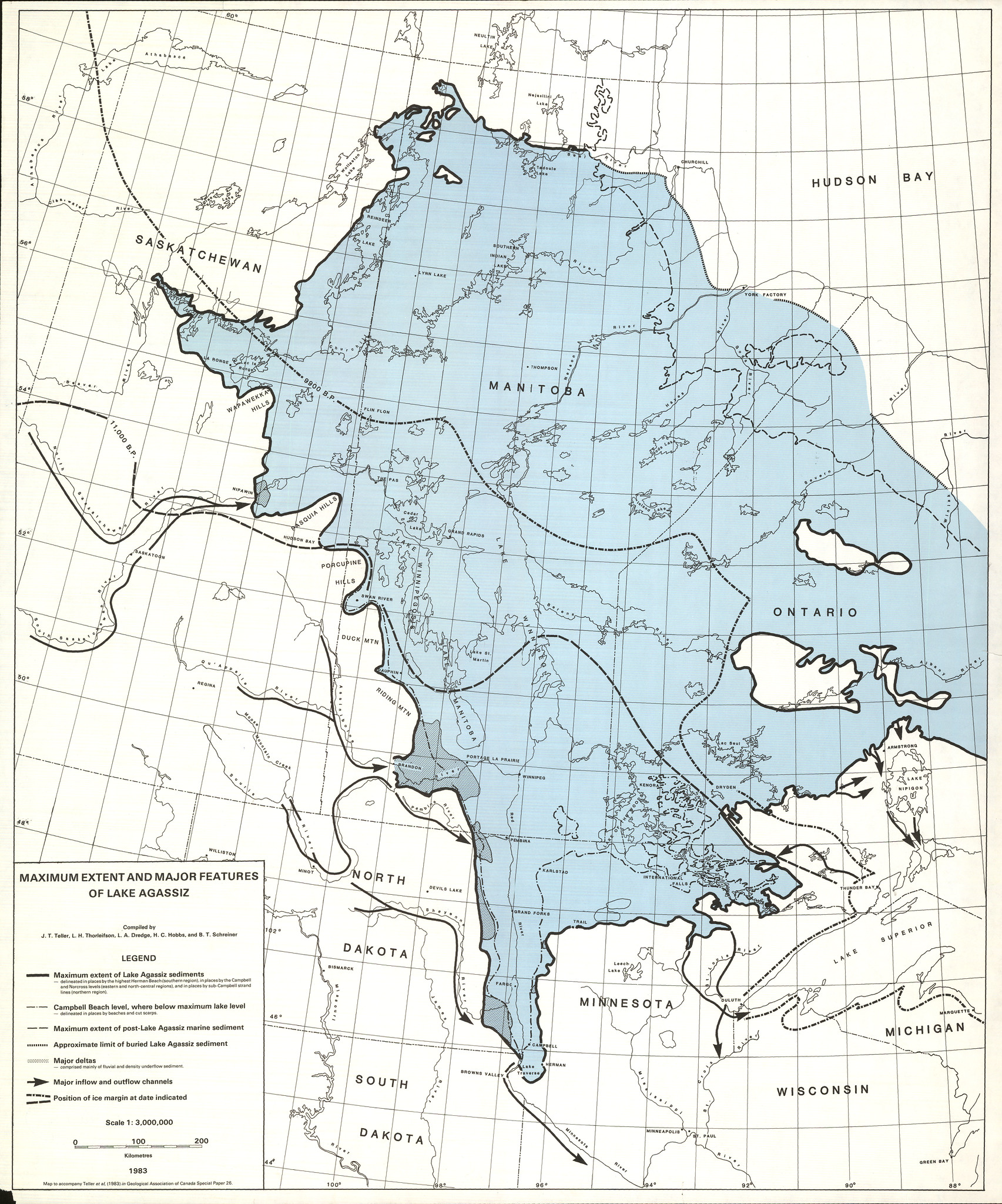
-
Article
Lakes in Canadian Music
With the exception of the Great Lakes which border Ontario on the south, Canada's lakes no longer play a significant role in the country's development; rather they serve recreation and tourism, provide hydro-power, and are valued for their natural beauty.
"https://thecanadianencyclopedia.ca/images/tce_placeholder.jpg?v=e9dca980c9bdb3aa11e832e7ea94f5d9" // resources/views/front/categories/view.blade.php
https://thecanadianencyclopedia.ca/images/tce_placeholder.jpg?v=e9dca980c9bdb3aa11e832e7ea94f5d9
-
Article
Lampreys in Canada
Lampreys are a group of primitive vertebrates which, together with hagfish and various extinct forms, comprise the fish class Agnatha. Lampreys occur in both the northern and southern hemispheres. About 41 extant species are known, as well as fossil forms dating from the Mississippian and Pennsylvanian (353–300 million years ago) in the US. Twenty-three species are found in North America, of which 21 are indigenous. Eleven species occur in Canada.
"https://d3d0lqu00lnqvz.cloudfront.net/media/media/31c5a075-649d-4cef-bc38-72753702d9cd.jpg" // resources/views/front/categories/view.blade.php
https://d3d0lqu00lnqvz.cloudfront.net/media/media/31c5a075-649d-4cef-bc38-72753702d9cd.jpg
-
Article
Land
Land, in law, is an area of Earth's solid surface that is the property of an individual, group or state. Hence, the Canadian polity controls a total of 9,215,430 km2 of land and 755,180 km2 of freshwater, for a total territory of 9,970,610 km2, the second-largest national territory in the world after Russia.
"https://d3d0lqu00lnqvz.cloudfront.net/georgianbay/Beausoleil-Island-Coast.jpg" // resources/views/front/categories/view.blade.php
https://d3d0lqu00lnqvz.cloudfront.net/georgianbay/Beausoleil-Island-Coast.jpg