
Browse "Nature & Geography"
-
Article
Dinosaur Hunting in Western Canada
Most early discoveries were made in artificial excavations, eg, rock quarries or coal mines.
"https://d3d0lqu00lnqvz.cloudfront.net/media/media/e8e23bed-66e7-4173-9e92-b61c0b06e940.jpg" // resources/views/front/categories/view.blade.php
https://d3d0lqu00lnqvz.cloudfront.net/media/media/e8e23bed-66e7-4173-9e92-b61c0b06e940.jpg
-
Article
Dinosaurs Found in Canada
Canada is home to some of the richest deposits of dinosaur fossils in the world (see also Dinosaurs and Canada). The vast majority of the dinosaurs discovered in Canada are from Alberta, where the rising Rocky Mountains at the end of the Cretaceous period and a network of ancient rivers provided the sediment necessary for burying and preserving their remains. The names of many of the 88 dinosaurs listed below pay homage to the province, including Albertosaurus sarcophagus, Edmontosaurus regalis and Ornithomimus edmontonicus. Others honour prominent people in Canadian paleontology, for example, Lambeosaurus for Lawrence Lambe, a paleontologist active at the turn of the 20th century, Epichirostenotes curriei for Philip Currie, a paleontologist and the founder of the Royal Tyrrell Museum and Borealopelta markmitchelli for Mark Mitchell, an RTM technician who spent 7,000 hours removing rock from the fossil.
"https://d3d0lqu00lnqvz.cloudfront.net/media/new_article_images/Thanatotheristes/ThanatotheristesKuether.jpg" // resources/views/front/categories/view.blade.php
https://d3d0lqu00lnqvz.cloudfront.net/media/new_article_images/Thanatotheristes/ThanatotheristesKuether.jpg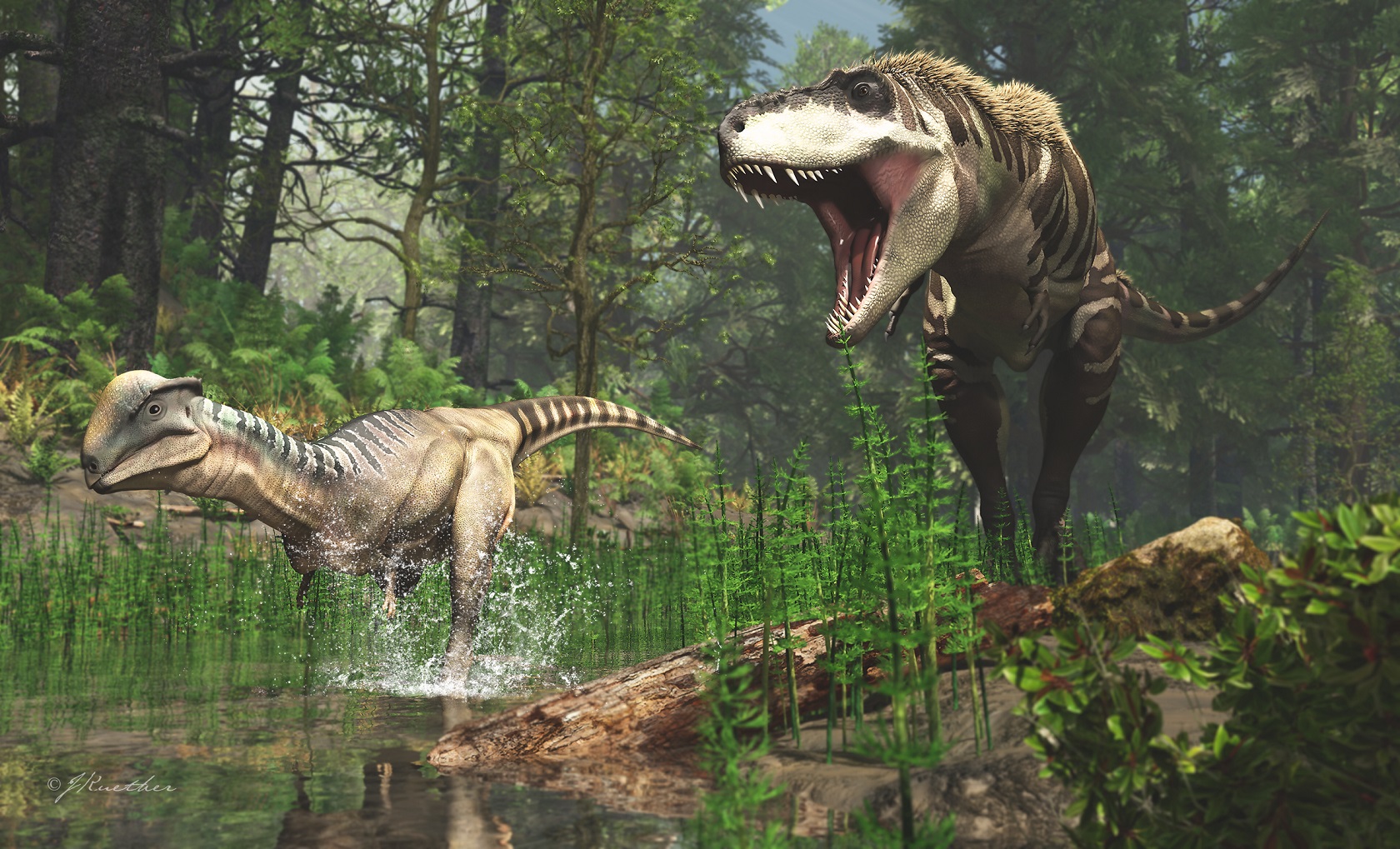
-
Article
Dipper
The dipper (Cinclidae) family of birds comprises 5 species of birds known colloquially as water ouzel.
"https://d3d0lqu00lnqvz.cloudfront.net/media/media/e2eb8f1d-d403-4bf9-87d8-cda7c2ff2e86.jpg" // resources/views/front/categories/view.blade.php
https://d3d0lqu00lnqvz.cloudfront.net/media/media/e2eb8f1d-d403-4bf9-87d8-cda7c2ff2e86.jpg
-
Article
Dobsonfly
The dobsonfly is a large (100-140 mm), soft-bodied freshwater insect of order Megaloptera, family Corydalidae; smaller forms are called fishflies.
"https://thecanadianencyclopedia.ca/images/tce_placeholder.jpg?v=e9dca980c9bdb3aa11e832e7ea94f5d9" // resources/views/front/categories/view.blade.php
https://thecanadianencyclopedia.ca/images/tce_placeholder.jpg?v=e9dca980c9bdb3aa11e832e7ea94f5d9
-
Article
Dock
Dock, herbaceous plant of genus Rumex, family Polygonaceae (buckwheat); most docks are perennial.
"https://d3d0lqu00lnqvz.cloudfront.net/media/media/455358cb-1299-4193-8369-04e4d7853231.jpg" // resources/views/front/categories/view.blade.php
https://d3d0lqu00lnqvz.cloudfront.net/media/media/455358cb-1299-4193-8369-04e4d7853231.jpg
-
Article
Dogs in Canada
Dog (Canis familiaris) is a carnivorous mammal, and probably the first domesticated animal. In Canada, dogs were first kept by Indigenous peoples. The Canadian Kennel Club recognizes 187 breeds, five of which are uniquely Canadian: the Tahltan bear dog, the Canadian Inuit dog, the Nova Scotia duck-tolling retriever, the Newfoundland dog and the Labrador retriever. A sixth dog breed indigenous to Canada, the Salish woolly dog, went extinct before the Canadian Kennel Club officially registered it as a breed.
"https://d3d0lqu00lnqvz.cloudfront.net/media/media/deecf112-740f-4f90-9728-1699df21682a.jpg" // resources/views/front/categories/view.blade.php
https://d3d0lqu00lnqvz.cloudfront.net/media/media/deecf112-740f-4f90-9728-1699df21682a.jpg
-
Article
Dogwood
Dogwood (Cornaceae), family of perennial herbaceous plants, trees and shrubs, represented in North America by about 15 members of the genus Cornus.
"https://thecanadianencyclopedia.ca/images/tce_placeholder.jpg?v=e9dca980c9bdb3aa11e832e7ea94f5d9" // resources/views/front/categories/view.blade.php
https://thecanadianencyclopedia.ca/images/tce_placeholder.jpg?v=e9dca980c9bdb3aa11e832e7ea94f5d9
-
Article
Dolphin and Porpoise
Dolphin and porpoise are the common names for small, toothed mammals of the order Cetacea, which also includes whales. They are found in all oceans and many major river systems. In North America, dolphins, with long snouts, are distinguished from porpoises, with blunt heads, but the terms are sometimes applied interchangeably to many small toothed whales, including members of the families Delphinidae, Phocoenidae, Stenidae and Platanistidae.
"https://d3d0lqu00lnqvz.cloudfront.net/media/media/28264f26-4fe4-4487-8190-683ffef8a53c.jpg" // resources/views/front/categories/view.blade.php
https://d3d0lqu00lnqvz.cloudfront.net/media/media/28264f26-4fe4-4487-8190-683ffef8a53c.jpg
-
Article
Dorion School Bus–Train Crash
A collision between a school bus and a freight train on 7 October 1966 killed 19 students from Cité-des-Jeunes secondary school near Vaudreuil, Quebec, and their bus driver. The crash is among the worst road disasters in Canadian history.
"https://thecanadianencyclopedia.ca/images/tce_placeholder.jpg?v=e9dca980c9bdb3aa11e832e7ea94f5d9" // resources/views/front/categories/view.blade.php
https://thecanadianencyclopedia.ca/images/tce_placeholder.jpg?v=e9dca980c9bdb3aa11e832e7ea94f5d9
-
Article
Dove
Dove is the name applied to certain species of the pigeon family, especially to those of smaller size.
"https://d3d0lqu00lnqvz.cloudfront.net/media/media/aef25c68-fffc-4656-849c-7f7924ae5b48.jpg" // resources/views/front/categories/view.blade.php
https://d3d0lqu00lnqvz.cloudfront.net/media/media/aef25c68-fffc-4656-849c-7f7924ae5b48.jpg
-
Article
Dragonfly
Dragonfly, common name for robust carnivorous insects of order Odonata [Gk "toothed," referring to mouth parts].
"https://d3d0lqu00lnqvz.cloudfront.net/media/media/61b31847-6ec0-4449-80f4-4d16eb081624.jpg" // resources/views/front/categories/view.blade.php
https://d3d0lqu00lnqvz.cloudfront.net/media/media/61b31847-6ec0-4449-80f4-4d16eb081624.jpg
-
Article
Droughts in Canada
Drought is the condition of critically low water supply caused by persistently below-normal precipitation. Drought begins with decreased soil moisture as well as surface and underground water supplies that, in turn, lead to suppressed plant growth and restrictions in the use of surface and underground water supplies for domestic, municipal, agricultural and industrial purposes.
"https://d3d0lqu00lnqvz.cloudfront.net/media/media/ea2328a1-2ce9-4f2e-be69-d92cbfb2ae7a.jpg" // resources/views/front/categories/view.blade.php
https://d3d0lqu00lnqvz.cloudfront.net/media/media/ea2328a1-2ce9-4f2e-be69-d92cbfb2ae7a.jpg
-
Editorial
Drought in Palliser's Triangle
The following article is an editorial written by The Canadian Encyclopedia staff. Editorials are not usually updated.
"https://thecanadianencyclopedia.ca/images/tce_placeholder.jpg?v=e9dca980c9bdb3aa11e832e7ea94f5d9" // resources/views/front/categories/view.blade.php
https://thecanadianencyclopedia.ca/images/tce_placeholder.jpg?v=e9dca980c9bdb3aa11e832e7ea94f5d9
-
Article
Drumlin
Drumlins are smooth, half-egg-shaped or ellipsoidal hills which formed beneath Quaternary Glaciers. Drumlins [Gaelic druim, "hill"] were first described in Ireland. They lie parallel to the direction of ice movement, the blunt (stoss) end facing up-glacier, the lee sloping down-glacier. Drumlins may be up to 50 m high and several kilometres long, with an average length-to-width ratio of 2:1 to 3:1. Highly elongated drumlins are often called drumlinoids. Drumlins occur in broad fields or swarms, up-glacier from major end Moraines in Europe and North America. Swarms of several thousands occur in Nova Scotia, southern Ontario and the Thelon Plain of the Northwest Territories and Nunavut; smaller groups occur in most other provinces.
"https://d3d0lqu00lnqvz.cloudfront.net/lakesincanada/Glacial-Processes.jpg" // resources/views/front/categories/view.blade.php
https://d3d0lqu00lnqvz.cloudfront.net/lakesincanada/Glacial-Processes.jpg
-
Article
Dry Bean
Common bean refers to both bean plants grown solely for immature fleshy pods (garden or green bean) and those grown for dry seeds (dry bean).
"https://d3d0lqu00lnqvz.cloudfront.net/media/media/8e804f6a-faf5-40ac-966e-493d9162961b.jpg" // resources/views/front/categories/view.blade.php
https://d3d0lqu00lnqvz.cloudfront.net/media/media/8e804f6a-faf5-40ac-966e-493d9162961b.jpg