Browse "Communities & Sociology"
-
Article
Vancouver Island Coal Strike
Vancouver Island Coal Strike began on 16 Sept 1912 when miners at Cumberland declared a "holiday" to protest the firing of Oscar Mottishaw. Canadian Collieries, recent purchaser of the Dunsmuir Mines, locked them out and hired Chinese and recruits from Britain and the US as strikebreakers.
"https://d3d0lqu00lnqvz.cloudfront.net/media/media/11058644-57a7-4aa7-8aab-685691a5d1da.jpg" // resources/views/front/categories/view.blade.php
https://d3d0lqu00lnqvz.cloudfront.net/media/media/11058644-57a7-4aa7-8aab-685691a5d1da.jpg
-
Article
Vancouver Women's Musical Society
Vancouver Women's Musical Society (formerly the Vancouver Woman's Musical Club). Founded in 1905 by Mrs B.T. Rogers, Mrs J.J. Banfield, Mrs C.M. Beecher, (first president 1905-7), and others and incorporated in 1916 under the guidance of Esther Beecher Weld and Mrs Walter Coulthard.
"https://thecanadianencyclopedia.ca/images/tce_placeholder.jpg?v=e9dca980c9bdb3aa11e832e7ea94f5d9" // resources/views/front/categories/view.blade.php
https://thecanadianencyclopedia.ca/images/tce_placeholder.jpg?v=e9dca980c9bdb3aa11e832e7ea94f5d9
-
Article
Vegetarianism
Vegetarianism describes the diet (eg, green vegetables, cereals, seeds, fruit and nuts, roots and perhaps eggs and dairy products) of those who abstain from food of animal sources. Many Canadians have chosen a vegetarian diet for economic, religious, moral or health reasons.
"https://thecanadianencyclopedia.ca/images/tce_placeholder.jpg?v=e9dca980c9bdb3aa11e832e7ea94f5d9" // resources/views/front/categories/view.blade.php
https://thecanadianencyclopedia.ca/images/tce_placeholder.jpg?v=e9dca980c9bdb3aa11e832e7ea94f5d9
-
Article
The Vertical Mosaic
The Vertical Mosaic (TVM) is the title of an iconic book by Canadian sociologist John Porter (1921‒79). Published in 1965, TVM is Porter’s most famous and influential book, and established him as one of the major figures in Canadian social science in the 20th century.
"https://thecanadianencyclopedia.ca/images/tce_placeholder.jpg?v=e9dca980c9bdb3aa11e832e7ea94f5d9" // resources/views/front/categories/view.blade.php
https://thecanadianencyclopedia.ca/images/tce_placeholder.jpg?v=e9dca980c9bdb3aa11e832e7ea94f5d9
-
Article
Vision Quest
Coined by 19th century anthropologists, the term “vision quest” describes a spiritual journey in various Indigenous cultures in which participants, often adolescents, are said to receive sacred knowledge and strength from the spirit world. Practised as a rite of passage among some Indigenous cultures in North America, such as the Siksika (Blackfoot), Cree, Anishinaabe (including the Ojibwe) and Inuit, vision quests reflect the role of spirituality and contemplative thinking in Indigenous cultures, and provide an important connection between the participant, the Creator and nature. Though reduced as a practice following colonization, vision quests remain part of the cultural traditions of Indigenous populations in Canada in the modern era.
"https://d3d0lqu00lnqvz.cloudfront.net/media/media/8872e55d-4b42-4de1-ad17-b9b614458c09.jpg" // resources/views/front/categories/view.blade.php
https://d3d0lqu00lnqvz.cloudfront.net/media/media/8872e55d-4b42-4de1-ad17-b9b614458c09.jpg
-
Article
Voyageurs
Voyageurs were independent contractors, workers or minor partners in companies involved in the fur trade. They were licensed to transport goods to trading posts and were usually forbidden to do any trading of their own. The fur trade changed over the years, as did the groups of men working in it. In the 17th century, voyageurs were often coureurs des bois — unlicensed traders responsible for delivering trade goods from suppliers to Indigenous peoples. The implementation of the trading licence system in 1681 set voyageurs apart from coureurs des bois, who were then considered outlaws of sorts. Today, the word voyageur, like the term coureur des bois, evokes the romantic image of men canoeing across the continent in search of furs. Their life was full of perilous adventure, gruelling work and cheerful camaraderie.
"https://d3d0lqu00lnqvz.cloudfront.net/media/media/50d0c290-345d-4655-b501-3cfa471dfdb7.jpg" // resources/views/front/categories/view.blade.php
https://d3d0lqu00lnqvz.cloudfront.net/media/media/50d0c290-345d-4655-b501-3cfa471dfdb7.jpg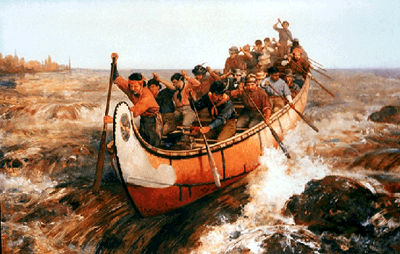
-
Article
Wartime Elections Act
The Wartime Elections Act of 1917 gave the vote to female relatives of Canadian soldiers serving overseas in the First World War. It also took the vote away from many Canadians who had immigrated from “enemy” countries. The Act was passed by Prime Minister Robert Borden’s Conservative government in an attempt to gain votes in the 1917 election. It ended up costing the Conservatives support among certain groups for years to come. The Act has a contentious legacy. It granted many women the right to vote, but it also legitimized in law many anti-immigrant sentiments.
"https://d3d0lqu00lnqvz.cloudfront.net/media/media/6e19f5db-f5f6-4776-baf8-40a98b38b97d.jpg" // resources/views/front/categories/view.blade.php
https://d3d0lqu00lnqvz.cloudfront.net/media/media/6e19f5db-f5f6-4776-baf8-40a98b38b97d.jpg
-
Article
Welfare State
The welfare state in Canada is a multi-billion dollar system of government programs that transfer money and services to Canadians to deal with an array of societal needs.
"https://d3d0lqu00lnqvz.cloudfront.net/media/media/596ef79e-2f5f-4c7b-974d-2d7c77a5a5a4.jpg" // resources/views/front/categories/view.blade.php
https://d3d0lqu00lnqvz.cloudfront.net/media/media/596ef79e-2f5f-4c7b-974d-2d7c77a5a5a4.jpg
-
Article
Windsor Ford Strike of 1945
The Windsor Ford Strike was a 99-day strike from 12 September to 19 December 1945 by 11,000 employees of the Windsor, Ontario, Ford Motor Company plant. Some 8,000 auto workers from other plants also participated. The Ford workers, who were led by the United Automobile Workers of Canada (UAW), demanded recognition of their union by Ford and mandatory membership for all plant workers. The strike was ultimately resolved through binding arbitration under Supreme Court Justice Ivan C. Rand and resulted in the widely used Rand Formula.
"https://d3d0lqu00lnqvz.cloudfront.net/media/media/57fe6b52-3005-46d1-9277-819796270c5e.jpg" // resources/views/front/categories/view.blade.php
https://d3d0lqu00lnqvz.cloudfront.net/media/media/57fe6b52-3005-46d1-9277-819796270c5e.jpg
-
Editorial
Winnipeg General Strike: Canada's Most Influential Strike
The following article is an editorial written by The Canadian Encyclopedia staff. Editorials are not usually updated. An eerie calm descended on the streets of Winnipeg on the morning of May 15, 1919. The street cars and delivery wagons lay idle. Some 50,000 tradesmen, labourers, city and provincial employees had walked off the job, leaving the city paralyzed. It was North America's first general strike.
"https://thecanadianencyclopedia.ca/images/tce_placeholder.jpg?v=e9dca980c9bdb3aa11e832e7ea94f5d9" // resources/views/front/categories/view.blade.php
https://thecanadianencyclopedia.ca/images/tce_placeholder.jpg?v=e9dca980c9bdb3aa11e832e7ea94f5d9
-
Article
Winter Festivals
Quebec Winter Carnival night parade, February 16, 2013 in Quebec City. \r\nImage: The Canadian Press/photographer Jacques\r\nBoissinot.\r\nPreviousNext In addition to the hardships of establishing themselves in a new land, the enormous toil involved in clearing and cultivating vast areas of wilderness and establishing the formal societal structures that would enable them to cooperatively survive in a new and unfamiliar environment, Canada's early settlers were faced with a climate unlike any that many of them had experienced...
"https://d3d0lqu00lnqvz.cloudfront.net/media/media/1d63338e-549f-4de1-9c07-a834ab64dbfc.jpg" // resources/views/front/categories/view.blade.php
https://d3d0lqu00lnqvz.cloudfront.net/media/media/1d63338e-549f-4de1-9c07-a834ab64dbfc.jpg
-
Article
Women and Education
Although women have always been well represented in schools as students and teachers, it is possible, by examining women's participation in schooling, to understand how that participation has both reflected and produced the unequal position of women in society.
"https://thecanadianencyclopedia.ca/images/tce_placeholder.jpg?v=e9dca980c9bdb3aa11e832e7ea94f5d9" // resources/views/front/categories/view.blade.php
https://thecanadianencyclopedia.ca/images/tce_placeholder.jpg?v=e9dca980c9bdb3aa11e832e7ea94f5d9
-
Article
Women and Health
If life expectancy is any indication of health, Canadian women are, on average, much healthier than they were 70 years ago. The life expectancy of female babies born in 1921 was 61 while female babies born today are expected to live to age 82.
"https://thecanadianencyclopedia.ca/images/tce_placeholder.jpg?v=e9dca980c9bdb3aa11e832e7ea94f5d9" // resources/views/front/categories/view.blade.php
https://thecanadianencyclopedia.ca/images/tce_placeholder.jpg?v=e9dca980c9bdb3aa11e832e7ea94f5d9
-
Article
Women and the Law
Women have looked to the law as a tool to change their circumstances, while at the same time the law is one of the instruments which confirms their dependent status as citizens (see Status of Women). The first phase of the Women's Movement, in proclaiming that women were capable of reason as well as reproduction and nurturing, claimed a place for women in the public sphere, while also relying upon the concept of "separate spheres" to delineate their areas of strength and competence.
"https://thecanadianencyclopedia.ca/images/tce_placeholder.jpg?v=e9dca980c9bdb3aa11e832e7ea94f5d9" // resources/views/front/categories/view.blade.php
https://thecanadianencyclopedia.ca/images/tce_placeholder.jpg?v=e9dca980c9bdb3aa11e832e7ea94f5d9
-
Article
Women in the Labour Force
Women are considered labour force participants only if they work outside the home. In the past women have been expected to be in the labour force only until they marry; this reflects the historical, idealized notion of a society in which the man is the breadwinner and the woman the homemaker.
"https://d3d0lqu00lnqvz.cloudfront.net/media/media/57bf0875-fdbe-4d5c-8309-1ab4037ceaeb.jpg" // resources/views/front/categories/view.blade.php
https://d3d0lqu00lnqvz.cloudfront.net/media/media/57bf0875-fdbe-4d5c-8309-1ab4037ceaeb.jpg