Browse "Communities & Sociology"
-
Article
Inuit Experiences at Residential School
Residential schools were government-sponsored religious schools created to assimilate Indigenous children into Euro-Canadian culture. Schools in the North were run by missionaries for nearly a century before the federal government began to open new, so-called modern institutions in the 1950s. This was less than a decade after a Special Joint Committee (see Indigenous Suffrage) found that the system was ineffectual. The committee’s recommendations led to the eventual closure of residential schools across the country.
"https://d3d0lqu00lnqvz.cloudfront.net/InuitResidentialSchool/Inuit-Residenital-School (Library and Archives Canada_PA-042133).jpg" // resources/views/front/categories/view.blade.php
https://d3d0lqu00lnqvz.cloudfront.net/InuitResidentialSchool/Inuit-Residenital-School (Library and Archives Canada_PA-042133).jpg.jpg)
-
Article
Inuit High Arctic Relocations in Canada
In 1953 and 1955, the Royal Canadian Mounted Police, acting as representatives of the Department of Resources and Development, moved approximately 92 Inuit from Inukjuak, formerly called Port Harrison, in Northern Quebec, and Mittimatalik (Pond Inlet), in what is now Nunavut, to settle two locations on the High Arctic islands. It has been argued that the Government of Canada ordered the relocations to establish Canadian sovereignty in the Arctic, and proposed to Inuit the move, promising improved living conditions. The Inuit were assured plentiful wildlife, but soon discovered that they had been misled, and endured hardships. The effects have lingered for generations. The Inuit High Arctic relocations are often referred to as a “dark chapter” in Canadian history, and an example of how the federal government forced changes that fundamentally affected (and continue to affect) Inuit lives.
"https://d3d0lqu00lnqvz.cloudfront.net/media/media/72b158ab-21db-4572-9fec-db8a9548c9cf.jpg" // resources/views/front/categories/view.blade.php
https://d3d0lqu00lnqvz.cloudfront.net/media/media/72b158ab-21db-4572-9fec-db8a9548c9cf.jpg
-
Article
Inuit Tapiriit Kanatami (ITK)
Inuit Tapiriit Kanatami (formerly known as the Eskimo Brotherhood of Canada) is a national advocacy organization that promotes awareness about political, social, cultural and environmental issues that impact Inuit communities, from the Inuvialuit Settlement Region in the Northwest Territories, to Nunavut, Nunavik in Northern Québec, Nunatsiavut in Northern Labrador and land claims regions.
"https://d3d0lqu00lnqvz.cloudfront.net/media/media/d3f189ee-7d9b-4e59-8dd8-5840852adf92.jpg" // resources/views/front/categories/view.blade.php
https://d3d0lqu00lnqvz.cloudfront.net/media/media/d3f189ee-7d9b-4e59-8dd8-5840852adf92.jpg
-
Article
Ipperwash Crisis
The Ipperwash Crisis took place in 1995 on land in and around Ontario’s Ipperwash Provincial Park, which was claimed by the Kettle and Stony Point First Nation. The underlying cause of the crisis was the appropriation of the Stoney Point Reserve in 1942 by the federal government for use as a military camp. After repeated requests for the land to be returned, members of the Stony Point First Nation occupied the camp in 1993 and in 1995. On 4 September 1995 protesters also occupied Ipperwash Provincial Park nearby. Tension between the protesters and the OPP increased, resulting in a confrontation on 6 September 1995 during which Dudley George, an Ojibwa protestor, was killed.
"https://d3d0lqu00lnqvz.cloudfront.net/media/media/bcf04d96-a331-4532-bed5-98ee62f4034e.jpg" // resources/views/front/categories/view.blade.php
https://d3d0lqu00lnqvz.cloudfront.net/media/media/bcf04d96-a331-4532-bed5-98ee62f4034e.jpg
-
Article
Italian Music in Canada
Though a few Italians were associated with early European exploration in Canada (eg, John Cabot, b Giovanni Caboto), immigration did not begin in earnest until ca 1880, increasing dramatically in the early 20th century.
"https://thecanadianencyclopedia.ca/images/tce_placeholder.jpg?v=e9dca980c9bdb3aa11e832e7ea94f5d9" // resources/views/front/categories/view.blade.php
https://thecanadianencyclopedia.ca/images/tce_placeholder.jpg?v=e9dca980c9bdb3aa11e832e7ea94f5d9
-
Article
Jansenism
Jansenism, a theological doctrine which urged greater personal holiness, espoused predestination and was linked to some extent with GALLICANISM.
"https://thecanadianencyclopedia.ca/images/tce_placeholder.jpg?v=e9dca980c9bdb3aa11e832e7ea94f5d9" // resources/views/front/categories/view.blade.php
https://thecanadianencyclopedia.ca/images/tce_placeholder.jpg?v=e9dca980c9bdb3aa11e832e7ea94f5d9
-
Article
Japanese Music in Canada
The first Japanese immigrant to Canada arrived in 1877, but it was not until ca 1885 that his countrymen followed his example in any numbers - in the form of a colony of fishermen who worked off the west coast.
"https://thecanadianencyclopedia.ca/images/tce_placeholder.jpg?v=e9dca980c9bdb3aa11e832e7ea94f5d9" // resources/views/front/categories/view.blade.php
https://thecanadianencyclopedia.ca/images/tce_placeholder.jpg?v=e9dca980c9bdb3aa11e832e7ea94f5d9
-
Macleans
Japanese Cult Leader Arrested
When they finally found him, he was meditating, seated in the lotus position in a three-foot-high space the size of a large coffin.This article was originally published in Maclean's Magazine on May 29, 1995
"https://thecanadianencyclopedia.ca/images/tce_placeholder.jpg?v=e9dca980c9bdb3aa11e832e7ea94f5d9" // resources/views/front/categories/view.blade.php
https://thecanadianencyclopedia.ca/images/tce_placeholder.jpg?v=e9dca980c9bdb3aa11e832e7ea94f5d9
-
Editorial
Japanese Canadian Internment: Prisoners in their own Country
Beginning in early 1942, the Canadian government detained and dispossessed more than 90 per cent of Japanese Canadians, some 21,000 people, living in British Columbia. They were detained under the War Measures Act and were interned for the rest of the Second World War. Their homes and businesses were sold by the government to pay for their detention. In 1988, Prime Minister Brian Mulroney apologized on behalf of the Canadian government for the wrongs it committed against Japanese Canadians. The government also made symbolic redress payments and repealed the War Measures Act.
"https://d3d0lqu00lnqvz.cloudfront.net/media/media/c61c85b5-d92f-44a0-8602-7e2c38458873.jpg" // resources/views/front/categories/view.blade.php
https://d3d0lqu00lnqvz.cloudfront.net/media/media/c61c85b5-d92f-44a0-8602-7e2c38458873.jpg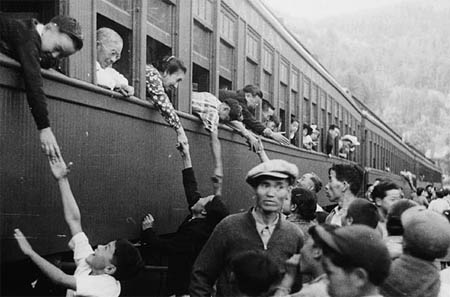
-
Article
Jehovah's Witnesses
Jehovah’s Witnesses traces its beginnings to the Advent Movement during the 1800s. Jehovah's Witnesses, religious denomination known internationally for tireless door-to-door EVANGELISM, large conventions, and members' refusal to bear arms, salute flags or accept blood transfusions.
"https://thecanadianencyclopedia.ca/images/tce_placeholder.jpg?v=e9dca980c9bdb3aa11e832e7ea94f5d9" // resources/views/front/categories/view.blade.php
https://thecanadianencyclopedia.ca/images/tce_placeholder.jpg?v=e9dca980c9bdb3aa11e832e7ea94f5d9
-
Article
The Jesuit Relations
The Jesuit Relations is a collection of the annual reports written by the Jesuit missionaries in Canada and sent to France from 1632 to 1672. These reports are an important historical resource regarding all of the events which occurred in the colony during this period. More specifically, they describe the central role played by the members of the Society of Jesus in the colonization of North America. (See Population Settlement of New France.) These reports provide an overview of the colonial vision of the times and describe the successes and failures of the missionaries in their efforts to convert the First Nations. Printed and distributed in Paris, primarily as a propaganda tool, the Jesuit Relations are very popular with travel literature enthusiasts. They remain a unique source of information regarding the early days of New France.
"https://d3d0lqu00lnqvz.cloudfront.net/media/media/1ab35d09-0c75-441b-b37e-15cacbc481d7.jpg" // resources/views/front/categories/view.blade.php
https://d3d0lqu00lnqvz.cloudfront.net/media/media/1ab35d09-0c75-441b-b37e-15cacbc481d7.jpg
-
Article
Jesuits
The Society of Jesus was founded in Paris in 1534 by Saint Ignatius Loyola, a Spanish soldier who underwent a profound religious experience while recovering from serious wounds. Loyola called the society "The Company of Jesus" to indicate its military spirit. The order was authorized in September 1540 to ordain its members. The name "Jesuits" (meaning those who too frequently use or appropriate the name of Jesus) was used against the order as a term of reproach but in time was accepted by its members.
"https://d3d0lqu00lnqvz.cloudfront.net/media/media/16b8b94b-0ca0-468a-8f8f-09141c3462be.jpg" // resources/views/front/categories/view.blade.php
https://d3d0lqu00lnqvz.cloudfront.net/media/media/16b8b94b-0ca0-468a-8f8f-09141c3462be.jpg
-
Article
Jesuits' Estates Act
During the French regime Jesuits were granted considerable property and seigneuries, which they used for educational purposes and for their missions among Indigenous people.
"https://thecanadianencyclopedia.ca/images/tce_placeholder.jpg?v=e9dca980c9bdb3aa11e832e7ea94f5d9" // resources/views/front/categories/view.blade.php
https://thecanadianencyclopedia.ca/images/tce_placeholder.jpg?v=e9dca980c9bdb3aa11e832e7ea94f5d9
-
Article
Jeunesses Laurentiennes
Jeunesses Laurentiennes (also known as Jeunes Laurentiens; both expressions mean “Laurentian youth”) was a French-Canadian nationalist youth movement founded in 1936. With a traditional vision of society, in which the Catholic religion played a central role, Jeunesses Laurentiennes organized conferences and celebrations, published a magazine, and occasionally acted as a pressure group. Until the organization was disbanded in 1950, it served as a training ground for many young militant French-Canadian nationalists.
"https://d3d0lqu00lnqvz.cloudfront.net/media/media/087e6e29-46c4-42c3-a81d-df5a80a5c519.jpg" // resources/views/front/categories/view.blade.php
https://d3d0lqu00lnqvz.cloudfront.net/media/media/087e6e29-46c4-42c3-a81d-df5a80a5c519.jpg
-
Article
Jewish Canadians
Unlike most immigrants to Canada, Jews did not come from a place where they were the majority cultural group. Jews were internationally dispersed at the time of the ancient Roman Empire and after unsuccessful revolts against it lost their sovereignty in their ancient homeland. Subsequently, Jews lived, sometimes for many centuries, as minorities in the Middle East, North Africa and Europe. Jews have been in what would become Canada as early as the 18th century. Many more immigrated in the 19th and 20th centuries. In the 2021 census, around 335,000 people identified themselves as Jewish in Canada. (See also Judaism.)
"https://d3d0lqu00lnqvz.cloudfront.net/media/media/455197f8-b830-4e6f-8952-4bbaa53ee57d.jpg" // resources/views/front/categories/view.blade.php
https://d3d0lqu00lnqvz.cloudfront.net/media/media/455197f8-b830-4e6f-8952-4bbaa53ee57d.jpg