
Browse "Communities & Sociology"
-
Article
Indonesian Canadians
Immigration from Indonesia to Canada began after the Second World War. In the wake of the decolonization process, 300,000 “Indos” (Indische Nederlander), persons of mixed Dutch and Asian ancestry, were repatriated to the Netherlands. Some of them decided to continue their journeys, settling in Australia, the United States and Canada. Throughout the 1960s and early 1970s, political instability also led many Indonesians to immigrate to Canada. According to the 2016 census, 21,395 individuals indicated that they had Indonesian origins. Notable Indonesian Canadians include violin maker Piet Molenaar and Toronto filmmaker Mike Hoolboom.
"https://d3d0lqu00lnqvz.cloudfront.net/media/media/dac2bfbe-b7bb-4080-83aa-a7a2cab9cc08.jpg" // resources/views/front/categories/view.blade.php
https://d3d0lqu00lnqvz.cloudfront.net/media/media/dac2bfbe-b7bb-4080-83aa-a7a2cab9cc08.jpg
-
Article
Indspire
Indspire is a national charitable organization, formerly known as the National Aboriginal Achievement Foundation. Indspire is dedicated to investing in the education of Indigenous people in Canada. In so doing, the organization hopes to give Indigenous students the skills and opportunities to create positive futures for themselves and their communities. Indspire aims to inspire and promote excellence. Every year, Indspire presents awards to Indigenous peoples who have made significant contributions to their communities and to Indigenous peoples as a whole. Well-known recipients of the Indspire Awards include Murray Sinclair, Susan Aglukark, Maria Campbell, Daphne Odjig, Tomson Highway, Reggie Leach and hundreds more.
"https://d3d0lqu00lnqvz.cloudfront.net/Indspire/indspire.jpg" // resources/views/front/categories/view.blade.php
https://d3d0lqu00lnqvz.cloudfront.net/Indspire/indspire.jpg
-
Article
Innu (Montagnais-Naskapi)
Innu, which means “people” in the Innu language, is the predominant term used to describe all Innu. Some groups maintain the use of one of two older terms: Montagnais (French for “mountain people”), usually applied to groups in forested, more southern communities, and Naskapi, which refers to far northern groups who inhabit the barren lands of the subarctic. In the 2021 census, 18,620 people identified as having Innu ancestry, with 17,970 people claiming Innu/Montagnais ancestry and 735 people claiming Naskapi ancestry.
"https://d3d0lqu00lnqvz.cloudfront.net/media/media/innu essipit first nation.jpg" // resources/views/front/categories/view.blade.php
https://d3d0lqu00lnqvz.cloudfront.net/media/media/innu essipit first nation.jpg
-
Article
Intergenerational Trauma and Residential Schools
Historical trauma occurs when trauma caused by historical oppression is passed down through generations. For more than 100 years, the Canadian government supported residential school programs that isolated Indigenous children from their families and communities (see Residential Schools in Canada). Under the guise of educating and preparing Indigenous children for their participation in Canadian society, the federal government and other administrators of the residential school system committed what has since been described as an act of cultural genocide. As generations of students left these institutions, they returned to their home communities without the knowledge, skills or tools to cope in either world. The impacts of their institutionalization in residential school continue to be felt by subsequent generations. This is called intergenerational trauma. This is the full-length entry about Intergenerational Trauma and Residential Schools. For a plain-language summary, please see Intergenerational Trauma and Residential Schools (Plain-Language Summary).
"https://thecanadianencyclopedia.ca/images/tce_placeholder.jpg?v=e9dca980c9bdb3aa11e832e7ea94f5d9" // resources/views/front/categories/view.blade.php
https://thecanadianencyclopedia.ca/images/tce_placeholder.jpg?v=e9dca980c9bdb3aa11e832e7ea94f5d9
-
Article
Interior Salish
The Interior Salish peoples include the Lillooet (or Lil’wat, see also Lillooet, British Columbia), Shuswap (now Secwepemc), Thompson (now Nlaka'pamux), Sinixt and Okanagan (Syilx) First Nations. These First Nations occupy territory in the interior of British Columbia(although some territory extends into the state of Washington in the United States). They speak languages belonging to the Interior Salish division of the Salishan language family. In the 2016 Census (Canada), 5,620 peoples identified themselves as Salish speakers, including 1,290 that speak Shuswap (Secwepemctsin). (See also Indigenous Languages in Canada).
"https://d3d0lqu00lnqvz.cloudfront.net/media/media/99144a52-aa7d-447b-86e4-3b03248f412d.jpg" // resources/views/front/categories/view.blade.php
https://d3d0lqu00lnqvz.cloudfront.net/media/media/99144a52-aa7d-447b-86e4-3b03248f412d.jpg
-
Interview
Interned in Canada: an Interview with Pat Adachi
Pat Adachi was born and raised in Vancouver, the daughter of Japanese immigrants. She grew up in the heart of the city’s Little Tokyo neighbourhood, within walking distance of the local grounds where her father would take her on Sundays to watch her favourite baseball team, the Vancouver Asahi. Adachi and her family lived normal lives, until she and her community were uprooted in 1942, when the federal government ordered Japanese Canadians to internment camps in rural British Columbia (see Internment of Japanese Canadians). In this interview, Adachi shares her story and relates the experiences of the 22,000 Japanese Canadians who were interned in Canada during the Second World War. This interview has been edited for length and clarity.
"https://d3d0lqu00lnqvz.cloudfront.net/media/new_article_images/Pat Adachi.jpg" // resources/views/front/categories/view.blade.php
https://d3d0lqu00lnqvz.cloudfront.net/media/new_article_images/Pat Adachi.jpg
-
Article
Internment of Japanese Canadians
The forcible expulsion and confinement of Japanese Canadians during the Second World War is one of the most tragic sets of events in Canada’s history. Some 21,000–22,000 Japanese Canadians were taken from their homes on Canada’s West Coast, without any charge or due process. Beginning 24 February 1942, they were exiled to remote areas of British Columbia and elsewhere. The federal government stripped them of their property and pressured many of them to accept mass deportation after the war. Those who remained were not allowed to return to the West Coast until 1 April 1949. In 1988, the federal government officially apologized for its treatment of Japanese Canadians. A redress payment of $21,000 was made to each survivor, and more than $12 million was allocated to a community fund and human rights projects. This article is the full-length text on Japanese Internment in Canada. For a plain-language summary, see Internment of Japanese Canadians (Plain-Language Summary).
"https://d3d0lqu00lnqvz.cloudfront.net/media/media/0bec6156-0467-4a97-909f-da599383381d.jpg" // resources/views/front/categories/view.blade.php
https://d3d0lqu00lnqvz.cloudfront.net/media/media/0bec6156-0467-4a97-909f-da599383381d.jpg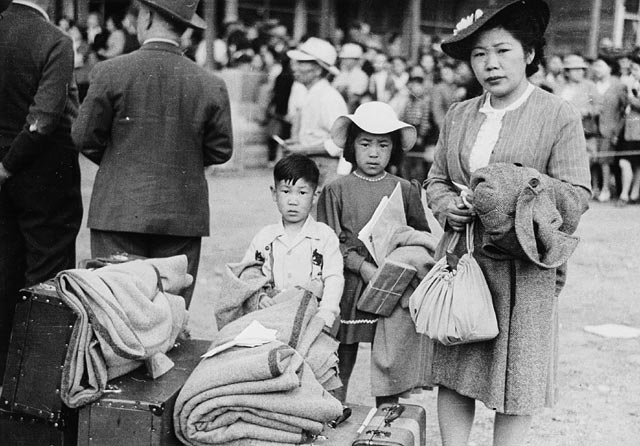
-
Article
Inuit Art
The history of Inuit cultures and the art of the various regions and times can only be understood if the myth of a homogeneous Inuit culture is discarded altogether. Though it has not been possible to determine the exact origin(s) of the Inuit, nor of the various Inuit cultures, five distinct cultures have been established in the Canadian area: Pre-Dorset , Dorset , Thule, Historic and Contemporary.
"https://d3d0lqu00lnqvz.cloudfront.net/media/media/4d37de3c-41d6-48db-bf9f-070d0882d77d.jpg" // resources/views/front/categories/view.blade.php
https://d3d0lqu00lnqvz.cloudfront.net/media/media/4d37de3c-41d6-48db-bf9f-070d0882d77d.jpg
-
Article
Inuit Co-operatives
Beginning in the mid-1950s, Inuit were encouraged to move into the trading posts to be near schools and medical services.
"https://d3d0lqu00lnqvz.cloudfront.net/media/media/57a518c7-0e95-4505-b0ca-fd75cda6b879.jpg" // resources/views/front/categories/view.blade.php
https://d3d0lqu00lnqvz.cloudfront.net/media/media/57a518c7-0e95-4505-b0ca-fd75cda6b879.jpg
-
Macleans
Inuit Culture All the Rage in France
IN PARIS'S GRAND OLD Musée de l'Homme, near the Eiffel Tower, the flow of fascinated visitors these days is steady.This article was originally published in Maclean's Magazine on February 14, 2005
"https://thecanadianencyclopedia.ca/images/tce_placeholder.jpg?v=e9dca980c9bdb3aa11e832e7ea94f5d9" // resources/views/front/categories/view.blade.php
https://thecanadianencyclopedia.ca/images/tce_placeholder.jpg?v=e9dca980c9bdb3aa11e832e7ea94f5d9
-
Collection
Inuit
Inuit are one of three groupings of Indigenous peoples in Canada, the other two being Métis and First Nations. Inuit traditional territory includes land in the northern portions of the Northwest Territories, Nunavut, Quebec and Labrador — an area collectively known as Inuit Nunangat. This collection brings together resources on The Canadian Encyclopedia related to Inuit, including articles, timelines, education guides, quizzes and videos. For other collections related to Indigenous peoples, see Métis, First Nations ...
"https://d3d0lqu00lnqvz.cloudfront.net/media/homepage_features/Inuit2.jpg" // resources/views/front/categories/view.blade.php
https://d3d0lqu00lnqvz.cloudfront.net/media/homepage_features/Inuit2.jpg
-
Article
Inuit Printmaking
While carving is a viable enterprise in most Inuit communities, printmaking requires special skills and sophisticated equipment to compete in an international market.
"https://d3d0lqu00lnqvz.cloudfront.net/media/media/b8f059b1-3755-477f-a3c1-ba8420091091.jpg" // resources/views/front/categories/view.blade.php
https://d3d0lqu00lnqvz.cloudfront.net/media/media/b8f059b1-3755-477f-a3c1-ba8420091091.jpg
-
Article
Inuit Vocal Games
Inuit vocal games describe central Canadian Arctic practices that are both musical and ludic (spontaneous or playful). According to regional differences, these can be divided into several genres with different names.
"https://d3d0lqu00lnqvz.cloudfront.net/media/media/68cae00c-f728-459d-bb87-2162d08774fa.jpg" // resources/views/front/categories/view.blade.php
https://d3d0lqu00lnqvz.cloudfront.net/media/media/68cae00c-f728-459d-bb87-2162d08774fa.jpg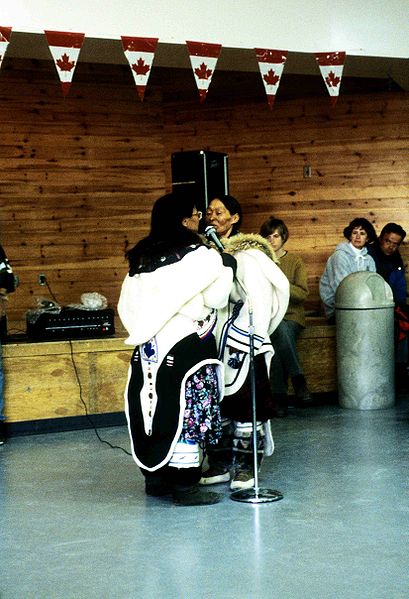
-
Article
Inuksuk (Inukshuk)
Inuksuk (also spelled inukshuk, plural inuksuit) is a figure made of piled stones or boulders constructed to communicate with humans throughout the Arctic. Traditionally constructed by the Inuit, inuksuit are integral to Inuit culture and are often intertwined with representations of Canada and the North. A red inuksuk is found on the flag of Nunavut. In Inuktitut, the term inuksuk means "to act in the capacity of a human." It is an extension of the word inuk meaning "a human being." Inuksuit have been found close to archaeological sites dating from 2400 to 1800 BCE in the Mingo Lake region of southwest Baffin Island. (See also Prehistory.) While stone figures resembling human forms are often referred to as inuksuk, such figures are actually known as inunnguaq.
"https://d3d0lqu00lnqvz.cloudfront.net/media/media/fda0c3a3-c613-4196-ba0a-690925ca6c04.jpg" // resources/views/front/categories/view.blade.php
https://d3d0lqu00lnqvz.cloudfront.net/media/media/fda0c3a3-c613-4196-ba0a-690925ca6c04.jpg
-
Article
Inuktitut Words for Snow and Ice
It is often said that the Inuit have dozens of words to refer to snow and ice. Anthropologist John Steckley, in his book White Lies about the Inuit (2007), notes that many often cite 52 as the number of different terms in Inuktitut. This belief in a high number of words for snow and ice has been sharply criticized by a large number of linguists and anthropologists.
"https://d3d0lqu00lnqvz.cloudfront.net/media/media/1c4db935-fcf6-4b0d-a8f4-7ab6c8a30a3c.jpg" // resources/views/front/categories/view.blade.php
https://d3d0lqu00lnqvz.cloudfront.net/media/media/1c4db935-fcf6-4b0d-a8f4-7ab6c8a30a3c.jpg