Share on Facebook
 Share on X
 Share by Email
 Share on Google Classroom
The telegraph (Gk, tele, meaning "far," and graphein,"to write") was conceived in 1837 in North America by Samuel Morse, and in Europe by the English partnership of William Cooke and Charles Wheatstone. It is a means of electrically transmitting encoded messages through the systematic opening and closing of electric circuits. The telegraph was introduced to Canada in 1846. (See also Telecommunications.)
Telegraph Companies
19th Century
In Canada, the first telegraph company, the Toronto, Hamilton and Niagara Electro-Magnetic Telegraph Company, was formed in 1846. The largest company in Canada during the early years of the industry, however, was the Montreal Telegraph Company (founded in 1847), controlled by Hugh Allan. It connected such centres as Sackville (New Brunswick), Detroit, Montreal, Ottawa, Buffalo and Portland.
In 1868, the Montreal Telegraph Co. began facing direct competition from the newly established Dominion Telegraph Company and price wars broke out. In 1880 the Great North Western Telegraph Company was established to connect Ontario and Manitoba, but by 1881 it had been taken over by Western Union Company of the United States and was used by Western Union to consolidate the Canadian industry, attaining leases on the lines of both the Montreal and Dominion telegraph companies. As a result, for a brief time Western Union controlled virtually all telegraphy in Canada.
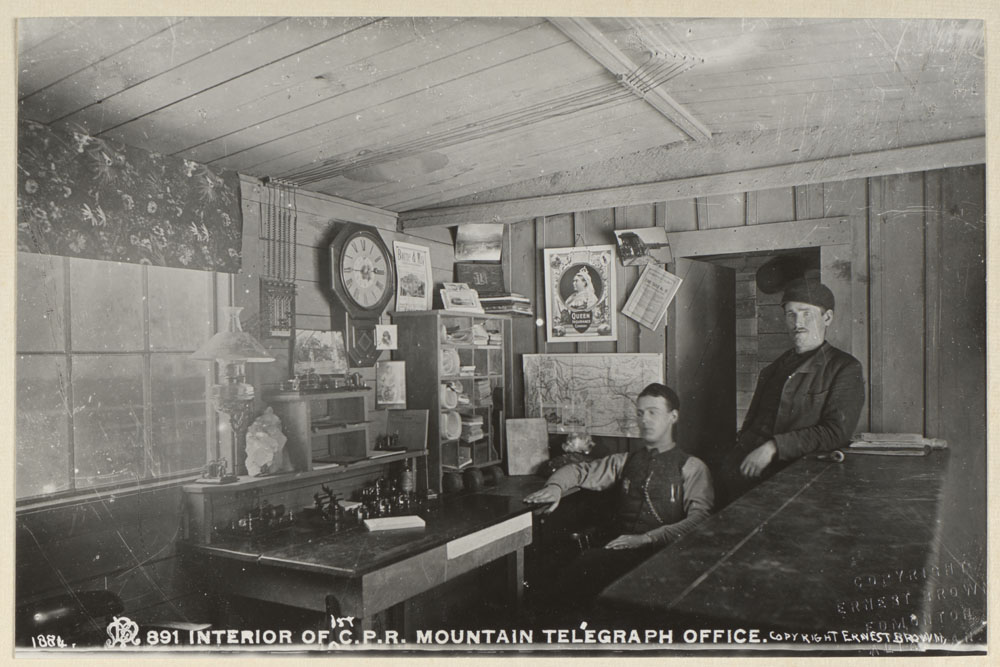
Canadian Pacific Railway Telegraphs commenced commercial telegraph service between Lake Superior and the Rockies in 1885, extended soon to Ontario and thereafter to Atlantic Canada, breaking Western Union's monopoly (see Canadian Pacific Railway). Perhaps attributable to this new competition, the Great North Western Telegraph Company faced bankruptcy and was taken over by the telegraph subsidiary of Canadian Northern Railway Company on 1 January 1915. The railway itself was in financial difficulty, however, and was soon purchased by the federal government, subsequently forming a component of Canadian National Railways Company. In this way Great North Western Telegraph Co. became Canadian National Telegraph Company.
20th Century
A major principle of provisioning telecommunications facilities, namely the separation of control of the content of messages from control over transmission, was established in 1910 by the Board of Railway Commissioners for Canada. Almost since the inception of the Canadian telegraph, news gathering had been controlled by the major telegraph companies. In 1894 Canadian Pacific Telegraphs contracted with Associated Press, the major news agency in the US, and itself condensed and selected Associated Press news items for distribution to Canadian newspapers. Canadian telegraph operators for years remained the principal collectors of Canadian news.
In 1907, however, Canadian Pacific Telegraphs attempted to quadruple prices charged for its news service to three Winnipeg newspapers which, in opposition, joined to form an independent news service, the Western Associated Press (WAP). Subsequently, Canadian Pacific cut off its news service to the Nelson, British Columbia, News, an action attributable to publication of articles critical of Canadian Pacific. Upon appeal from WAP, the Board of Railway Commissioners in 1910 ruled Canadian Pacific rates to be unlawful and hence the company abandoned the field of news gathering and selection, thereby establishing the principle of the common carrier, that is, accepting for transmission all messages without interference upon payment of lawful rates.
By the 1930s, the Canadian National and Canadian Pacific Railway companies, as the principal providers of telegraph service in Canada, were interchanging traffic on an exclusive basis with US companies - Postal Telegraph Company in the case of Canadian National, and with Western Union in the case of Canadian Pacific. The Canadian telegraph operations continued to compete until 1967, when agreement was reached for reciprocal office abandonment. In this way CNCP Telecommunications emerged first as a joint venture, and then in 1980 as a partnership between the two railways. The partnership was dissolved in 1988, however, when Canadian Pacific acquired Canadian National's interest in CNCP. In 1989 cable TV magnate Ted Rogers acquired 40 per cent interest in CNCP Telecommunications, and the company's name was change to Unitel Communcations Inc.
In 1992 the Canadian Radio-Television and Telecommunications Commission issued a decision permitting Unitel and other companies to enter the long-distance voice telephone services market in competition with telephone companies. In thus competing, however, Unitel verged on bankruptcy, whereupon both Rogers and Canadian Pacific sold their shares to the American Telephone and Telegraph Co (AT&T), already a minority shareholder, and to a consortium of Canadian banks.