
Browse "Things"
-
Article
Canada and the Rhineland Offensive
The Rhineland Offensive (8 February–24 March 1945) was one of the last major European campaigns of the Second World War. In what was some of the bitterest fighting of the war, First Canadian Army and Ninth US Army forced the Germans back to the Rhine River. For the Canadian army, the first phase was Operation Veritable (8–21 February), an attack over inundated ground in the Reichswald forest. The second phase, Operation Blockbuster (26 February–10 March), was a gruelling attack through the Hochwald Forest. Canadians were also involved in Operation Plunder (23 March–1 April), an assault across the Rhine and expansion of the bridgehead, and Operation Varsity (24 March), an airborne assault. Under General Harry Crerar, First Canadian Army fought tough battles in the Reichswald and the Hochwald, preparing the way for the Allies to cross the Rhine and enter Germany. More than 5,300 Canadians were killed, wounded or captured during the campaign.
"https://d3d0lqu00lnqvz.cloudfront.net/media/media/Rhineland/Blackfriars-Bridge.jpg" // resources/views/front/categories/view.blade.php
https://d3d0lqu00lnqvz.cloudfront.net/media/media/Rhineland/Blackfriars-Bridge.jpg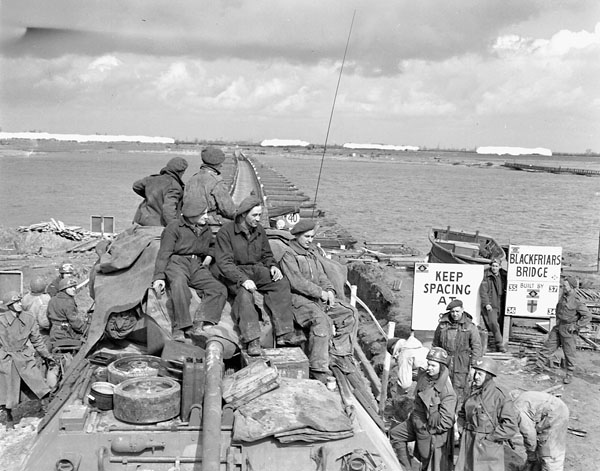
-
Article
Canada and the Battle of the Somme
The Battle of the Somme, also known as the Somme Offensive, was fought during the First World War from 1 July to 18 November 1916. In the summer of 1916 the British launched the largest battle of the war on the Western Front, against German lines. The offensive was one of the bloodiest in human history. Over the course of five months, approximately 1.2 million men were killed or wounded at the Somme. The Canadian Corps (see Canadian Expeditionary Force) was involved in the final three months of fighting. On the first day of the offensive, the First Newfoundland Regiment, which was not part of the Canadian forces, was nearly annihilated at Beaumont-Hamel. The Battle of the Somme produced little gains and has long been an example of senseless slaughter and the futility of trench warfare (see also The Somme).
"https://d3d0lqu00lnqvz.cloudfront.net/media/new_article_images/somme3-1.jpg" // resources/views/front/categories/view.blade.php
https://d3d0lqu00lnqvz.cloudfront.net/media/new_article_images/somme3-1.jpg
-
Article
Battle of the St. Lawrence
The Battle of the St. Lawrence was an extension of the larger Battle of the Atlantic— the German campaign during the Second World War to disrupt shipping from North America to the United Kingdom. Between 1942 and 1945, German submarines (U-boats) repeatedly penetrated the waters of the St. Lawrence River and Gulf, sinking 26 ships and killing hundreds. It was the first time since the War of 1812 that naval battles were waged in Canada's inland waters.
"https://d3d0lqu00lnqvz.cloudfront.net/media/media/517fb1f8-1594-4d4f-a7cd-9c84c456c1d8.jpg" // resources/views/front/categories/view.blade.php
https://d3d0lqu00lnqvz.cloudfront.net/media/media/517fb1f8-1594-4d4f-a7cd-9c84c456c1d8.jpg
-
Article
Battle of the Thames (Moraviantown)
The Battle of the Thames (sometimes called the Battle of Moraviantown) occurred 5 October 1813, during the War of 1812. Following the American naval victory under Captain Oliver H.
"https://d3d0lqu00lnqvz.cloudfront.net/media/media/32ebdaa1-6004-4100-9bdd-5565c2c10307.jpg" // resources/views/front/categories/view.blade.php
https://d3d0lqu00lnqvz.cloudfront.net/media/media/32ebdaa1-6004-4100-9bdd-5565c2c10307.jpg
-
Article
Battle of Tippecanoe
The Battle of Tippecanoe, on 7 November 1811, was an American victory over First Nations during Tecumseh's War (see also Tecumseh). The Old Northwest, incorporating the region north of the Ohio River and east of the Mississippi, witnessed several wars between the US and Indigenous peoples beginning in 1785. American complaints that the British aided Indigenous peoples in resisting American settlement of the Old Northwest have been cited as one of the causes of the War of 1812.
"https://d3d0lqu00lnqvz.cloudfront.net/media/media/26510149-77ba-4109-baf1-1c8bffba4b12.jpg" // resources/views/front/categories/view.blade.php
https://d3d0lqu00lnqvz.cloudfront.net/media/media/26510149-77ba-4109-baf1-1c8bffba4b12.jpg
-
Article
Battle of Vimy Ridge (Plain-Language Summary)
Vimy Ridge is in northern France. From 9 to 12 April 1917 the Canadian Corps fought a battle against the German army there. It was on the Western Front in the First World War. The Canadians won. The Canadian Corps was made up of four divisions. This was the first time they fought together. More than 10,000 Canadians were killed and wounded. Many Canadians believe Vimy Ridge gave birth to the Canadian nation. Not everyone believes this.This article is a plain-language summary of “The Battle of Vimy Ridge”. If you are interested in reading this about this topic in more depth, please see the full-length entry, Battle of Vimy Ridge.
"https://d3d0lqu00lnqvz.cloudfront.net/media/vimy_foundation/VF1-2/VF2-10.jpg" // resources/views/front/categories/view.blade.php
https://d3d0lqu00lnqvz.cloudfront.net/media/vimy_foundation/VF1-2/VF2-10.jpg
-
Article
Battle of the Windmill
The Battle of the Windmill was one of a series of raids launched along the Canada/US border in the summer and fall of 1838 by the Hunters’ Lodges, secret societies established by Canadian rebels who had taken refuge in the northern United States after the failed rebellions of 1837. Several thousand Americans also joined these societies, whose goal was to push the United Kingdom and the United States into war so as to liberate the Canadian provinces from British tyranny. The Battle of the Windmill was fought from 12 to 16 November 1838 near Prescott, in Upper Canada, and ended in a defeat for the invaders from the US. One month later, the Battle of Windsor put an end to the American incursions and Canadian rebellions.
"https://d3d0lqu00lnqvz.cloudfront.net/media/media/a29edf81-65ab-48c5-a87d-9d3d2122ed6d.jpg" // resources/views/front/categories/view.blade.php
https://d3d0lqu00lnqvz.cloudfront.net/media/media/a29edf81-65ab-48c5-a87d-9d3d2122ed6d.jpg
-
Article
Canada and the Second Battle of Ypres
The Second Battle of Ypres was fought during the First World War from 22 April to 25 May 1915. It was the first major battle fought by Canadian troops in the Great War. The battle took place on the Ypres salient on the Western Front, in Belgium, outside the city of Ypres (now known by its Flemish name, Ieper). The untested Canadians distinguished themselves as a determined fighting force, resisting the horror of the first large-scale poison gas attack in modern history. Canadian troops held a strategically critical section of the frontline until reinforcements could be brought in. More than 6,500 Canadians were killed, wounded or captured in the Second Battle of Ypres.
"https://d3d0lqu00lnqvz.cloudfront.net/media/new_article_images/ypres/a022718.jpg" // resources/views/front/categories/view.blade.php
https://d3d0lqu00lnqvz.cloudfront.net/media/new_article_images/ypres/a022718.jpg
-
Article
Notable Canadian Battles
Seven Years War Battle of the Plains of Abraham The Battle of the Plains of Abraham (13 September 1759) was a pivotal moment in the Seven Years War and in the history of Canada. A British invasion force led by General James Wolfe defeated French troops under the Marquis de Montcalm, leading to the French surrender of Quebec to the British. The French never recaptured Quebec and effectively lost control of New France in 1760. Battle of Sainte-Foy The Battle of Sainte-Foy (28 April...
"https://d3d0lqu00lnqvz.cloudfront.net/media/media/56567521-2ca2-4ae0-bceb-b259db0aca8e.jpg" // resources/views/front/categories/view.blade.php
https://d3d0lqu00lnqvz.cloudfront.net/media/media/56567521-2ca2-4ae0-bceb-b259db0aca8e.jpg
-
Article
Bay
A bay is a body of water partly surrounded by land and connected to a larger body of water. It is typically bigger than a cove and smaller than a gulf. However, this is not always the case. For example, Hudson Bay is much larger than the Persian Gulf. Strictly speaking and by international agreement, to be defined as a bay, a water body’s mouth (the boundary between itself and the larger body of water to which it is connected) must not exceed 24 nautical miles. In addition, its area must exceed that of a semicircle drawn with the mouth as its diameter.
"https://d3d0lqu00lnqvz.cloudfront.net/media/new_article_images/Bay/HudsonBay.jpg" // resources/views/front/categories/view.blade.php
https://d3d0lqu00lnqvz.cloudfront.net/media/new_article_images/Bay/HudsonBay.jpg
-
Article
BC Hydro
BC Hydro and Power Authority (BC Hydro), a provincial Crown corportation is the third-largest electric utility in Canada.
"https://d3d0lqu00lnqvz.cloudfront.net/media/media/81dcdef6-e2cf-4f68-9df0-3cff9cd951b2.jpg" // resources/views/front/categories/view.blade.php
https://d3d0lqu00lnqvz.cloudfront.net/media/media/81dcdef6-e2cf-4f68-9df0-3cff9cd951b2.jpg
-
Article
BC Lions
The BC Lions are a professional football franchise that plays in the West Division of the Canadian Football League (CFL). Since 1954, the team has won six Grey Cup championships.
"https://thecanadianencyclopedia.ca/images/tce_placeholder.jpg?v=e9dca980c9bdb3aa11e832e7ea94f5d9" // resources/views/front/categories/view.blade.php
https://thecanadianencyclopedia.ca/images/tce_placeholder.jpg?v=e9dca980c9bdb3aa11e832e7ea94f5d9
-
Macleans
BC Referendum Controversy
This article was originally published in Maclean’s magazine on May 13, 2002. Partner content is not updated. The beauty of a referendum is that no matter how complex or inappropriate the question, the answer can only be Yes or No. Except, apparently, in British Columbia, where Up Yours is also gaining a measure of popularity.
"https://thecanadianencyclopedia.ca/images/tce_placeholder.jpg?v=e9dca980c9bdb3aa11e832e7ea94f5d9" // resources/views/front/categories/view.blade.php
https://thecanadianencyclopedia.ca/images/tce_placeholder.jpg?v=e9dca980c9bdb3aa11e832e7ea94f5d9
-
Macleans
BC Telecom/Telus Merger
This article was originally published in Maclean’s magazine on 8 March 1999. Partner content is not updated. George Petty is a plain-speaking guy, not prone to superlatives. So when he told Telus Corp. shareholders last April that he wanted to turn the Alberta telecommunications company into one of the worlds "premier communications" firms, he was not bluffing.
"https://thecanadianencyclopedia.ca/images/tce_placeholder.jpg?v=e9dca980c9bdb3aa11e832e7ea94f5d9" // resources/views/front/categories/view.blade.php
https://thecanadianencyclopedia.ca/images/tce_placeholder.jpg?v=e9dca980c9bdb3aa11e832e7ea94f5d9
-
Macleans
BC to Vote on Electoral Reform
HOW BRUTAL is BRITISH COLUMBIA political life? Consider Liberal Premier Gordon CAMPBELL, who has survived - so far, and notwithstanding a disastrous drunk driving conviction - his first term in office.This article was originally published in Maclean's Magazine on April 4, 2005
"https://thecanadianencyclopedia.ca/images/tce_placeholder.jpg?v=e9dca980c9bdb3aa11e832e7ea94f5d9" // resources/views/front/categories/view.blade.php
https://thecanadianencyclopedia.ca/images/tce_placeholder.jpg?v=e9dca980c9bdb3aa11e832e7ea94f5d9