
Browse "Things"
-
Article
Mercantile Bank of Canada
Mercantile Bank of Canada had head offices in Montréal. The Mercantile Bank operated a general banking business through 13 branches and one representative office.
"https://thecanadianencyclopedia.ca/images/tce_placeholder.jpg?v=e9dca980c9bdb3aa11e832e7ea94f5d9" // resources/views/front/categories/view.blade.php
https://thecanadianencyclopedia.ca/images/tce_placeholder.jpg?v=e9dca980c9bdb3aa11e832e7ea94f5d9
-
Article
Mercantilism
Mercantilism is an economic theory and policy practised during Canada’s colonial periods. The theory of mercantilism holds that there is a fixed amount of wealth in the world. A nation’s wealth is thus dependent on exporting (selling to other countries) more than it imports (buying from others). European nations — including France and England (later Great Britain) — used this system to their advantage from the 16th century through the mid-19th century. The purpose was to extract as much wealth as possible from the colonies without investing much into them. The Atlantic slave trade is also inextricably linked to mercantilism. (See Black Enslavement in Canada.) This article is a full-length entry about mercantilism. For a plain-language summary, please see Mercantilism (Plain-Language Summary).
"https://d3d0lqu00lnqvz.cloudfront.net/media/media/e4ec1e55-01c2-4b77-a220-f05a84fd4c9c.jpg" // resources/views/front/categories/view.blade.php
https://d3d0lqu00lnqvz.cloudfront.net/media/media/e4ec1e55-01c2-4b77-a220-f05a84fd4c9c.jpg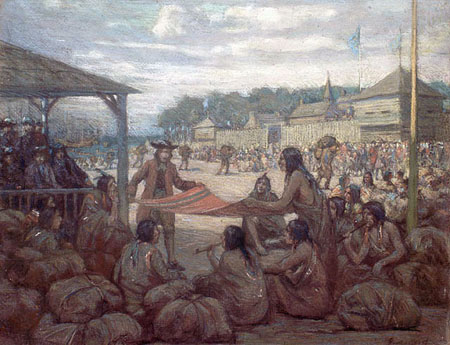
-
Article
Mercantilism (Plain-Language Summary)
Mercantilism is two things. First, it is an economic theory. This theory is simple. It says that wealth is scarce. Wealth can come in the form of money and resources. Scarce means that there is not enough of something. Second, mercantilism is an economic policy. A policy is a set of rules or regulations to follow. Many nations practiced mercantilism. These nations were European imperialist powers. The two best known mercantilist nations were England (Great Britain) and France. They aimed to export more goods than they imported from their colonies. They hoped to make a lot of money and not spend much money. The Atlantic slave trade was mercantilist in nature. (See also Black Enslavement in Canada (Plain-Language Summary).) This article is a plain-language summary of mercantilism. If you are interested in reading about this topic more in depth, please see our full-length entry, Mercantilism.
"https://d3d0lqu00lnqvz.cloudfront.net/media/media/e4ec1e55-01c2-4b77-a220-f05a84fd4c9c.jpg" // resources/views/front/categories/view.blade.php
https://d3d0lqu00lnqvz.cloudfront.net/media/media/e4ec1e55-01c2-4b77-a220-f05a84fd4c9c.jpg
-
Macleans
Mercedes-Chrysler Merge
This article was originally published in Maclean’s magazine on May 18, 1998. Partner content is not updated. No, Levi-Strauss is not in talks to merge with Italy's Armani. Nor, as far as anyone knows, is McDonald's planning to team up with a chain of snooty French restaurants.
"https://thecanadianencyclopedia.ca/images/tce_placeholder.jpg?v=e9dca980c9bdb3aa11e832e7ea94f5d9" // resources/views/front/categories/view.blade.php
https://thecanadianencyclopedia.ca/images/tce_placeholder.jpg?v=e9dca980c9bdb3aa11e832e7ea94f5d9
-
Article
Merchant Navy of Canada
A merchant navy (or merchant marine) is the fleet of a country’s commercial vessels that carries people, raw materials and manufactured goods. It also refers to the personnel who crew these ships. The history of Canada’s merchant fleet is one of up and downs. From the heady days of the late 19th century to its virtual disappearance a few years later, through a rapid build-up as a key Allied component during the Second World War, to its final demise in mid-20th century, Canada’s Merchant Navy has not been treated well.
"https://d3d0lqu00lnqvz.cloudfront.net/media/media/bcd949e2-4a12-436b-9ba1-70a4f01b0db8.jpg" // resources/views/front/categories/view.blade.php
https://d3d0lqu00lnqvz.cloudfront.net/media/media/bcd949e2-4a12-436b-9ba1-70a4f01b0db8.jpg
-
Article
Mercury
Mercury (Hg) is a silvery white metal also known as quicksilver. Mercury is named for the Roman god of commerce, travel and thievery. It has been used for over 3000 years. Its chemical symbol, Hg, is derived from the Latin word hydrargyrum, which means "liquid silver.
"https://thecanadianencyclopedia.ca/images/tce_placeholder.jpg?v=e9dca980c9bdb3aa11e832e7ea94f5d9" // resources/views/front/categories/view.blade.php
https://thecanadianencyclopedia.ca/images/tce_placeholder.jpg?v=e9dca980c9bdb3aa11e832e7ea94f5d9
-
Macleans
Merrill Lynch Buys Midland Walwyn
This article was originally published in Maclean’s magazine on July 6, 1998. Partner content is not updated. How's this for a long-range forecast? In 1989-1990, when a mid-sized Canadian investment brokerage called Midland Doherty Financial Corp. was running on empty, management did the rounds of all the big banks and fund managers in an attempt to sell enough cheap equity to keep the firm going.
"https://thecanadianencyclopedia.ca/images/tce_placeholder.jpg?v=e9dca980c9bdb3aa11e832e7ea94f5d9" // resources/views/front/categories/view.blade.php
https://thecanadianencyclopedia.ca/images/tce_placeholder.jpg?v=e9dca980c9bdb3aa11e832e7ea94f5d9
-
Article
Metallurgy
Metallurgy is the art, science and technology of turning metals and alloys (i.e., materials consisting of two or more metals) into forms suitable for practical use.
"https://d3d0lqu00lnqvz.cloudfront.net/media/media/3ed8d545-4edb-40bb-bc0e-6d7b68d6c22a.jpg" // resources/views/front/categories/view.blade.php
https://d3d0lqu00lnqvz.cloudfront.net/media/media/3ed8d545-4edb-40bb-bc0e-6d7b68d6c22a.jpg
-
Article
Metamorphic Rock
Metamorphic rock is one of the 3 major classes of rock comprising the Earth's crust, the others being SEDIMENTARY and IGNEOUS ROCKS. Metamorphic rock has been transformed, while in the solid state, by pressure, temperature and deformation.
"https://d3d0lqu00lnqvz.cloudfront.net/media/media/e0a546d9-bcaf-41e5-a7d4-076b178b5592.jpg" // resources/views/front/categories/view.blade.php
https://d3d0lqu00lnqvz.cloudfront.net/media/media/e0a546d9-bcaf-41e5-a7d4-076b178b5592.jpg
-
Article
Meteorology
Meteorology is the science that studies the atmosphere and atmospheric phenomena, using data about temperature, humidity, clouds, wind, etc. Its ultimate aim is to explain the structure and functioning of the atmosphere using the basic laws of physics. The major theoretical divisions are physical and dynamic meteorology (very closely related and often coupled under the title atmospheric physics) and synoptic meteorology. Climatology is the branch of meteorology most concerned with weather, climate and climate change.
"https://d3d0lqu00lnqvz.cloudfront.net/ice/icy-branch-in-spring.jpg" // resources/views/front/categories/view.blade.php
https://d3d0lqu00lnqvz.cloudfront.net/ice/icy-branch-in-spring.jpg
-
Article
Methodism
The movement was first represented in what is now Canada by one of Wesley's followers, Laurence COUGHLAN, who began to preach in Newfoundland in 1766. Yorkshire settlers around Chignecto, NS, in the 1770s were the first sizable group of Methodists in the Maritimes.
"https://d3d0lqu00lnqvz.cloudfront.net/media/media/15c7fc4e-83d2-495c-a288-da377bb62d06.jpg" // resources/views/front/categories/view.blade.php
https://d3d0lqu00lnqvz.cloudfront.net/media/media/15c7fc4e-83d2-495c-a288-da377bb62d06.jpg
-
Article
Music of the Métis
Métis music reflects their mixed ancestry and therefore comprises an amalgam of music styles, languages, and socio-cultural elements.
"https://d3d0lqu00lnqvz.cloudfront.net/media/media/c072de9d-96cf-43ef-9a30-484df15f79df.jpg" // resources/views/front/categories/view.blade.php
https://d3d0lqu00lnqvz.cloudfront.net/media/media/c072de9d-96cf-43ef-9a30-484df15f79df.jpg
-
Article
Métis Experiences at Residential School
Although the first residential schools in Canada were established with the intention of assimilating First Nations children into Euro-Canadian culture, Métis and Inuit children were also institutionalized in such facilities. Métis children experienced similar day-to-day conditions to those of other students in residential schools, but they were often considered “outsiders” by their peers and administrators. This perception affected their experiences within these institutions in particular ways.
"https://d3d0lqu00lnqvz.cloudfront.net/MetisExperiences/Webp.net-resizeimage.jpg" // resources/views/front/categories/view.blade.php
https://d3d0lqu00lnqvz.cloudfront.net/MetisExperiences/Webp.net-resizeimage.jpg
-
Article
Métis Nation-Saskatchewan
The Métis Nation-Saskatchewan (MN-S) is a self-governing Métis political organization, representing the interests of Métis citizens across Saskatchewan. Its governance structure includes a Provincial Métis Council, regional representatives and local community councils, all working to uphold Métis rights, culture and self-determination. The MN-S has over 34,000 registered citizens. While Métis rights were constitutionally recognized in 1982 under section 35 of the Canadian Constitution, the MN-S formally adopted its own constitution on 3 December 1993.
"https://thecanadianencyclopedia.ca/images/tce_placeholder.jpg?v=e9dca980c9bdb3aa11e832e7ea94f5d9" // resources/views/front/categories/view.blade.php
https://thecanadianencyclopedia.ca/images/tce_placeholder.jpg?v=e9dca980c9bdb3aa11e832e7ea94f5d9
-
Article
Métis National Council
The Métis National Council is a national Métis organization that includes representation from provincial organizations in Alberta and Ontario. It emerged during the intense constitutional debate over Aboriginal rights in the early 1980s. The Métis National Council continues to champion a culturally and politically distinct Métis Nation with roots in Western Canada, and with outstanding claims to self-government, land and other Aboriginal rights (see also Rights of Indigenous Peoples in Canada).
"https://d3d0lqu00lnqvz.cloudfront.net/media/media/4de10db1-6b8b-45ef-a60a-55998c7afca0.jpg" // resources/views/front/categories/view.blade.php
https://d3d0lqu00lnqvz.cloudfront.net/media/media/4de10db1-6b8b-45ef-a60a-55998c7afca0.jpg