Browse "Things"
-
Article
Media and the Law
The media are the means by which we receive information we want and need. Over time, town criers and clay tablets have given way to printed text. Now, a wide variety of aural and visual information is conveyed to us in bits and bytes through a number of intermediaries.
"https://thecanadianencyclopedia.ca/images/tce_placeholder.jpg?v=e9dca980c9bdb3aa11e832e7ea94f5d9" // resources/views/front/categories/view.blade.php
https://thecanadianencyclopedia.ca/images/tce_placeholder.jpg?v=e9dca980c9bdb3aa11e832e7ea94f5d9
-
Article
Media Bias in Canada
Bias means supporting or opposing something or someone in an unfair way, regardless of the evidence. Media bias is when information spread by media or a news outlet reflects the interests and biases of ownership or individuals of that media company. Corporations may have a clear bias for one political party or issue and may influence its media outlets to reflect that bias. Individual journalists or news outlets may favour one side of an issue and reflect that bias — consciously or unconsciously — in the way they cover stories. The fact that a majority of journalists in Canada are White can also lead to biased reporting on minority groups. People can overcome unconscious bias by thinking and talking about it, and especially by listening to people from less privileged backgrounds.
"https://d3d0lqu00lnqvz.cloudfront.net/media/new_article_images/MediaBias/dreamstime_xl_142501942.jpg" // resources/views/front/categories/view.blade.php
https://d3d0lqu00lnqvz.cloudfront.net/media/new_article_images/MediaBias/dreamstime_xl_142501942.jpg
-
Article
Media Bias in Canada (Plain-Language Summary)
Bias is when you support or oppose someone or something based on your own opinion, regardless of the evidence. Media bias is when content spread by media reflects the interests of that company or its ownership. Corporations may have a clear bias for one political party or issue. A company may have its media outlets reflect that bias. Journalists or news outlets may favour one side of an issue and reflect that bias in the way they cover stories. Bias can be overcome by being aware of it and talking about it. And by listening to people from less privileged backgrounds.
"https://d3d0lqu00lnqvz.cloudfront.net/media/new_article_images/DigitalMedia/dreamstime_xl_142501942.jpg" // resources/views/front/categories/view.blade.php
https://d3d0lqu00lnqvz.cloudfront.net/media/new_article_images/DigitalMedia/dreamstime_xl_142501942.jpg
-
Article
Media Convergence in Canada
Media convergence refers to the merging of previously distinct media technologies and platforms through digitization and computer networking. This is also known as technological convergence. Media convergence is also a business strategy whereby communications companies integrate their ownership of different media properties. This is also called media consolidation, media concentration or economic convergence. (See also Media Ownership.)
"https://thecanadianencyclopedia.ca/images/tce_placeholder.jpg?v=e9dca980c9bdb3aa11e832e7ea94f5d9" // resources/views/front/categories/view.blade.php
https://thecanadianencyclopedia.ca/images/tce_placeholder.jpg?v=e9dca980c9bdb3aa11e832e7ea94f5d9
-
Article
Media Convergence in Canada (Plain-Language Summary)
Media convergence is a term for two things: 1) It is when different media merge through technology. This is also known as technological convergence. 2) It is also when companies own different media outlets as part of a business strategy. This is also called media consolidation, media concentration or economic convergence.
"https://d3d0lqu00lnqvz.cloudfront.net/media/new_article_images/MediaConvergence/5473206942_6900ac8142_z.jpg" // resources/views/front/categories/view.blade.php
https://d3d0lqu00lnqvz.cloudfront.net/media/new_article_images/MediaConvergence/5473206942_6900ac8142_z.jpg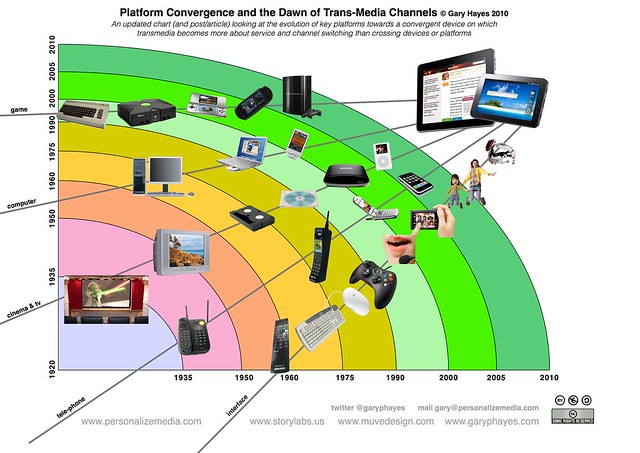
-
Article
Media Literacy
Media literacy refers to the ability to interpret and understand how various forms of media operate, and the impact those media can have on one’s perspective on people, events or issues. To be media literate is to understand that media are constructions, that audiences negotiate meaning, that all media have commercial, social and political implications, and that the content of media depends in part on the nature of the medium. Media literacy involves thinking critically and actively deconstructing the media one consumes. It also involves understanding one’s role as a consumer and creator of media and understanding the ways in which governments regulate media.
"https://d3d0lqu00lnqvz.cloudfront.net/media/new_article_images/SocialMedia/dreamstime_xl_123237692.jpg" // resources/views/front/categories/view.blade.php
https://d3d0lqu00lnqvz.cloudfront.net/media/new_article_images/SocialMedia/dreamstime_xl_123237692.jpg
-
Article
Media Ownership
Western societies are relying increasingly on communication through various media and relatively less on face-to-face contact to organize and co-ordinate activities, to disseminate knowledge and information, to educate and entertain.
"https://d3d0lqu00lnqvz.cloudfront.net/media/media/ea0ac524-dd46-427f-80bb-7c88b614515b.jpg" // resources/views/front/categories/view.blade.php
https://d3d0lqu00lnqvz.cloudfront.net/media/media/ea0ac524-dd46-427f-80bb-7c88b614515b.jpg
-
Article
Medical Anthropology
Medical anthropology is the study of interactions between culture and health. Medical anthropologists are interested in how a person's cultural background influences his or her experiences with health, illness and medical systems.
"https://thecanadianencyclopedia.ca/images/tce_placeholder.jpg?v=e9dca980c9bdb3aa11e832e7ea94f5d9" // resources/views/front/categories/view.blade.php
https://thecanadianencyclopedia.ca/images/tce_placeholder.jpg?v=e9dca980c9bdb3aa11e832e7ea94f5d9
-
Article
Medical Drug Abuse
Although medicines have been misused for as long as they have been available, a universally accepted definition of the term "drug abuse" does not exist.
"https://thecanadianencyclopedia.ca/images/tce_placeholder.jpg?v=e9dca980c9bdb3aa11e832e7ea94f5d9" // resources/views/front/categories/view.blade.php
https://thecanadianencyclopedia.ca/images/tce_placeholder.jpg?v=e9dca980c9bdb3aa11e832e7ea94f5d9
-
"https://thecanadianencyclopedia.ca/images/tce_placeholder.jpg?v=e9dca980c9bdb3aa11e832e7ea94f5d9" // resources/views/front/categories/view.blade.php
https://thecanadianencyclopedia.ca/images/tce_placeholder.jpg?v=e9dca980c9bdb3aa11e832e7ea94f5d9
-
Article
Medical Ethics
Medical ethics are concerned with moral questions raised by the practice of medicine and, more generally, by health care.
"https://thecanadianencyclopedia.ca/images/tce_placeholder.jpg?v=e9dca980c9bdb3aa11e832e7ea94f5d9" // resources/views/front/categories/view.blade.php
https://thecanadianencyclopedia.ca/images/tce_placeholder.jpg?v=e9dca980c9bdb3aa11e832e7ea94f5d9
-
Article
Medical Jurisprudence
Medical jurisprudence, broadly defined, covers the relationship between a patient and a health-care provider such as a doctor, nurse, dentist, physiotherapist, or even an institution such as a HOSPITAL.
"https://thecanadianencyclopedia.ca/images/tce_placeholder.jpg?v=e9dca980c9bdb3aa11e832e7ea94f5d9" // resources/views/front/categories/view.blade.php
https://thecanadianencyclopedia.ca/images/tce_placeholder.jpg?v=e9dca980c9bdb3aa11e832e7ea94f5d9
-
Article
Medical Records
When a patient receives medical treatment or other health care, there is normally a legal and ethical obligation on the health-care provider (as well as the health-care facility, such as a hospital) to keep a detailed written record of the patient's treatment.
"https://thecanadianencyclopedia.ca/images/tce_placeholder.jpg?v=e9dca980c9bdb3aa11e832e7ea94f5d9" // resources/views/front/categories/view.blade.php
https://thecanadianencyclopedia.ca/images/tce_placeholder.jpg?v=e9dca980c9bdb3aa11e832e7ea94f5d9
-
Article
Medical Research
Medical research ranges from fundamental research to clinical and applied technology.
"https://d3d0lqu00lnqvz.cloudfront.net/media/media/aca57006-6f6c-42b9-9d64-c5610ad2da2b.jpg" // resources/views/front/categories/view.blade.php
https://d3d0lqu00lnqvz.cloudfront.net/media/media/aca57006-6f6c-42b9-9d64-c5610ad2da2b.jpg
-
Article
Medical Ultrasound
Medical ultrasound (synonyms: diagnostic ultrasound, sonography, ultrasonography) is the use of high frequency sound waves that are far above the range of human hearing to image the interior of the body. It is used widely in Canada in both hospital and out-patient settings to assist in the identification and/or treatment of many diseases, and to monitor pregnancy. Therapeutic ultrasound, the use of sound waves in physical therapy to provide deep heating to soft issues such as muscles and tendons, is a different process and is not the subject of this article.
"https://d3d0lqu00lnqvz.cloudfront.net/medicalultrasound/medicalskillsweek.jpg" // resources/views/front/categories/view.blade.php
https://d3d0lqu00lnqvz.cloudfront.net/medicalultrasound/medicalskillsweek.jpg