Browse "Things"
-
Article
Jefferson Salamander
The Jefferson salamander (Ambystoma jeffersonianum) is a forest-dwelling salamander native to northeastern North America. Within Canada, it is only found in Southern Ontario. They are a member of the Ambystomatidae family, also known as “mole salamanders,” because they spend much of their lives underground. In Canada, the Jefferson salamander faces a severity of threats and is declining across much of its range, and it is listed as an endangered species under the Canadian Species at Risk Act.
"https://d3d0lqu00lnqvz.cloudfront.net/jeffersonsalamander/Jefferson-Salamander-Adult.jpg" // resources/views/front/categories/view.blade.php
https://d3d0lqu00lnqvz.cloudfront.net/jeffersonsalamander/Jefferson-Salamander-Adult.jpg
-
Article
Jehovah's Witnesses
Jehovah’s Witnesses traces its beginnings to the Advent Movement during the 1800s. Jehovah's Witnesses, religious denomination known internationally for tireless door-to-door EVANGELISM, large conventions, and members' refusal to bear arms, salute flags or accept blood transfusions.
"https://thecanadianencyclopedia.ca/images/tce_placeholder.jpg?v=e9dca980c9bdb3aa11e832e7ea94f5d9" // resources/views/front/categories/view.blade.php
https://thecanadianencyclopedia.ca/images/tce_placeholder.jpg?v=e9dca980c9bdb3aa11e832e7ea94f5d9
-
Article
Jellyfish
Jellyfish is the common name for the free-swimming medusae invertebrates of the phylum Cnidaria. Jellyfish are characterized by an umbrella-shaped body containing a jellylike substance (mesoglea), between upper and lower surfaces, which acts as a buoyancy aid. Three types are recognized: true jellyfish (Scyphozoa), hydromedusae (Hydrozoa) and colonial Siphonophora and Chondrophora.
"https://d3d0lqu00lnqvz.cloudfront.net/jellyfish/two-jellyfish.jpg" // resources/views/front/categories/view.blade.php
https://d3d0lqu00lnqvz.cloudfront.net/jellyfish/two-jellyfish.jpg
-
Article
"Jesous Ahatonhia"
“Jesous Ahatonhia” (“Jesus Is Born”), also known as “'Noël Huron,” was the first Canadian Christmas carol. Though widely believed to have been written by the Jesuit missionary Jean de Brébeuf (1593–1649), who taught the song to the Wendat near Georgian Bay circa 1642, it is not known whether the verses of “Jesous Ahatonhia” were written to fit the melody (apparently derived from the 16th-century French song “Une Jeune Pucelle”) with which they have come to be associated.
"https://thecanadianencyclopedia.ca/images/tce_placeholder.jpg?v=e9dca980c9bdb3aa11e832e7ea94f5d9" // resources/views/front/categories/view.blade.php
https://thecanadianencyclopedia.ca/images/tce_placeholder.jpg?v=e9dca980c9bdb3aa11e832e7ea94f5d9
-
Article
The Jesuit Relations
The Jesuit Relations is a collection of the annual reports written by the Jesuit missionaries in Canada and sent to France from 1632 to 1672. These reports are an important historical resource regarding all of the events which occurred in the colony during this period. More specifically, they describe the central role played by the members of the Society of Jesus in the colonization of North America. (See Population Settlement of New France.) These reports provide an overview of the colonial vision of the times and describe the successes and failures of the missionaries in their efforts to convert the First Nations. Printed and distributed in Paris, primarily as a propaganda tool, the Jesuit Relations are very popular with travel literature enthusiasts. They remain a unique source of information regarding the early days of New France.
"https://d3d0lqu00lnqvz.cloudfront.net/media/media/1ab35d09-0c75-441b-b37e-15cacbc481d7.jpg" // resources/views/front/categories/view.blade.php
https://d3d0lqu00lnqvz.cloudfront.net/media/media/1ab35d09-0c75-441b-b37e-15cacbc481d7.jpg
-
Article
Jesuits
The Society of Jesus was founded in Paris in 1534 by Saint Ignatius Loyola, a Spanish soldier who underwent a profound religious experience while recovering from serious wounds. Loyola called the society "The Company of Jesus" to indicate its military spirit. The order was authorized in September 1540 to ordain its members. The name "Jesuits" (meaning those who too frequently use or appropriate the name of Jesus) was used against the order as a term of reproach but in time was accepted by its members.
"https://d3d0lqu00lnqvz.cloudfront.net/media/media/16b8b94b-0ca0-468a-8f8f-09141c3462be.jpg" // resources/views/front/categories/view.blade.php
https://d3d0lqu00lnqvz.cloudfront.net/media/media/16b8b94b-0ca0-468a-8f8f-09141c3462be.jpg
-
Article
Jesuits' Estates Act
During the French regime Jesuits were granted considerable property and seigneuries, which they used for educational purposes and for their missions among Indigenous people.
"https://thecanadianencyclopedia.ca/images/tce_placeholder.jpg?v=e9dca980c9bdb3aa11e832e7ea94f5d9" // resources/views/front/categories/view.blade.php
https://thecanadianencyclopedia.ca/images/tce_placeholder.jpg?v=e9dca980c9bdb3aa11e832e7ea94f5d9
-
Article
Jet Stream
The jet stream is a band of wind moving high above the Earth's surface from west to east. Typically, the jet stream circles the Earth between 8–14 km above the ground. It is 2–4 km deep, 50–150 km wide and a few thousand kilometres long. Speeds occasionally reach 400 km/h but on average blow over North America at l00–200 km/h, circling the globe in about five days. Usually several jet stream systems travel around the Earth, sometimes in a discontinuous band, other times completely encircling the globe. Now and then they branch into two or three streams, only to merge as a stronger jet stream downwind.
"https://d3d0lqu00lnqvz.cloudfront.net/media/media/ecf3dcdb-d1d5-49d1-a385-264f348ad3b2.jpg" // resources/views/front/categories/view.blade.php
https://d3d0lqu00lnqvz.cloudfront.net/media/media/ecf3dcdb-d1d5-49d1-a385-264f348ad3b2.jpg
-
Article
Jeunesses Laurentiennes
Jeunesses Laurentiennes (also known as Jeunes Laurentiens; both expressions mean “Laurentian youth”) was a French-Canadian nationalist youth movement founded in 1936. With a traditional vision of society, in which the Catholic religion played a central role, Jeunesses Laurentiennes organized conferences and celebrations, published a magazine, and occasionally acted as a pressure group. Until the organization was disbanded in 1950, it served as a training ground for many young militant French-Canadian nationalists.
"https://d3d0lqu00lnqvz.cloudfront.net/media/media/087e6e29-46c4-42c3-a81d-df5a80a5c519.jpg" // resources/views/front/categories/view.blade.php
https://d3d0lqu00lnqvz.cloudfront.net/media/media/087e6e29-46c4-42c3-a81d-df5a80a5c519.jpg
-
Article
Jeux de la Francophonie
The idea for the Jeux de la Francophonie (Francophone Games) was born at the 1987 Sommet de la Francophonie in Quebec City. (See Francophonie and Canada.) Delegates at the summit discussed organizing an event that would bring French-speaking countries together while providing them with an international showcase. The Games are intended as not only an instrument of sport, but also an opportunity to showcase each nation’s heritage on an international stage. In addition to sporting events, there are artistic competitions.
"https://d3d0lqu00lnqvz.cloudfront.net/Logo_jeuxfrancophonie.svg.png" // resources/views/front/categories/view.blade.php
https://d3d0lqu00lnqvz.cloudfront.net/Logo_jeuxfrancophonie.svg.png
-
Article
Jeux du Québec
Plans for the Jeux du Québec were drawn up in the late sixties. Québec amateur sports stakeholders then proposed holding a competition that would stimulate interest in sports into the farthest reaches of the province.
"https://thecanadianencyclopedia.ca/images/tce_placeholder.jpg?v=e9dca980c9bdb3aa11e832e7ea94f5d9" // resources/views/front/categories/view.blade.php
https://thecanadianencyclopedia.ca/images/tce_placeholder.jpg?v=e9dca980c9bdb3aa11e832e7ea94f5d9
-
Article
Jewellery and Silverware Industry
Jewellery and Silverware IndustryJewellery and Silverware Industry includes establishments that manufacture jewellery (including costume jewellery, emblems, watch bracelets and precious metal cigar and cigarette cases) and silverware (including sterling or plated flatware and hollowware, and trophies), and those which rerefine or roll precious metals and produce precious metal alloys. The jewellery industry in Canada dates back to the 17th century and includes clockmakers and watchmakers as well as silversmiths who emigrated from the British Isles....
"https://thecanadianencyclopedia.ca/images/tce_placeholder.jpg?v=e9dca980c9bdb3aa11e832e7ea94f5d9" // resources/views/front/categories/view.blade.php
https://thecanadianencyclopedia.ca/images/tce_placeholder.jpg?v=e9dca980c9bdb3aa11e832e7ea94f5d9
-
Article
Jewish Canadians
Unlike most immigrants to Canada, Jews did not come from a place where they were the majority cultural group. Jews were internationally dispersed at the time of the ancient Roman Empire and after unsuccessful revolts against it lost their sovereignty in their ancient homeland. Subsequently, Jews lived, sometimes for many centuries, as minorities in the Middle East, North Africa and Europe. Jews have been in what would become Canada as early as the 18th century. Many more immigrated in the 19th and 20th centuries. In the 2021 census, around 335,000 people identified themselves as Jewish in Canada. (See also Judaism.)
"https://d3d0lqu00lnqvz.cloudfront.net/media/media/455197f8-b830-4e6f-8952-4bbaa53ee57d.jpg" // resources/views/front/categories/view.blade.php
https://d3d0lqu00lnqvz.cloudfront.net/media/media/455197f8-b830-4e6f-8952-4bbaa53ee57d.jpg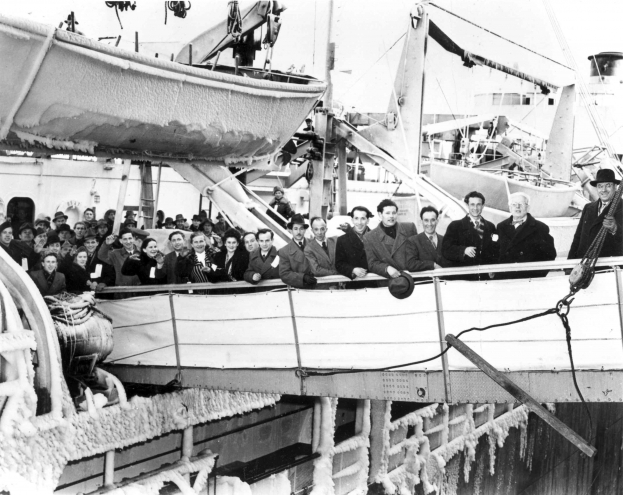
-
Article
Jewish Food in Canada
Jewish food in Canada was in large part shaped by the arrival of Eastern European Ashkenazi Jews in the late 1880s. Later Jewish immigration from North Africa and the Middle East also influenced the cuisine of Jewish Canadians, as they introduced new dishes and ingredients to the culinary landscape. Many foods remain distinctly Jewish, mainly being cooked and eaten by members of the Jewish community. However, some foods brought to Canada by Jews have also become popular foods enjoyed by Canadians of various backgrounds. Jewish food has become central to the culinary identity of Canada. (See Popular Jewish Dishes in Canada.)
"https://d3d0lqu00lnqvz.cloudfront.net/Jewish_dishes/challah.jpg" // resources/views/front/categories/view.blade.php
https://d3d0lqu00lnqvz.cloudfront.net/Jewish_dishes/challah.jpg
-
Article
Jewish Literature in Canada
Jewish Writing in Canada is characterized by linguistic and thematic influences derived from successive waves of immigration, and it appears mainly in Yiddish, Hebrew, English and French. Some Jewish writers work in other languages, such as German and Hungarian, reflecting the countries of their origin. Jewish concerns have also been treated by non-Jewish authors; eg, Gwethalyn Graham's Earth and High Heaven (1944) deals with intermarriage and anti-Semitism, Philip Child's Day of Wrath(1945) is concerned with Jewish persecution in Nazi Germany, and Yves Thériault's Aaron (1954) concentrates on the rejection of orthodoxy and the question of assimilation.
"https://d3d0lqu00lnqvz.cloudfront.net/media/media/b127f3da-c0b7-45d1-be4a-73e9d2103fd9.jpg" // resources/views/front/categories/view.blade.php
https://d3d0lqu00lnqvz.cloudfront.net/media/media/b127f3da-c0b7-45d1-be4a-73e9d2103fd9.jpg