
Browse "Things"
-
Article
Jays in Canada
Jay is the common name used for several members of the Corvidae family. In Canada, there are five species of jays, representing two subfamilies and four genera. Blue jays (Cyanocitta cristata), Stellar's jays (Cyanocitta stelleri) and Canada jays (Perisoreus canadensis) are fairly widespread. California scrub-jays (Aphelocoma californica) and pinyon jays (Gymnorhinus cyanocephalus) are rare and only occasionally found in the southernmost part of western Canada.
"https://d3d0lqu00lnqvz.cloudfront.net/jaysincanada/Stellar-s-Jay.jpg" // resources/views/front/categories/view.blade.php
https://d3d0lqu00lnqvz.cloudfront.net/jaysincanada/Stellar-s-Jay.jpg
-
Article
Jaymar Music Ltd.
Jaymar Music Ltd. Publishing company was established in 1967 in London, Ont, under the direction of Peter J. Martin.
"https://thecanadianencyclopedia.ca/images/tce_placeholder.jpg?v=e9dca980c9bdb3aa11e832e7ea94f5d9" // resources/views/front/categories/view.blade.php
https://thecanadianencyclopedia.ca/images/tce_placeholder.jpg?v=e9dca980c9bdb3aa11e832e7ea94f5d9
-
Article
Jay's Treaty
Jay’s Treaty was signed on 19 November 1794 by representatives of United States and Britain. The treaty is the product of trade and border negotiations. It is known for the provision that allows Indigenous people from Canada to live and work freely in the United States. The Canadian federal government does not recognize the reciprocal provision as binding. (See also Treaties with Indigenous Peoples in Canada.)
"https://d3d0lqu00lnqvz.cloudfront.net/media/media/e2ed8154-40d4-4e3e-b31e-c5e732db0af5.jpg" // resources/views/front/categories/view.blade.php
https://d3d0lqu00lnqvz.cloudfront.net/media/media/e2ed8154-40d4-4e3e-b31e-c5e732db0af5.jpg
-
Article
Jazz in Canada
Combining elements of European and African traditions, jazz is a style of music that originated with African Americans in the early 20th century. It is characterized by its improvisatory nature, rhythmic vitality (i.e., “swing”) and emotional expressiveness. Because jazz predates its earliest documented evidence (i.e., recordings), some controversy surrounds its origins. According to generally accepted theory, however, jazz can be traced to the socio-musical environment of New Orleans at the dawn of the 20th century.
"https://d3d0lqu00lnqvz.cloudfront.net/media/media/33987eea-209a-4612-bb8c-4287c7dd71a5.jpg" // resources/views/front/categories/view.blade.php
https://d3d0lqu00lnqvz.cloudfront.net/media/media/33987eea-209a-4612-bb8c-4287c7dd71a5.jpg
-
Article
Jazz Festivals
Jazz festivals. Traditionally heard in nightclubs, jazz was first presented in a festival setting in France in the late 1940s and at Newport, RI, in 1954. The 'jazz festival' typically brings together several ensembles over a period of days in one or more venues.
"https://d3d0lqu00lnqvz.cloudfront.net/media/media/721c956f-72bf-4c8b-9f62-13dda94c4dd5.jpg" // resources/views/front/categories/view.blade.php
https://d3d0lqu00lnqvz.cloudfront.net/media/media/721c956f-72bf-4c8b-9f62-13dda94c4dd5.jpg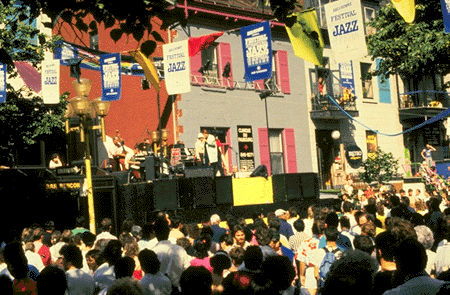
-
Macleans
JDS Uniphase Corporation
Jozef Straus has a reputation for being a bit, well, eccentric. There's that funky black beret he wears practically everywhere but in the shower - his company, Nepean, Ont.-based JDS Uniphase Corp., has even taken to handing copies of it out to visitors.This article was originally published in Maclean's Magazine on March 27, 2000
"https://thecanadianencyclopedia.ca/images/tce_placeholder.jpg?v=e9dca980c9bdb3aa11e832e7ea94f5d9" // resources/views/front/categories/view.blade.php
https://thecanadianencyclopedia.ca/images/tce_placeholder.jpg?v=e9dca980c9bdb3aa11e832e7ea94f5d9
-
Article
Jean Lyons School of Music
Jean Lyons School of Music. Teaching academy in piano and theory, established in Vancouver in 1963 by the pianist and teacher Jean Lyons.
"https://thecanadianencyclopedia.ca/images/tce_placeholder.jpg?v=e9dca980c9bdb3aa11e832e7ea94f5d9" // resources/views/front/categories/view.blade.php
https://thecanadianencyclopedia.ca/images/tce_placeholder.jpg?v=e9dca980c9bdb3aa11e832e7ea94f5d9
-
Article
Jefferson Salamander
The Jefferson salamander (Ambystoma jeffersonianum) is a forest-dwelling salamander native to northeastern North America. Within Canada, it is only found in Southern Ontario. They are a member of the Ambystomatidae family, also known as “mole salamanders,” because they spend much of their lives underground. In Canada, the Jefferson salamander faces a severity of threats and is declining across much of its range, and it is listed as an endangered species under the Canadian Species at Risk Act.
"https://d3d0lqu00lnqvz.cloudfront.net/jeffersonsalamander/Jefferson-Salamander-Adult.jpg" // resources/views/front/categories/view.blade.php
https://d3d0lqu00lnqvz.cloudfront.net/jeffersonsalamander/Jefferson-Salamander-Adult.jpg
-
Article
Jehovah's Witnesses
Jehovah’s Witnesses traces its beginnings to the Advent Movement during the 1800s. Jehovah's Witnesses, religious denomination known internationally for tireless door-to-door EVANGELISM, large conventions, and members' refusal to bear arms, salute flags or accept blood transfusions.
"https://thecanadianencyclopedia.ca/images/tce_placeholder.jpg?v=e9dca980c9bdb3aa11e832e7ea94f5d9" // resources/views/front/categories/view.blade.php
https://thecanadianencyclopedia.ca/images/tce_placeholder.jpg?v=e9dca980c9bdb3aa11e832e7ea94f5d9
-
Article
Jellyfish
Jellyfish is the common name for the free-swimming medusae invertebrates of the phylum Cnidaria. Jellyfish are characterized by an umbrella-shaped body containing a jellylike substance (mesoglea), between upper and lower surfaces, which acts as a buoyancy aid. Three types are recognized: true jellyfish (Scyphozoa), hydromedusae (Hydrozoa) and colonial Siphonophora and Chondrophora.
"https://d3d0lqu00lnqvz.cloudfront.net/jellyfish/two-jellyfish.jpg" // resources/views/front/categories/view.blade.php
https://d3d0lqu00lnqvz.cloudfront.net/jellyfish/two-jellyfish.jpg
-
Article
"Jesous Ahatonhia"
“Jesous Ahatonhia” (“Jesus Is Born”), also known as “'Noël Huron,” was the first Canadian Christmas carol. Though widely believed to have been written by the Jesuit missionary Jean de Brébeuf (1593–1649), who taught the song to the Wendat near Georgian Bay circa 1642, it is not known whether the verses of “Jesous Ahatonhia” were written to fit the melody (apparently derived from the 16th-century French song “Une Jeune Pucelle”) with which they have come to be associated.
"https://thecanadianencyclopedia.ca/images/tce_placeholder.jpg?v=e9dca980c9bdb3aa11e832e7ea94f5d9" // resources/views/front/categories/view.blade.php
https://thecanadianencyclopedia.ca/images/tce_placeholder.jpg?v=e9dca980c9bdb3aa11e832e7ea94f5d9
-
Article
The Jesuit Relations
The Jesuit Relations is a collection of the annual reports written by the Jesuit missionaries in Canada and sent to France from 1632 to 1672. These reports are an important historical resource regarding all of the events which occurred in the colony during this period. More specifically, they describe the central role played by the members of the Society of Jesus in the colonization of North America. (See Population Settlement of New France.) These reports provide an overview of the colonial vision of the times and describe the successes and failures of the missionaries in their efforts to convert the First Nations. Printed and distributed in Paris, primarily as a propaganda tool, the Jesuit Relations are very popular with travel literature enthusiasts. They remain a unique source of information regarding the early days of New France.
"https://d3d0lqu00lnqvz.cloudfront.net/media/media/1ab35d09-0c75-441b-b37e-15cacbc481d7.jpg" // resources/views/front/categories/view.blade.php
https://d3d0lqu00lnqvz.cloudfront.net/media/media/1ab35d09-0c75-441b-b37e-15cacbc481d7.jpg
-
Article
Jesuits
The Society of Jesus was founded in Paris in 1534 by Saint Ignatius Loyola, a Spanish soldier who underwent a profound religious experience while recovering from serious wounds. Loyola called the society "The Company of Jesus" to indicate its military spirit. The order was authorized in September 1540 to ordain its members. The name "Jesuits" (meaning those who too frequently use or appropriate the name of Jesus) was used against the order as a term of reproach but in time was accepted by its members.
"https://d3d0lqu00lnqvz.cloudfront.net/media/media/16b8b94b-0ca0-468a-8f8f-09141c3462be.jpg" // resources/views/front/categories/view.blade.php
https://d3d0lqu00lnqvz.cloudfront.net/media/media/16b8b94b-0ca0-468a-8f8f-09141c3462be.jpg
-
Article
Jesuits' Estates Act
During the French regime Jesuits were granted considerable property and seigneuries, which they used for educational purposes and for their missions among Indigenous people.
"https://thecanadianencyclopedia.ca/images/tce_placeholder.jpg?v=e9dca980c9bdb3aa11e832e7ea94f5d9" // resources/views/front/categories/view.blade.php
https://thecanadianencyclopedia.ca/images/tce_placeholder.jpg?v=e9dca980c9bdb3aa11e832e7ea94f5d9
-
Article
Jet Stream
The jet stream is a band of wind moving high above the Earth's surface from west to east. Typically, the jet stream circles the Earth between 8–14 km above the ground. It is 2–4 km deep, 50–150 km wide and a few thousand kilometres long. Speeds occasionally reach 400 km/h but on average blow over North America at l00–200 km/h, circling the globe in about five days. Usually several jet stream systems travel around the Earth, sometimes in a discontinuous band, other times completely encircling the globe. Now and then they branch into two or three streams, only to merge as a stronger jet stream downwind.
"https://d3d0lqu00lnqvz.cloudfront.net/media/media/ecf3dcdb-d1d5-49d1-a385-264f348ad3b2.jpg" // resources/views/front/categories/view.blade.php
https://d3d0lqu00lnqvz.cloudfront.net/media/media/ecf3dcdb-d1d5-49d1-a385-264f348ad3b2.jpg