Browse "Things"
-
Macleans
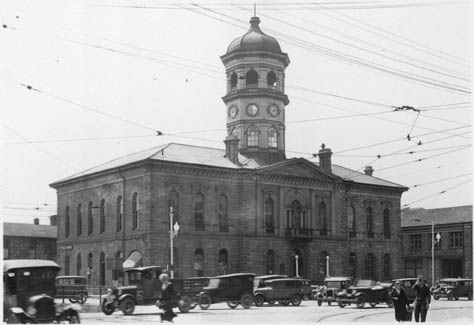
Griffintown Remembered
This article was originally published in Maclean’s magazine on March 17, 2003. Partner content is not updated. HAPPY FURLONG'S LIFE was saved by a quart of beer. When the elderly carriage driver left his rooming house at the corner of Shannon and Ottawa streets in MONTREAL's Griffintown shortly after 10 a.m.
"https://thecanadianencyclopedia.ca/images/tce_placeholder.jpg?v=e9dca980c9bdb3aa11e832e7ea94f5d9" // resources/views/front/categories/view.blade.php
https://thecanadianencyclopedia.ca/images/tce_placeholder.jpg?v=e9dca980c9bdb3aa11e832e7ea94f5d9
-
"https://d3d0lqu00lnqvz.cloudfront.net/media/media/719a5a9d-e031-496a-a4d4-2555d667b686.jpg" // resources/views/front/categories/view.blade.php
https://d3d0lqu00lnqvz.cloudfront.net/media/media/719a5a9d-e031-496a-a4d4-2555d667b686.jpg
-
Article
Grit
Grit, a popular reference to a member of the LIBERAL PARTY of Canada. The nickname derives from grit, fine sand or gravel, which is often valued for its abrasive quality, and from an American slang term implying firmness of character, as used in the phrase "true grit.
"https://d3d0lqu00lnqvz.cloudfront.net/media/media/407f0fe6-9a89-4187-b3af-b6293f8c1155.jpg" // resources/views/front/categories/view.blade.php
https://d3d0lqu00lnqvz.cloudfront.net/media/media/407f0fe6-9a89-4187-b3af-b6293f8c1155.jpg
-
Article
Grizzly Bear
The grizzly bear (Ursus arctos horribilis) is a large mammal of the order Carnivora. Grizzly bears are a subspecies of brown bear that lives in North America, with distinct regional populations ranging across western Canada. They are the second largest land carnivore in North America.
"https://d3d0lqu00lnqvz.cloudfront.net/media/media/9e6ac704-cfae-4d7b-8f0b-916349927664.jpg" // resources/views/front/categories/view.blade.php
https://d3d0lqu00lnqvz.cloudfront.net/media/media/9e6ac704-cfae-4d7b-8f0b-916349927664.jpg
-
Article
Grosbeak
Grosbeak is a common name for large members of 2 families of birds, Cardinalidae (cardinal) and Fringillidae (finch).
"https://thecanadianencyclopedia.ca/images/tce_placeholder.jpg?v=e9dca980c9bdb3aa11e832e7ea94f5d9" // resources/views/front/categories/view.blade.php
https://thecanadianencyclopedia.ca/images/tce_placeholder.jpg?v=e9dca980c9bdb3aa11e832e7ea94f5d9
-
Article
Gross Domestic Product (GDP)
Gross domestic product (GDP) refers to the value of all final goods and services produced within a country by all factors of production, regardless of their ownership, usually during one year. Statistics Canada switched to GDP in their calculations of national production in 1986 to facilitate comparisons with other international statistics as most other countries used GDP. Despite its limitations, GDP is considered the best and most concise overall measure of economic performance. It is often used to calculate changes in a country’s standard of living. The growth of inflation-adjusted GDP (known as real GDP) is an important economic performance indicator. The tracking of GDP over time is used as evidence of business cycle performance, as traditionally two consecutive quarters of negative real GDP growth are referred to as a recession. As well, the distinction is often made between the growth of total real GDP (known as extensive growth) and the growth of real GDP per person (intensive growth), with intensive growth often used as an indicator of welfare per person in an economy.
"https://d3d0lqu00lnqvz.cloudfront.net/media/media/6bd55c36-e3ea-4ede-b4b9-a93257b9f45f.png" // resources/views/front/categories/view.blade.php
https://d3d0lqu00lnqvz.cloudfront.net/media/media/6bd55c36-e3ea-4ede-b4b9-a93257b9f45f.png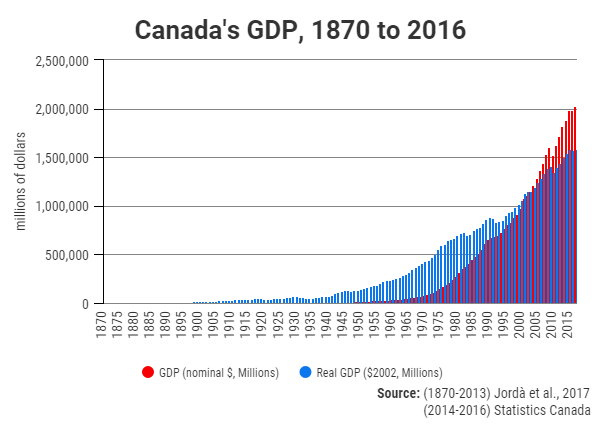
-
Article
Groundhog Day in Canada
Groundhog Day is celebrated in Canada and the United States every year on 2 February. Legend has it that watching a groundhog emerge from its burrow can determine the weather forecast for the coming weeks. Accordingly, if it is a sunny day and the groundhog sees its shadow, it goes back to sleep for six more weeks of winter. If the weather is cloudy and the groundhog does not see its shadow, it stays outside, meaning that the worst of winter is over and spring will soon arrive. Many communities in Canada keep up this tradition today, attracting the attention of tourists and media alike.
"https://d3d0lqu00lnqvz.cloudfront.net/media/media/5ff0e2de-fcda-40e4-9cbe-b84c86365415.jpg" // resources/views/front/categories/view.blade.php
https://d3d0lqu00lnqvz.cloudfront.net/media/media/5ff0e2de-fcda-40e4-9cbe-b84c86365415.jpg
-
Article
Groundsel
Groundsel, or ragwort, common names for plants of genus Senecio, family Compositae or Asteraceae.
"https://d3d0lqu00lnqvz.cloudfront.net/media/media/9a776da6-54b7-4271-b584-7af19ab25d8b.jpg" // resources/views/front/categories/view.blade.php
https://d3d0lqu00lnqvz.cloudfront.net/media/media/9a776da6-54b7-4271-b584-7af19ab25d8b.jpg
-
Article
Groundwater
Groundwater interacts with lakes and rivers as part of the hydrologic cycle. The cycle begins with the formation of clouds through evaporation from the ocean, lakes, rivers, plants and soil.
"https://d3d0lqu00lnqvz.cloudfront.net/media/media/1aa8fafc-a0a0-48c9-86a8-6e588b13ecfe.jpg" // resources/views/front/categories/view.blade.php
https://d3d0lqu00lnqvz.cloudfront.net/media/media/1aa8fafc-a0a0-48c9-86a8-6e588b13ecfe.jpg
-
Article
Group of Seven
The Group of Seven, also known as the Algonquin School, was a school of landscape painters. It was founded in 1920 as an organization of self-proclaimed modern artists and disbanded in 1933. The group presented the dense, northern boreal forest of the Canadian Shield as a transcendent, spiritual force. Their depictions of Canada’s rugged wind-swept forest panoramas were eventually equated with a romanticized notion of Canadian strength and independence. Their works were noted for their bright colours, tactile paint handling, and simple yet dynamic forms. In addition to Tom Thomson, David Milne and Emily Carr, the Group of Seven were the most important Canadian artists of the early 20th century. Their influence is seen in artists as diverse as abstract painter Jack Bush, the Painters Eleven, and Scottish painter Peter Doig.
"https://d3d0lqu00lnqvz.cloudfront.net/media/media/8b176fb1-c3cb-418c-a75f-a4c425f928d0.jpg" // resources/views/front/categories/view.blade.php
https://d3d0lqu00lnqvz.cloudfront.net/media/media/8b176fb1-c3cb-418c-a75f-a4c425f928d0.jpg
-
Article
Grouse in Canada
The grouse (Tetraonidae) is a small subfamily (18 species) of chickenlike birds with circumpolar distribution above latitude 26° north. It includes ptarmigans as well as those birds commonly called grouse. Members of the largest species can weigh up to 6,360 g; the smallest, 340 g. The sharp-tailed grouse is the provincial bird of Saskatchewan.
"https://d3d0lqu00lnqvz.cloudfront.net/media/media/99149971-fea4-445a-8bfe-58335a68e67f.jpg" // resources/views/front/categories/view.blade.php
https://d3d0lqu00lnqvz.cloudfront.net/media/media/99149971-fea4-445a-8bfe-58335a68e67f.jpg
-
Article
GRT of Canada Ltd
GRT of Canada, Ltd. Record company, active 1969-79. It was established in London, Ont, as a subsidiary of General Recorded Tape of California.
"https://thecanadianencyclopedia.ca/images/tce_placeholder.jpg?v=e9dca980c9bdb3aa11e832e7ea94f5d9" // resources/views/front/categories/view.blade.php
https://thecanadianencyclopedia.ca/images/tce_placeholder.jpg?v=e9dca980c9bdb3aa11e832e7ea94f5d9
-
Macleans
GST Harmonized in Atlantic
Frank McKenna had a big smile on his face, and a new spin on a familiar sales pitch. In a national newspaper advertisement that appeared late last week, the New Brunswick premier told readers across the country that "the best place in Canada to do business keeps getting better and better.This article was originally published in Maclean's Magazine on May 6, 1996
"https://thecanadianencyclopedia.ca/images/tce_placeholder.jpg?v=e9dca980c9bdb3aa11e832e7ea94f5d9" // resources/views/front/categories/view.blade.php
https://thecanadianencyclopedia.ca/images/tce_placeholder.jpg?v=e9dca980c9bdb3aa11e832e7ea94f5d9
-
Article
Guarantee Act
Guarantee Act, 1849, conceived by Francis HINCKS and carried in the Legislative Assembly of the Province of Canada, established the principle of government assistance to railways. Under the terms of the Act, any railway more than 75 mi (120 km) long was eligible for a government guarantee on the interest of half its bonds as soon as half the line had been completed.
"https://d3d0lqu00lnqvz.cloudfront.net/media/media/e75f49df-4ccf-4613-bcbb-01819f3f0479.jpg" // resources/views/front/categories/view.blade.php
https://d3d0lqu00lnqvz.cloudfront.net/media/media/e75f49df-4ccf-4613-bcbb-01819f3f0479.jpg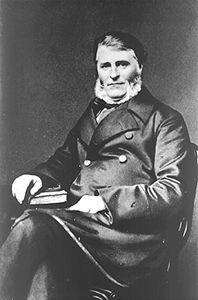
-
Article
Guelph in the First World War
Guelph, Ontario, was typical of small Canadian cities during the First World War. Of its population of about 16,000, more than a third, 5,610, volunteered for military service; 3,328 were accepted. Today, 216 of their names are engraved on the city’s cenotaph. While Guelphites served overseas, the war had a profound and lasting effect on their hometown — an experience that provides an insight into wartime Canada.
"https://d3d0lqu00lnqvz.cloudfront.net/media/media/e38f8065-b481-40c7-9d21-690d7e0a84dc.jpg" // resources/views/front/categories/view.blade.php
https://d3d0lqu00lnqvz.cloudfront.net/media/media/e38f8065-b481-40c7-9d21-690d7e0a84dc.jpg