Browse "Things"
-
Article
Compact Theory of Confederation
Compact Theory of Confederation, see CONSTITUTIONAL HISTORY.
"https://thecanadianencyclopedia.ca/images/tce_placeholder.jpg?v=e9dca980c9bdb3aa11e832e7ea94f5d9" // resources/views/front/categories/view.blade.php
https://thecanadianencyclopedia.ca/images/tce_placeholder.jpg?v=e9dca980c9bdb3aa11e832e7ea94f5d9
-
Article
Company of One Hundred Associates
The Company of New France, or Company of One Hundred Associates (Compagnie des Cent-Associés) as it was more commonly known, was formed in France in 1627. Its purpose was to increase New France’s population while enjoying a monopoly on almost all colonial trade. It took bold steps but suffered many setbacks. The company folded in 1663. It earned little return on its investment, though it helped establish New France as a viable colony.
"https://d3d0lqu00lnqvz.cloudfront.net/media/media/e4ec1e55-01c2-4b77-a220-f05a84fd4c9c.jpg" // resources/views/front/categories/view.blade.php
https://d3d0lqu00lnqvz.cloudfront.net/media/media/e4ec1e55-01c2-4b77-a220-f05a84fd4c9c.jpg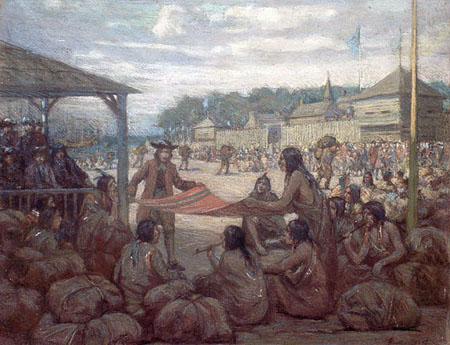
-
Article
Compagnie des Indes occidentales
The Compagnie des Indes occidentales was a trading company that drove France’s colonial economy from 1664 to 1674. Its name translates to West Indies Company. King Louis XIV gave the company exclusive rights to trade and govern in all French colonies. Its territory extended from the Americas to the Caribbean and Western Africa. In addition to natural resources such as furs and sugar, the Compagnie traded enslaved people. This company is not to be confused with the French trading company founded by John Law and renamed Compagnie des Indes in 1719.
"https://thecanadianencyclopedia.ca/images/tce_placeholder.jpg?v=e9dca980c9bdb3aa11e832e7ea94f5d9" // resources/views/front/categories/view.blade.php
https://thecanadianencyclopedia.ca/images/tce_placeholder.jpg?v=e9dca980c9bdb3aa11e832e7ea94f5d9
-
Article
Compagnie du Nord
Compagnie du Nord (Compagnie de la Baie du Nord), fd 1682 by Canadian merchants, led by Charles Aubert de la Chesnaye, to trade into Hudson Bay by sea.
"https://thecanadianencyclopedia.ca/images/tce_placeholder.jpg?v=e9dca980c9bdb3aa11e832e7ea94f5d9" // resources/views/front/categories/view.blade.php
https://thecanadianencyclopedia.ca/images/tce_placeholder.jpg?v=e9dca980c9bdb3aa11e832e7ea94f5d9
-
Article
Company of Young Canadians
Company of Young Canadians, a short-lived voluntary agency of the government of Canada, established with a mandate to encourage social, economic and community development in Canada.
"https://thecanadianencyclopedia.ca/images/tce_placeholder.jpg?v=e9dca980c9bdb3aa11e832e7ea94f5d9" // resources/views/front/categories/view.blade.php
https://thecanadianencyclopedia.ca/images/tce_placeholder.jpg?v=e9dca980c9bdb3aa11e832e7ea94f5d9
-
Article
Company Towns
Company towns, important in Canada's capital formation and industrialization, urban development, and trade-union movement.
"https://thecanadianencyclopedia.ca/images/tce_placeholder.jpg?v=e9dca980c9bdb3aa11e832e7ea94f5d9" // resources/views/front/categories/view.blade.php
https://thecanadianencyclopedia.ca/images/tce_placeholder.jpg?v=e9dca980c9bdb3aa11e832e7ea94f5d9
-
Article
Comparative Literature
Comparative LiteratureComparative literature is the international or multilingual study of literary history, ie, of broad currents of thought and style and of major schools; of literary genres, forms and modes; of motifs and themes; of the presence of a work of literature, an author, a whole literature or even a country, in another national literature; of authors writing in different languages, but linked with "influences" and typological affinities. Comparative literature includes literary criticism and theory,...
"https://thecanadianencyclopedia.ca/images/tce_placeholder.jpg?v=e9dca980c9bdb3aa11e832e7ea94f5d9" // resources/views/front/categories/view.blade.php
https://thecanadianencyclopedia.ca/images/tce_placeholder.jpg?v=e9dca980c9bdb3aa11e832e7ea94f5d9
-
Article
Competition Festivals
Competition festivals. Public, graded competitions for student and amateur classical musicians; school, amateur, and church choirs; and school, amateur, and civic instrumental ensembles. Contestants are adjudicated publicly by trained professionals who give them comparative marks.
"https://thecanadianencyclopedia.ca/images/tce_placeholder.jpg?v=e9dca980c9bdb3aa11e832e7ea94f5d9" // resources/views/front/categories/view.blade.php
https://thecanadianencyclopedia.ca/images/tce_placeholder.jpg?v=e9dca980c9bdb3aa11e832e7ea94f5d9
-
Article
Competition Policy
Competition policy refers to legislation used by the federal government to eliminate privately imposed restraints on trade and to encourage competition.
"https://thecanadianencyclopedia.ca/images/tce_placeholder.jpg?v=e9dca980c9bdb3aa11e832e7ea94f5d9" // resources/views/front/categories/view.blade.php
https://thecanadianencyclopedia.ca/images/tce_placeholder.jpg?v=e9dca980c9bdb3aa11e832e7ea94f5d9
-
Article
Compo Company Ltd.
Compo Company Ltd. First Canadian independent record pressing plant; also the largest of its day. Established in 1918 as a pressing plant at Lachine, near Montreal, by Herbert S.
"https://thecanadianencyclopedia.ca/images/tce_placeholder.jpg?v=e9dca980c9bdb3aa11e832e7ea94f5d9" // resources/views/front/categories/view.blade.php
https://thecanadianencyclopedia.ca/images/tce_placeholder.jpg?v=e9dca980c9bdb3aa11e832e7ea94f5d9
-
Article
Composition competitions
Composition competitions. Increasingly numerous after 1950, sponsored by governmental, professional, educational, and other organizations. Prizes may be in the form of medals, scholarships, commissions, performances and cash, or cash alone.
"https://thecanadianencyclopedia.ca/images/tce_placeholder.jpg?v=e9dca980c9bdb3aa11e832e7ea94f5d9" // resources/views/front/categories/view.blade.php
https://thecanadianencyclopedia.ca/images/tce_placeholder.jpg?v=e9dca980c9bdb3aa11e832e7ea94f5d9
-
Article
Composition
Composition Composition. See the following: Anthems, motets, and psalms Art song Ballets and dance theatre Brass Cantata Cello Choral composition Chamber music composition Christmas Composition, instrumental solos and duos Composition, topical Composition competitions Composition for ensemble teaching Composition techniques, contemporary Concertos and concertante music Double-bass Easter, Lent, the Passion Electroacoustic music Film scores Folk-music-inspired composition Guitar Harp Harpsichord composition Incidental music Librettos Literature set to music Lullabies Masses Musical theatre Opera composition Oratorio composition Orchestral...
"https://thecanadianencyclopedia.ca/images/tce_placeholder.jpg?v=e9dca980c9bdb3aa11e832e7ea94f5d9" // resources/views/front/categories/view.blade.php
https://thecanadianencyclopedia.ca/images/tce_placeholder.jpg?v=e9dca980c9bdb3aa11e832e7ea94f5d9
-
Article
Composition for Ensemble Teaching
Composition for ensemble teaching. Some Canadian composers have been loth - or insufficiently experienced - to work within the constraints imposed by writing for student performers.
"https://thecanadianencyclopedia.ca/images/tce_placeholder.jpg?v=e9dca980c9bdb3aa11e832e7ea94f5d9" // resources/views/front/categories/view.blade.php
https://thecanadianencyclopedia.ca/images/tce_placeholder.jpg?v=e9dca980c9bdb3aa11e832e7ea94f5d9
-
Article
Composition, instrumental solos and duos
IntroductionOne may consider the repertoire of Canadian compositions in these categories in two ways. First, 'repertoire' may indicate those works which are played repeatedly.
"https://thecanadianencyclopedia.ca/images/tce_placeholder.jpg?v=e9dca980c9bdb3aa11e832e7ea94f5d9" // resources/views/front/categories/view.blade.php
https://thecanadianencyclopedia.ca/images/tce_placeholder.jpg?v=e9dca980c9bdb3aa11e832e7ea94f5d9
-
Article
Comprehensive Land Claims: Modern Treaties
Comprehensive land claims are modern-day treaties made between Indigenous peoples and the federal government. They are based on the traditional use and occupancy of land by Indigenous peoples who did not sign treaties and were not displaced from their lands by war or other means. These claims, which are settled by negotiation, follow a process established by the federal government to enable First Nations, Inuit and Métis to obtain full recognition as the original inhabitants of what is now Canada. Settlement of these claims comprises a variety of terms including money, land, forms of local government, rights to wildlife, rights protecting language and culture, and joint management of lands and resources. Treaties are constitutionally protected, mutually binding agreements. Those signed by Indigenous peoples between 1701 and 1923 are commonly referred to as historic treaties, and modern treaties refer to those agreements negotiated since then.
"https://d3d0lqu00lnqvz.cloudfront.net/media/media/a79638c8-fe6a-4fd5-9892-a7cc95f76efc.jpg" // resources/views/front/categories/view.blade.php
https://d3d0lqu00lnqvz.cloudfront.net/media/media/a79638c8-fe6a-4fd5-9892-a7cc95f76efc.jpg