
Browse "Politics & Law"
-
Article
Communauté des biens
Communauté des biens (community of property), term used in the legal codes of NEW FRANCE and Québec to describe the pooled assets of husband and wife. It began as part of the Coutume de Paris, introduced about 1640 and the sole legal code of the colony after 1664.
"https://thecanadianencyclopedia.ca/images/tce_placeholder.jpg?v=e9dca980c9bdb3aa11e832e7ea94f5d9" // resources/views/front/categories/view.blade.php
https://thecanadianencyclopedia.ca/images/tce_placeholder.jpg?v=e9dca980c9bdb3aa11e832e7ea94f5d9
-
Article
Communications Law
Communications LawCanadian communications law includes judicial decisions and statutes governing communications firms; however, the most important element of Canadian communications law comes from the decisions of the federal regulator, the CANADIAN RADIO-TELEVISION AND TELECOMMUNICATIONS COMMISSION (CRTC), which regulates radio, television, broadcast distribution undertakings (cable, satellite and IPTV television services) and most telecommunication services, wireless services and Internet service providers (ISPs). Not all communications are subject to regulatory oversight in Canada. Newspapers are not subject to...
"https://thecanadianencyclopedia.ca/images/tce_placeholder.jpg?v=e9dca980c9bdb3aa11e832e7ea94f5d9" // resources/views/front/categories/view.blade.php
https://thecanadianencyclopedia.ca/images/tce_placeholder.jpg?v=e9dca980c9bdb3aa11e832e7ea94f5d9
-
Article
Compact Theory of Confederation
Compact Theory of Confederation, see CONSTITUTIONAL HISTORY.
"https://thecanadianencyclopedia.ca/images/tce_placeholder.jpg?v=e9dca980c9bdb3aa11e832e7ea94f5d9" // resources/views/front/categories/view.blade.php
https://thecanadianencyclopedia.ca/images/tce_placeholder.jpg?v=e9dca980c9bdb3aa11e832e7ea94f5d9
-
Article
Company of Young Canadians
Company of Young Canadians, a short-lived voluntary agency of the government of Canada, established with a mandate to encourage social, economic and community development in Canada.
"https://thecanadianencyclopedia.ca/images/tce_placeholder.jpg?v=e9dca980c9bdb3aa11e832e7ea94f5d9" // resources/views/front/categories/view.blade.php
https://thecanadianencyclopedia.ca/images/tce_placeholder.jpg?v=e9dca980c9bdb3aa11e832e7ea94f5d9
-
Article
Competition Policy
Competition policy refers to legislation used by the federal government to eliminate privately imposed restraints on trade and to encourage competition.
"https://thecanadianencyclopedia.ca/images/tce_placeholder.jpg?v=e9dca980c9bdb3aa11e832e7ea94f5d9" // resources/views/front/categories/view.blade.php
https://thecanadianencyclopedia.ca/images/tce_placeholder.jpg?v=e9dca980c9bdb3aa11e832e7ea94f5d9
-
Article
Comprehensive Land Claims: Modern Treaties
Comprehensive land claims are modern-day treaties made between Indigenous peoples and the federal government. They are based on the traditional use and occupancy of land by Indigenous peoples who did not sign treaties and were not displaced from their lands by war or other means. These claims, which are settled by negotiation, follow a process established by the federal government to enable First Nations, Inuit and Métis to obtain full recognition as the original inhabitants of what is now Canada. Settlement of these claims comprises a variety of terms including money, land, forms of local government, rights to wildlife, rights protecting language and culture, and joint management of lands and resources. Treaties are constitutionally protected, mutually binding agreements. Those signed by Indigenous peoples between 1701 and 1923 are commonly referred to as historic treaties, and modern treaties refer to those agreements negotiated since then.
"https://d3d0lqu00lnqvz.cloudfront.net/media/media/a79638c8-fe6a-4fd5-9892-a7cc95f76efc.jpg" // resources/views/front/categories/view.blade.php
https://d3d0lqu00lnqvz.cloudfront.net/media/media/a79638c8-fe6a-4fd5-9892-a7cc95f76efc.jpg
-
Article
Confidentiality
The duty which requires physicians to keep the information they receive from their patients confidential is well established in Canadian common law, health care legislation and professional codes of conduct.
"https://thecanadianencyclopedia.ca/images/tce_placeholder.jpg?v=e9dca980c9bdb3aa11e832e7ea94f5d9" // resources/views/front/categories/view.blade.php
https://thecanadianencyclopedia.ca/images/tce_placeholder.jpg?v=e9dca980c9bdb3aa11e832e7ea94f5d9
-
Article
Conflict of Interest
Conflict of interest may be defined as a situation in which politicians and public servants have an actual or potential interest (usually financial) that may influence or appear to influence the conduct of their official duties (see PATRONAGE; CORRUPTION).
"https://thecanadianencyclopedia.ca/images/tce_placeholder.jpg?v=e9dca980c9bdb3aa11e832e7ea94f5d9" // resources/views/front/categories/view.blade.php
https://thecanadianencyclopedia.ca/images/tce_placeholder.jpg?v=e9dca980c9bdb3aa11e832e7ea94f5d9
-
Article
The Conquest of New France
The Conquest (La Conquête) is a term used to describe the acquisition of Canada by Great Britain during the Seven Years’ War. It also refers to the resulting conditions experienced by Canada’s 60,000 to 70,000 French-speaking inhabitants and numerous Indigenous groups. French forces at Quebec City surrendered to British forces on 18 September 1759, a few days after the crucial Battle of the Plains of Abraham. French resistance ended in 1760 with the capitulation of Montreal. In 1763, the Treaty of Paris surrendered New France to Britain. The Royal Proclamation of 1763 introduced assimilative policies that ultimately failed. They were replaced by the provisions of the Quebec Act of 1774. Although it helped spark the American Revolutionary War (1775–83), the Act also granted Canadians enviable conditions that resulted in generations of relative stability.
"https://d3d0lqu00lnqvz.cloudfront.net/JamesWolfe/Benjamin_West_DeathofGeneralWolfe.jpg" // resources/views/front/categories/view.blade.php
https://d3d0lqu00lnqvz.cloudfront.net/JamesWolfe/Benjamin_West_DeathofGeneralWolfe.jpg
-
Article
Conscription in Canada
Conscription is the compulsory enlistment or “call up” of citizens for military service. It is sometimes known as “the draft.” The federal government enacted conscription in both the First World War and the Second World War. Both instances created sharp divisions between English Canadians, who tended to support the practice, and French Canadians, who generally did not. Canada does not currently have mandatory military service. The Canadian Armed Forces are voluntary services.
"https://d3d0lqu00lnqvz.cloudfront.net/media/media/e38df4dd-d940-43c5-b849-2f2518c8f29d.jpg" // resources/views/front/categories/view.blade.php
https://d3d0lqu00lnqvz.cloudfront.net/media/media/e38df4dd-d940-43c5-b849-2f2518c8f29d.jpg
-
Article
Conscription in Canada (Plain-Language Summary)
Conscription is the drafting of people for mandatory military service. Canadians have been conscripted twice in history. Both times, only males were conscripted. The first time was during the First World War. The second time was during the Second World War. Conscription was an issue that divided Canada. Most English-speaking Canadians supported it. Most French-speaking Canadians opposed it. (This article is a plain-language summary of Conscription in Canada. If you are interested in reading about this topic in more depth, please see the full-length entry.)
"https://d3d0lqu00lnqvz.cloudfront.net/media/media/aab5fda7-e041-4148-b6de-40ea15191996.jpg" // resources/views/front/categories/view.blade.php
https://d3d0lqu00lnqvz.cloudfront.net/media/media/aab5fda7-e041-4148-b6de-40ea15191996.jpg
-
Article
Conservatism
The range of beliefs among those who call themselves conservatives in Canada is wide. Some, like the policy analysts of the Fraser Institute or like Stephen HARPER, the leader of the CANADIAN ALLIANCE, believe in a policy agenda of lower taxes, greater deregulation and increased privatization.
"https://thecanadianencyclopedia.ca/images/tce_placeholder.jpg?v=e9dca980c9bdb3aa11e832e7ea94f5d9" // resources/views/front/categories/view.blade.php
https://thecanadianencyclopedia.ca/images/tce_placeholder.jpg?v=e9dca980c9bdb3aa11e832e7ea94f5d9
-
Article
Constitution of Canada
The Constitution of Canada is the country’s governing legal framework. It defines the powers of the executive branches of government and of the legislatures at both the federal and provincial levels. Canada’s Constitution is not one document; it is a complex mix of statutes, orders, British and Canadian court decisions, and generally accepted practices known as constitutional conventions. In the words of the Supreme Court of Canada, “Constitutional convention plus constitutional law equal the total constitution of the country.” The Constitution provides Canada with the legal structure for a stable, democratic government.
"https://d3d0lqu00lnqvz.cloudfront.net/media/media/231555c5-c09f-428e-8a64-bbd73e0e0c0a.jpg" // resources/views/front/categories/view.blade.php
https://d3d0lqu00lnqvz.cloudfront.net/media/media/231555c5-c09f-428e-8a64-bbd73e0e0c0a.jpg
-
Article
Constitution Act, 1867
The Constitution Act, 1867 was originally known as the British North America Act (BNA Act). It was the law passed by the British Parliament on 29 March 1867 to create the Dominion of Canada. It came into effect on 1 July 1867. The Act is the foundational document of Canada’s Constitution. It outlines the structure of government in Canada and the distribution of powers between the central Parliament and the provincial legislatures. It was renamed the Constitution Act, 1867 with the patriation of the Constitution in 1982.
"https://d3d0lqu00lnqvz.cloudfront.net/media/media/f8f2bab3-d387-4165-9fbc-617c30019b95.jpg" // resources/views/front/categories/view.blade.php
https://d3d0lqu00lnqvz.cloudfront.net/media/media/f8f2bab3-d387-4165-9fbc-617c30019b95.jpg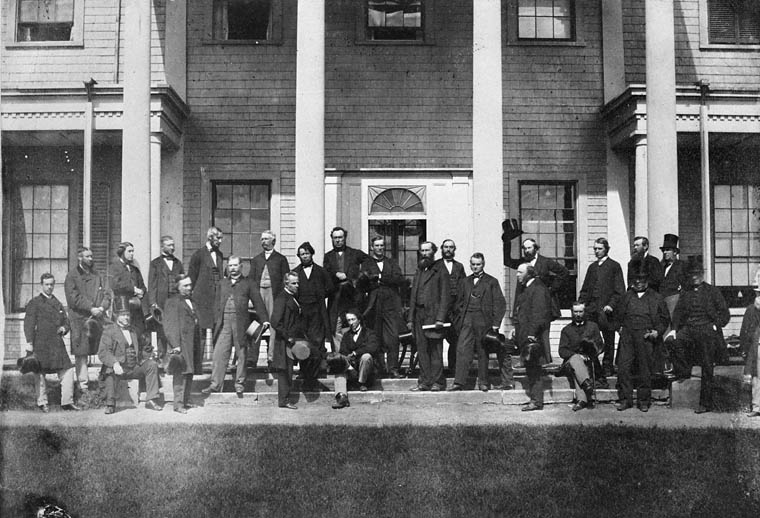
-
Article
Constitution Act, 1982
The Constitution Act, 1982 is a landmark document in Canadian history. It achieved full independence for Canada by allowing the country to change its Constitution without approval from Britain. It also enshrined the Charter of Rights and Freedoms in Canada’s Constitution, the highest law of the land. The Act was passed after a fierce, 18-month political and legal struggle that dominated headlines and the agendas of every government in the country. (See Patriation of the Constitution.)
"https://d3d0lqu00lnqvz.cloudfront.net/media/media/231555c5-c09f-428e-8a64-bbd73e0e0c0a.jpg" // resources/views/front/categories/view.blade.php
https://d3d0lqu00lnqvz.cloudfront.net/media/media/231555c5-c09f-428e-8a64-bbd73e0e0c0a.jpg