
Browse "Politics & Law"
-
Macleans
Clark to Become Tory Leader
There is not much Canadians dont know about Joe Clark by now. He is an eternal optimist to some, a punching bag for others, and that combination has set him up for some of the more humiliating political defeats of his generation.This article was originally published in Maclean's Magazine on November 2, 1998
"https://thecanadianencyclopedia.ca/images/tce_placeholder.jpg?v=e9dca980c9bdb3aa11e832e7ea94f5d9" // resources/views/front/categories/view.blade.php
https://thecanadianencyclopedia.ca/images/tce_placeholder.jpg?v=e9dca980c9bdb3aa11e832e7ea94f5d9
-
Article
Clear Grits
Clear Grits, Upper Canadian Reformers who became discontented with the conservatism of the Baldwin-LaFontaine ministry after 1849.
"https://thecanadianencyclopedia.ca/images/tce_placeholder.jpg?v=e9dca980c9bdb3aa11e832e7ea94f5d9" // resources/views/front/categories/view.blade.php
https://thecanadianencyclopedia.ca/images/tce_placeholder.jpg?v=e9dca980c9bdb3aa11e832e7ea94f5d9
-
Macleans
Clinton Defends Canadian Federalism
It doesn't take much to put the spring back into a Quebec separatist's step these days. Their grand project - a march towards independence from Canada, or at least a new partnership of equals with the rest of the country - has bogged down.This article was originally published in Maclean's Magazine on October 18, 1999
"https://thecanadianencyclopedia.ca/images/tce_placeholder.jpg?v=e9dca980c9bdb3aa11e832e7ea94f5d9" // resources/views/front/categories/view.blade.php
https://thecanadianencyclopedia.ca/images/tce_placeholder.jpg?v=e9dca980c9bdb3aa11e832e7ea94f5d9
-
Article
Co-operative Commonwealth Federation (CCF)
The Co-operative Commonwealth Federation (CCF) was founded in Calgary in 1932. It was a political coalition of progressive, socialist and labour groups. It sought economic reform to help Canadians affected by the Great Depression. The party governed Saskatchewan under Premier Tommy Douglas, who went on to be the first leader of the federal New Democratic Party (NDP). The CCF merged with the Canadian Labour Congress (CLC) to form the NDP in 1961. Although the CCF never held power nationally, the adoption of many of its ideas by ruling parties contributed greatly to the development of the Canadian welfare state.
"https://d3d0lqu00lnqvz.cloudfront.net/media/media/d27e812a-e155-4b23-94b4-55060feada96.jpg" // resources/views/front/categories/view.blade.php
https://d3d0lqu00lnqvz.cloudfront.net/media/media/d27e812a-e155-4b23-94b4-55060feada96.jpg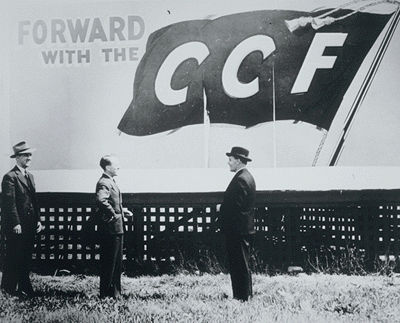
-
Article
Coalition Governments in Canada
Coalition governments are created when different political parties co-operate by forming a temporary alliance large enough to enjoy the confidence of Parliament, allowing them to form a government. Members of all parties in the coalition are appointed to Cabinet. This sometimes happens when no single party has achieved a majority of seats in the House of Commons or provincial legislature. Federal coalitions normally appear during periods of crisis such as war or political breakdown. The strengthening of party affiliations and the development of the party system since Confederation has made coalitions more difficult to negotiate. Politicians have become wary of the long-term results of coalitions and are reluctant to introduce them.
"https://d3d0lqu00lnqvz.cloudfront.net/media/media/e38df4dd-d940-43c5-b849-2f2518c8f29d.jpg" // resources/views/front/categories/view.blade.php
https://d3d0lqu00lnqvz.cloudfront.net/media/media/e38df4dd-d940-43c5-b849-2f2518c8f29d.jpg
-
Article
Colonial Office
Colonial Office, a department established by the British government to administer its colonial possessions, including British North America.
"https://thecanadianencyclopedia.ca/images/tce_placeholder.jpg?v=e9dca980c9bdb3aa11e832e7ea94f5d9" // resources/views/front/categories/view.blade.php
https://thecanadianencyclopedia.ca/images/tce_placeholder.jpg?v=e9dca980c9bdb3aa11e832e7ea94f5d9
-
Article
Commercial Law
Commercial law is that branch of private law concerned primarily with the supply of goods or services by merchants and other businesses for profit. Textbooks on commercial law frequently differ on the range of topics treated in them.
"https://thecanadianencyclopedia.ca/images/tce_placeholder.jpg?v=e9dca980c9bdb3aa11e832e7ea94f5d9" // resources/views/front/categories/view.blade.php
https://thecanadianencyclopedia.ca/images/tce_placeholder.jpg?v=e9dca980c9bdb3aa11e832e7ea94f5d9
-
Article
Commission of Government
The Commission of Government in Newfoundland was established in response to an extraordinary set of circumstances.
"https://thecanadianencyclopedia.ca/images/tce_placeholder.jpg?v=e9dca980c9bdb3aa11e832e7ea94f5d9" // resources/views/front/categories/view.blade.php
https://thecanadianencyclopedia.ca/images/tce_placeholder.jpg?v=e9dca980c9bdb3aa11e832e7ea94f5d9
-
Article
Commission of Inquiry on the Position of the French Language and on Language Rights in Québec (Gendron Commission)
The Commission of Inquiry on the Position of the French Language and on Language Rights in Québec (1969–1973) is a royal inquiry commission set up by the government under Jean-Jacques Bertrand. Noting the inequality between the English and French languages and the federal state’s hesitancy to take measures to encourage the independence and general development of the French Canadian population, the Gendron Commission elaborated a series of recommendations which led to the adoption of the Language Acts in 1974 and 1977 (see Quebec Language Policy).
"https://thecanadianencyclopedia.ca/images/tce_placeholder.jpg?v=e9dca980c9bdb3aa11e832e7ea94f5d9" // resources/views/front/categories/view.blade.php
https://thecanadianencyclopedia.ca/images/tce_placeholder.jpg?v=e9dca980c9bdb3aa11e832e7ea94f5d9
-
Article
Commissioner for Oaths
A Commissioner for Oaths is any person over 18 years of age commissioned by a lieutenant-governor to administer oaths and take affidavits.
"https://thecanadianencyclopedia.ca/images/tce_placeholder.jpg?v=e9dca980c9bdb3aa11e832e7ea94f5d9" // resources/views/front/categories/view.blade.php
https://thecanadianencyclopedia.ca/images/tce_placeholder.jpg?v=e9dca980c9bdb3aa11e832e7ea94f5d9
-
Article
Committee for an Independent Canada
The Committee for an Independent Canada (CIC) was conceived by Walter GORDON, Peter NEWMAN and Abraham Rotstein as a citizens' committee to promote Canadian economic and cultural independence. They recruited Jack MCCLELLAND and Claude RYAN as cochairmen and launched the CIC on 17 September 1970.
"https://d3d0lqu00lnqvz.cloudfront.net/media/media/346651f7-0648-43dc-b40f-649d2e4a6e84.jpg" // resources/views/front/categories/view.blade.php
https://d3d0lqu00lnqvz.cloudfront.net/media/media/346651f7-0648-43dc-b40f-649d2e4a6e84.jpg
-
Article
Common-Law Unions in Canada
A common-law union occurs when two people live together in a conjugal relationship, generally for at least a year (or more depending on the province in which they reside). Common-law couples in Canada have many of the same legal, parental and financial rights and obligations as married couples.
"https://thecanadianencyclopedia.ca/images/tce_placeholder.jpg?v=e9dca980c9bdb3aa11e832e7ea94f5d9" // resources/views/front/categories/view.blade.php
https://thecanadianencyclopedia.ca/images/tce_placeholder.jpg?v=e9dca980c9bdb3aa11e832e7ea94f5d9
-
Article
Commonwealth
The Commonwealth of Nations is made up of 56 countries, including Canada, that were for the most part once part of the British Empire. They work together on international policy and hold a major sports event every four years. It is one of the world’s oldest political associations of states.
"https://d3d0lqu00lnqvz.cloudfront.net/media/media/2f10ecd8-58d3-4a10-8b33-fa4f1d617d92.jpg" // resources/views/front/categories/view.blade.php
https://d3d0lqu00lnqvz.cloudfront.net/media/media/2f10ecd8-58d3-4a10-8b33-fa4f1d617d92.jpg
-
Article
Commonwealth of Learning
The Commonwealth of Learning (COL) is an intergovernmental organization that helps developing countries improve access to quality education and training.
"https://d3d0lqu00lnqvz.cloudfront.net/media/media/f973641b-750e-4197-9ba7-dc025d236929.jpg" // resources/views/front/categories/view.blade.php
https://d3d0lqu00lnqvz.cloudfront.net/media/media/f973641b-750e-4197-9ba7-dc025d236929.jpg
-
Article
Communal Properties Act Case
Walter v Attorney-General of Alberta (1965-69) tested the constitutional validity of the Communal Properties Act (1955), which had the effect of restricting the amount of lands that could be owned communally by religious groups such as the HUTTERITES and the DOUKHOBORS.
"https://d3d0lqu00lnqvz.cloudfront.net/media/media/9dde7de9-5182-4dab-a6b3-f141ce3c9272.jpg" // resources/views/front/categories/view.blade.php
https://d3d0lqu00lnqvz.cloudfront.net/media/media/9dde7de9-5182-4dab-a6b3-f141ce3c9272.jpg