
Browse "Military"
-
Article
Canada and the Cold War (Plain Language Summary)
During the Cold War, most of the world was divided into two camps. The "West" was led by the US and the "East" was led by the Soviet Union. Canada sided with the West. The Cold War started after the Second World War. It ended in 1991 when the Soviet Union collapsed. There was no direct or "hot" war between the two superpowers. But tensions were high, and people were afraid of nuclear war. Some smaller wars were fought, like the Korean War. (This article is a plain-language summary of the Cold War. If you are interested in reading about this topic in more depth, please see our full-length entry, Canada and the Cold War.)
"https://d3d0lqu00lnqvz.cloudfront.net/media/new_article_images/CubanMissileCrisis/7322067464_e858ddfc17_z.jpg" // resources/views/front/categories/view.blade.php
https://d3d0lqu00lnqvz.cloudfront.net/media/new_article_images/CubanMissileCrisis/7322067464_e858ddfc17_z.jpg
-
Article
Canada and the Iraq War
The Iraq War (2003–11) was fought against Iraq by a coalition of 46 countries led by the United States and the United Kingdom. The decision to go to war was based in part on faulty intelligence and assumptions about the Iraqi manufacture and storage of weapons of mass destruction (WMD). The war was conducted in two phases, a brief conventional one in March and April 2003 and a much longer counterinsurgency operation, which ended in December 2011. Despite American and British pressure, Canadian Prime Minister Jean Chrétien refused to publicly support the war. Ostensibly, this was because there was no United Nations (UN) Security Council resolution authorizing the operation, although several other factors were involved.
"https://d3d0lqu00lnqvz.cloudfront.net/media/media/b3532769-6fc5-4950-bcff-36d917baf2bc.jpg" // resources/views/front/categories/view.blade.php
https://d3d0lqu00lnqvz.cloudfront.net/media/media/b3532769-6fc5-4950-bcff-36d917baf2bc.jpg
-
Article
Canada and the Manhattan Project
Canada helped develop the world’s first nuclear reactors and nuclear arms. During the Second World War, Canada participated in British research to create an atomic weapon. In 1943, the British nuclear weapons program merged with its American equivalent, the Manhattan Project. Canada’s main contribution was the Montreal Laboratory, which later became the Chalk River Laboratory. (See Nuclear Research Establishments). This Allied war effort produced the atomic bombs dropped on the Japanese cities of Hiroshima and Nagasaki in 1945. It also led to the development of Canada’s nuclear energy industry. Click here for definitions of key terms used in this article.
"https://d3d0lqu00lnqvz.cloudfront.net/media/new_article_images/CanadaandtheManhattanProject/Chalk_River1947.jpg" // resources/views/front/categories/view.blade.php
https://d3d0lqu00lnqvz.cloudfront.net/media/new_article_images/CanadaandtheManhattanProject/Chalk_River1947.jpg
-
Article
Canada and the Responsibility to Protect (R2P)
The Responsibility to Protect (R2P) is a non-binding political commitment made by United Nations Member States to protect populations from genocide, crimes against humanity, ethnic cleansing and war crimes. Canadian leadership was instrumental in the establishment of the International Commission on Intervention and State Sovereignty (ICISS) in 2000, which led to the development and eventual adoption of R2P at the 2005 UN World Summit (see also Canada and Peacekeeping).
"https://d3d0lqu00lnqvz.cloudfront.net/media/media/b52c2243-2c08-4941-9163-e8feea5c4cd3.jpg" // resources/views/front/categories/view.blade.php
https://d3d0lqu00lnqvz.cloudfront.net/media/media/b52c2243-2c08-4941-9163-e8feea5c4cd3.jpg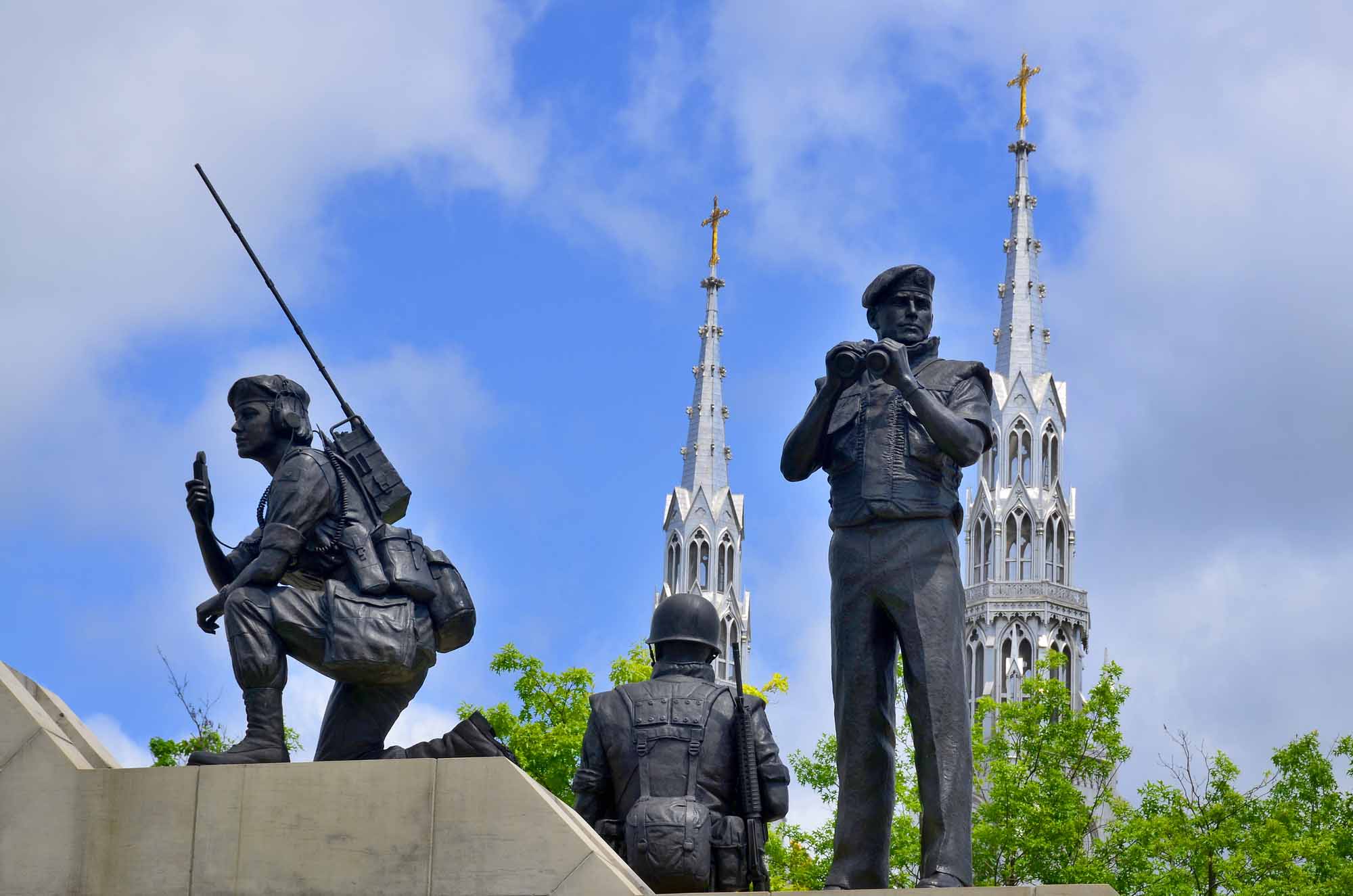
-
Macleans
Canada and the US Explore Joint Defence
This article was originally published in Maclean’s magazine on September 12, 2005. Partner content is not updated. FOR THE FIRST TIME SINCE the attacks of Sept. 11, 2001, Canadian and American officials will sit down across the table from one another this month and begin delicate negotiations over the future of their joint military institutions.
"https://thecanadianencyclopedia.ca/images/tce_placeholder.jpg?v=e9dca980c9bdb3aa11e832e7ea94f5d9" // resources/views/front/categories/view.blade.php
https://thecanadianencyclopedia.ca/images/tce_placeholder.jpg?v=e9dca980c9bdb3aa11e832e7ea94f5d9
-
Article
Canada and the War in Afghanistan (Plain-Language Summary)
The War in Afghanistan (2001–14) was Canada’s longest war. It was Canada’s first major combat mission since the Korean War. The war started after the 9/11 attacks. The goal was to fight al-Qaeda and the Taliban in Afghanistan. The Taliban lost power but continued to fight. More than 40,000 Canadian troops served in Afghanistan; 165 Canadians were killed. Many veterans suffered from post-traumatic stress disorder (PTSD). This article is a plain-language summary of the War in Afghanistan. If you are interested in reading about this topic in more depth, please see our full-length entry, Canada and the War in Afghanistan.
"https://d3d0lqu00lnqvz.cloudfront.net/media/media/553ab440-c0e6-4662-a19d-fca316914feb.jpg" // resources/views/front/categories/view.blade.php
https://d3d0lqu00lnqvz.cloudfront.net/media/media/553ab440-c0e6-4662-a19d-fca316914feb.jpg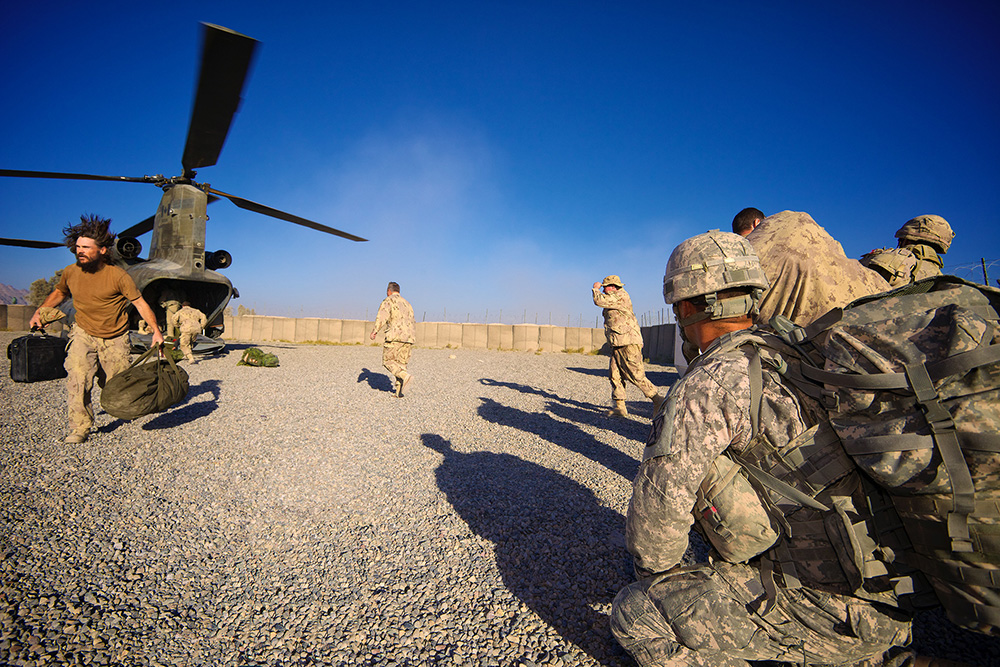
-
Article
Canada and Weapons of Mass Destruction
Canada has a long, complicated history with weapons of mass destruction (WMDs). Canadian soldiers have been attacked with chemical weapons and have used them offensively. (See Canada and Gas Warfare.) Canada has researched chemical, biological and nuclear weapons; but also, ways to defend against them. Some chemical weapons were tested in Canada and against Canadians with long-term consequences. Canada played a crucial role in the development of nuclear weapons. (See Canada and the Manhattan Project.) The country employed nuclear weapons primarily as defensive weapons during the Cold War. Canada signed international documents limiting the use of these weapons. Canada no longer has weapons of mass destruction. However, Canada is a member of the North Atlantic Treaty Organization and NORAD — alliances that employ nuclear weapons and other weapons of mass destruction.
"https://d3d0lqu00lnqvz.cloudfront.net/media/media/fe8757c3-dd58-4969-92f1-316d16aa4e6c.jpg" // resources/views/front/categories/view.blade.php
https://d3d0lqu00lnqvz.cloudfront.net/media/media/fe8757c3-dd58-4969-92f1-316d16aa4e6c.jpg
-
Macleans
Canada Likely to Join US in War against Iraq
This article was originally published in Maclean’s magazine on September 23, 2002. Partner content is not updated. IT WAS BY MOST ACCOUNTS an uncomfortable meeting when Jean CHRÉTIEN sat down with George W. Bush for 45 minutes in Detroit's Cobo Hall last week.
"https://thecanadianencyclopedia.ca/images/tce_placeholder.jpg?v=e9dca980c9bdb3aa11e832e7ea94f5d9" // resources/views/front/categories/view.blade.php
https://thecanadianencyclopedia.ca/images/tce_placeholder.jpg?v=e9dca980c9bdb3aa11e832e7ea94f5d9
-
Article
Canada's Road to the Second World War
As the threat of another world war loomed ever larger, Canadians, far from the conflict, would face a difficult choice of whether to stand again with Britain or remain isolated and safe in North America.
"https://d3d0lqu00lnqvz.cloudfront.net/media/Twitter_Cards/Wartime leaders.jpg" // resources/views/front/categories/view.blade.php
https://d3d0lqu00lnqvz.cloudfront.net/media/Twitter_Cards/Wartime leaders.jpg
-
Article
Canadian Army Medical Corps Nursing Sisters
More than 2,800 trained civilian nurses enlisted with the Canadian army during the First World War, becoming the first women in the modern world to hold military commissions as officers. As members of the Canadian Army Medical Corps (CAMC), the nursing sisters treated and cared for wounded soldiers overseas and at home. At least 58 died from disease or enemy action during the war.
"https://d3d0lqu00lnqvz.cloudfront.net/media/media/271eb18d-51cb-46d8-b660-42a54e9557c5.jpg" // resources/views/front/categories/view.blade.php
https://d3d0lqu00lnqvz.cloudfront.net/media/media/271eb18d-51cb-46d8-b660-42a54e9557c5.jpg
-
Article
Canadian Army Meteorological Group
The Canadian Army Meteorological Group (CAMG) was a Second World War unit that provided meteorological data to artillery units. The CAMG was involved in key campaigns during the war in Italy and Northwest Europe. Meteorological information helped improve the accuracy of artillery fire, contributing to Allied victory in the war.
"https://d3d0lqu00lnqvz.cloudfront.net/CAMG/Meteorology-observer.jpg" // resources/views/front/categories/view.blade.php
https://d3d0lqu00lnqvz.cloudfront.net/CAMG/Meteorology-observer.jpg
-
Article
Canadian Army Organization
The Canadian Army is organized into four geographically based divisions, as well as a headquarters and a doctrine and training centre. The divisions include regular and reserve units. The head of the Canadian Army is a lieutenant-general; the current commander, Lieutenant-General Michael Wright, assumed that position on 12 July 2024. As of October 2025, the army comprised about 22,000 Regular Force soldiers, 20,000 Reservists, 5,000 Canadian Rangers and 3,500 civilian employees.
"https://d3d0lqu00lnqvz.cloudfront.net/CA-Organization-Chart-legend-rev-colours-1.png" // resources/views/front/categories/view.blade.php
https://d3d0lqu00lnqvz.cloudfront.net/CA-Organization-Chart-legend-rev-colours-1.png
-
Article
Canadian Aviation Corps
The Canadian Aviation Corps was formed in September 1914, immediately after the start of the First World War. The three-person, one-plane unit sailed to Britain with the First Canadian Contingent in early October 1914 but never saw active service. The CAC was disbanded in May 1915. Canada would not have a permanent air force until 1924 (see Royal Canadian Air Force).
"https://d3d0lqu00lnqvz.cloudfront.net/Aviation/Burgess-Dunne-floatplane.jpg" // resources/views/front/categories/view.blade.php
https://d3d0lqu00lnqvz.cloudfront.net/Aviation/Burgess-Dunne-floatplane.jpg
-
Article
Canadian Expeditionary Force
The Canadian Expeditionary Force was the army raised by Canada for service overseas in the First World War. About 630,000 Canadians enlisted between 1914 and 1918—most of them volunteers—as soldiers, nurses, doctors, and forestry and railway crews. More than 234,000 were killed or wounded in the war.
"https://d3d0lqu00lnqvz.cloudfront.net/media/media/73ffb06f-627d-4c89-ba46-f99a9ca67524.jpg" // resources/views/front/categories/view.blade.php
https://d3d0lqu00lnqvz.cloudfront.net/media/media/73ffb06f-627d-4c89-ba46-f99a9ca67524.jpg
-
Article
Canadian Forces Base Borden
Canadian Forces Base (CFB) Borden has always been primarily a training base for the Canadian Forces (CF). It is located 80 km northwest of Toronto, and was named after Sir Frederick Borden, Laurier's militia minister (1896-1911).
"https://d3d0lqu00lnqvz.cloudfront.net/The-Memory-Project/image/2016_original.jpg" // resources/views/front/categories/view.blade.php
https://d3d0lqu00lnqvz.cloudfront.net/The-Memory-Project/image/2016_original.jpg