
Browse "History"
-
Article
The War of 1812 (Plain-Language Summary)
The War of 1812 was fought between Britain and the United States between 1812 and 1814. The war ended in a stalemate but had many lasting effects in Canada. It guaranteed Canada’s independence from the United States. It also gave Canadians their first experience working together as a community and helped develop a sense of nationhood. This article is a plain-language summary of the War of 1812. If you are interested in reading about this topic more in depth, please see our full-length entry, War of 1812.
"https://d3d0lqu00lnqvz.cloudfront.net/media/media/d60240b0-5df1-48c0-bd0f-e3c0fbc67705.jpg" // resources/views/front/categories/view.blade.php
https://d3d0lqu00lnqvz.cloudfront.net/media/media/d60240b0-5df1-48c0-bd0f-e3c0fbc67705.jpg
-
Article
The Wars
Timothy Findley’s 1977 novel about the mental and physical destruction of a young Canadian soldier in the First World War won the Governor General’s Literary Award for English Language Fiction. It is widely regarded as one of the country’s definitive historical war novels. It has been called “one of the most remarkable novels of war ever published” and “the finest historical novel ever written by a Canadian.” The Globe and Mail referred to The Wars as “the great Canadian novel about the First World War.”
"https://d3d0lqu00lnqvz.cloudfront.net/media/media/60246c70-8d6a-4c61-af84-72e302c3363a.jpg" // resources/views/front/categories/view.blade.php
https://d3d0lqu00lnqvz.cloudfront.net/media/media/60246c70-8d6a-4c61-af84-72e302c3363a.jpg
-
Article
Thunderbird
Thunderbird is a supernatural creature prominent in many Indigenous traditional stories. The thunderbird plays varying roles in different Indigenous traditions. Traditional stories of the thunderbird exist in cultures from the Pacific Northwest, the plains, and the eastern regions of what is now Canada (see also Northwest Coast Indigenous Peoples in Canada; Plains Indigenous Peoples in Canada).
"https://d3d0lqu00lnqvz.cloudfront.net/media/media/0c7246ce-04d4-4027-9907-07156a5ba0d6.jpg" // resources/views/front/categories/view.blade.php
https://d3d0lqu00lnqvz.cloudfront.net/media/media/0c7246ce-04d4-4027-9907-07156a5ba0d6.jpg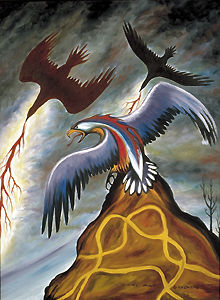
-
Article
Timber Axe
Two basic types of axe were used in the early 19th-century eastern forest industry. The more common poll axe had a single, fan-shaped cutting edge, a narrow head weighing 1.5-2.5 kg, and a hickory or maple handle. It was used for felling, scoring and lopping branches off fallen trees.
"https://d3d0lqu00lnqvz.cloudfront.net/media/media/cec78fec-e5dd-4380-bdb0-41072ce95e26.jpg" // resources/views/front/categories/view.blade.php
https://d3d0lqu00lnqvz.cloudfront.net/media/media/cec78fec-e5dd-4380-bdb0-41072ce95e26.jpg
-
Article
Timber Trade History
Wood was the staple of Canadian trade for much of the 19th century. Fueled by European demand, the timber trade brought investment and immigration to eastern Canada, fostered economic development, and transformed the regional environment far more radically than the earlier exploitation of fish and fur (see Fisheries; Fur Industry). It encouraged exploration, the building of towns and villages, and the opening of roads. While a great resource for Canada, timber also contributed at times to economic instability. Over the course of the industry’s history, weather conditions, commercial uncertainties and imperfect market intelligence produced wide fluctuations in the demand for—and the price of—wood.
"https://d3d0lqu00lnqvz.cloudfront.net/timbertradehistory/lumbercamp.jpg" // resources/views/front/categories/view.blade.php
https://d3d0lqu00lnqvz.cloudfront.net/timbertradehistory/lumbercamp.jpg
-
Article
Titanic
The Royal Mail Ship (RMS) Titanic was a British luxury passenger liner that sank on its maiden transatlantic voyage. At approximately 11:40 p.m. on 14 April, 1912, about 740 km south of Newfoundland, Titanic’s starboard (right) side scraped along an iceberg. The collision ruptured several watertight compartments. Water poured in, but the first lifeboat was not launched until an hour later. Approximately two-thirds of the liner’s passengers and crew died. Titanic’s sinking was one of the worst marine disasters in history and remains firmly embedded in popular culture today.
"https://d3d0lqu00lnqvz.cloudfront.net/media/media/69692e90-db50-4679-992f-989cebf24a69.jpg" // resources/views/front/categories/view.blade.php
https://d3d0lqu00lnqvz.cloudfront.net/media/media/69692e90-db50-4679-992f-989cebf24a69.jpg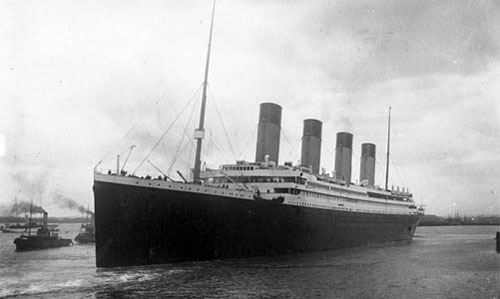
-
Macleans
Titanic Tourism Boom
For good or ill, the City of Halifax seems inextricably linked to the tragic April 14, 1912, sinking of the RMS Titanic, which saw 1,522 souls succumb to icy Atlantic waters.This article was originally published in Maclean's Magazine on June 1, 1998
"https://thecanadianencyclopedia.ca/images/tce_placeholder.jpg?v=e9dca980c9bdb3aa11e832e7ea94f5d9" // resources/views/front/categories/view.blade.php
https://thecanadianencyclopedia.ca/images/tce_placeholder.jpg?v=e9dca980c9bdb3aa11e832e7ea94f5d9
-
"https://thecanadianencyclopedia.ca/images/tce_placeholder.jpg?v=e9dca980c9bdb3aa11e832e7ea94f5d9" // resources/views/front/categories/view.blade.php
https://thecanadianencyclopedia.ca/images/tce_placeholder.jpg?v=e9dca980c9bdb3aa11e832e7ea94f5d9
-
Macleans
Toddlers Die in Van Crash
It was the dull drone of the van's horn that first alerted Josée Desilets to the horrific accident across the road from her small business selling windows. Her husband, Réjean Lambert, rushed out of their store in tiny St-Jean-Baptiste-de-Nicolet, Que.This article was originally published in Maclean's Magazine on March 27, 2000
"https://thecanadianencyclopedia.ca/images/tce_placeholder.jpg?v=e9dca980c9bdb3aa11e832e7ea94f5d9" // resources/views/front/categories/view.blade.php
https://thecanadianencyclopedia.ca/images/tce_placeholder.jpg?v=e9dca980c9bdb3aa11e832e7ea94f5d9
-
Article
Toronto Feature: Anti-Greek Riots
This article is from our Toronto Feature series. Features from past programs are not updated.
"https://thecanadianencyclopedia.ca/images/tce_placeholder.jpg?v=e9dca980c9bdb3aa11e832e7ea94f5d9" // resources/views/front/categories/view.blade.php
https://thecanadianencyclopedia.ca/images/tce_placeholder.jpg?v=e9dca980c9bdb3aa11e832e7ea94f5d9
-
Editorial
Toronto Maple Leafs 1967: The Last Stanley Cup
The following article is an editorial written by The Canadian Encyclopedia staff. Editorials are not usually updated.
"https://d3d0lqu00lnqvz.cloudfront.net/media/media/37b391b2-88e6-4b41-a63d-f243c6160251.jpg" // resources/views/front/categories/view.blade.php
https://d3d0lqu00lnqvz.cloudfront.net/media/media/37b391b2-88e6-4b41-a63d-f243c6160251.jpg
-
Article
Toronto Purchase (Treaty 13)
The Toronto Purchase of 1805 (also known as Treaty 13) was negotiated in an attempt to clarify and confirm the terms of the Johnson-Butler Purchase of 1787-88. Ultimately, it failed to do this and additional negotiations were required. These later discussions resulted in the Williams Treaties of 1923 and a compensatory settlement between the Government of Canada and the Mississaugas of the New Credit First Nation in 2010. (See also Upper Canada Land Surrenders.)
"https://d3d0lqu00lnqvz.cloudfront.net/TorontoPurchase.jpg" // resources/views/front/categories/view.blade.php
https://d3d0lqu00lnqvz.cloudfront.net/TorontoPurchase.jpg
-
Macleans
Toronto Shunned over SARS Fears
This article was originally published in Maclean’s magazine on May 5, 2003. Partner content is not updated.
"https://thecanadianencyclopedia.ca/images/tce_placeholder.jpg?v=e9dca980c9bdb3aa11e832e7ea94f5d9" // resources/views/front/categories/view.blade.php
https://thecanadianencyclopedia.ca/images/tce_placeholder.jpg?v=e9dca980c9bdb3aa11e832e7ea94f5d9
-
Macleans
Toronto Subway Crash Kills 3
This article was originally published in Maclean’s magazine on August 21, 1995. Partner content is not updated. So began a night of horror and heroism, of painful sacrifices and simple acts of human kindness. Sadd's train was about to go out of service when it was rammed from behind by another subway at 6:07 p.m. Between them, the two trains were carrying about 700 people.
"https://d3d0lqu00lnqvz.cloudfront.net/media/media/858bc6c6-fe38-49b1-8fe1-9bcaeba2a8d9.jpg" // resources/views/front/categories/view.blade.php
https://d3d0lqu00lnqvz.cloudfront.net/media/media/858bc6c6-fe38-49b1-8fe1-9bcaeba2a8d9.jpg
-
Macleans
Toronto's Days of Protest
Like many other Torontonians last Friday, Mayor Barbara Hall just wanted to go to work. But when she showed up at the front entrance to City Hall around 8 a.m.This article was originally published in Maclean's Magazine on November 4, 1996
"https://thecanadianencyclopedia.ca/images/tce_placeholder.jpg?v=e9dca980c9bdb3aa11e832e7ea94f5d9" // resources/views/front/categories/view.blade.php
https://thecanadianencyclopedia.ca/images/tce_placeholder.jpg?v=e9dca980c9bdb3aa11e832e7ea94f5d9