
Browse "Communities & Sociology"
-
Article
Labour Force in Canada
The labour force refers to the total adult population available to the labour market at a specific time. Statistics Canada administers the Labour Force Survey (LFS), a monthly household survey, that provides estimates about employment and unemployment rates in Canada as well as labour market characteristics. Data about Canada’s labour force helps economists and other analysts understand the Canadian economy.
"https://d3d0lqu00lnqvz.cloudfront.net/TCE_placeholder.png" // resources/views/front/categories/view.blade.php
https://d3d0lqu00lnqvz.cloudfront.net/TCE_placeholder.png
-
Article
Labour Party
That workers should have political representatives of their own class has been a recurrent theme in Canadian labour history, but no one organization has provided a permanent home for this idea. Many union leaders have preferred to advance their cause through established political parties. Also, acceptance of trade unionists and hybrid candidates by the major parties inhibited the formation of independent labour parties. (See National Union Centrals; Trade Unionism and Globalization; Confederation of National Trade Unions.)
"https://d3d0lqu00lnqvz.cloudfront.net/media/media/1795c31c-d8da-4c0e-9495-7c1faa47e330.jpg" // resources/views/front/categories/view.blade.php
https://d3d0lqu00lnqvz.cloudfront.net/media/media/1795c31c-d8da-4c0e-9495-7c1faa47e330.jpg
-
Article
Labour Policy
Labour policy includes policies concerned with relations between employers and employees and those concerned with the employment, training and distribution of workers in the LABOUR MARKET.
"https://thecanadianencyclopedia.ca/images/tce_placeholder.jpg?v=e9dca980c9bdb3aa11e832e7ea94f5d9" // resources/views/front/categories/view.blade.php
https://thecanadianencyclopedia.ca/images/tce_placeholder.jpg?v=e9dca980c9bdb3aa11e832e7ea94f5d9
-
Article
Labour Relations
Labour relations refers to the relations between employers and employees. They are affected by a number of factors, including labour organizations, collective bargaining, labour market, government policy, the structure of the economy, labour law and technological change.
"https://d3d0lqu00lnqvz.cloudfront.net/media/media/deaaaf0f-2d04-4ae8-8391-d6255fe2a78a.jpg" // resources/views/front/categories/view.blade.php
https://d3d0lqu00lnqvz.cloudfront.net/media/media/deaaaf0f-2d04-4ae8-8391-d6255fe2a78a.jpg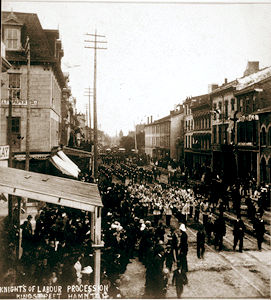
-
Article
Lac-Mégantic Rail Disaster
In the early morning of 6 July 2013, a runaway train hauling 72 tankers filled with crude oil derailed as it approached the centre of the town of Lac-Mégantic, Quebec. The tanker cars exploded and the oil caught fire, killing 47 people and destroying many buildings and other infrastructure in the town centre. The fourth deadliest railway disaster in Canadian history, the derailment led to changes in rail transport safety rules as well as legal action against the company and employees involved in the incident. Years after the derailment, re-building was still ongoing and many of the town’s residents continued to suffer from post-traumatic stress.
"https://d3d0lqu00lnqvz.cloudfront.net/media/new_article_images/Lac-Mégantic_Rail_Disaster/First responders.jpg" // resources/views/front/categories/view.blade.php
https://d3d0lqu00lnqvz.cloudfront.net/media/new_article_images/Lac-Mégantic_Rail_Disaster/First responders.jpg
-
Article
Ladies Ontario Hockey Association (LOHA)
The Ladies Ontario Hockey Association (LOHA) was the first governing body for community women’s ice hockey in Canada. It was formed in 1922 and disbanded in 1940. Initially, the league consisted of 18 senior teams from across Ontario, from bigger cities such as Toronto, London and Ottawa, to smaller centres such as Bowmanville, Huntsville and Owen Sound. The creation of the LOHA led to the 1925 founding of the Women’s Amateur Athletic Federation, which absorbed the LOHA when it disbanded.
"https://d3d0lqu00lnqvz.cloudfront.net/media/new_article_images/LadiesOntarioHockeyAssociation/Preston_Rivulettes_team_photo.jpg" // resources/views/front/categories/view.blade.php
https://d3d0lqu00lnqvz.cloudfront.net/media/new_article_images/LadiesOntarioHockeyAssociation/Preston_Rivulettes_team_photo.jpg
-
Article
Language
Language is a form of communication. More specifically, language is a communication system based on human sounds. There are, however, other forms of communication systems based on touch, scent, movement, colour, gesture and even the electrical impulses that pass through computers.
"https://d3d0lqu00lnqvz.cloudfront.net/media/new_article_images/LanguageLangue/Language_Langue.jpg" // resources/views/front/categories/view.blade.php
https://d3d0lqu00lnqvz.cloudfront.net/media/new_article_images/LanguageLangue/Language_Langue.jpg
-
Macleans
Language Law Decision in Quebec
It began with equal French and English lettering on a store sign, escalated with a $75 fine under Quebec's language laws - and ended with a court victory for Gwen Simpson and Wally Hoffmann.This article was originally published in Maclean's Magazine on November 1, 1999
"https://thecanadianencyclopedia.ca/images/tce_placeholder.jpg?v=e9dca980c9bdb3aa11e832e7ea94f5d9" // resources/views/front/categories/view.blade.php
https://thecanadianencyclopedia.ca/images/tce_placeholder.jpg?v=e9dca980c9bdb3aa11e832e7ea94f5d9
-
Article
Language Policy in Canada
Language policy is comprised of a body of theory, principles, laws, programs and measures designed to manage one or more languages in a country. In monolingual societies, language policy is usually concerned with promoting an approved, standardized grammar of the common language. In bilingual or multilingual societies, it is intended to manage situations in which two or more languages are in contact and/or conflict, and to enhance the use and status of certain languages over others. Language policy in Canada has been designed to manage historical relationships among multiple languages – notably French, English and Indigenous languages - and their various communities. While it has evolved over time, Canadian language policy has not always been marked by positive or just measures.
"https://d3d0lqu00lnqvz.cloudfront.net/media/media/40e047e3-6acc-474f-b2c6-76d673b789bc.jpg" // resources/views/front/categories/view.blade.php
https://d3d0lqu00lnqvz.cloudfront.net/media/media/40e047e3-6acc-474f-b2c6-76d673b789bc.jpg
-
Article
Languages in use in Canada
Although French and English are Canada’s only two official languages, the country’s linguistic diversity is very rich. According to the 2016 census, an increased number of Canadians are reporting a mother tongue or language spoken at home other than English or French compared to in previous years. This is in addition to a large diversity of Indigenous languages.
"https://thecanadianencyclopedia.ca/images/tce_placeholder.jpg?v=e9dca980c9bdb3aa11e832e7ea94f5d9" // resources/views/front/categories/view.blade.php
https://thecanadianencyclopedia.ca/images/tce_placeholder.jpg?v=e9dca980c9bdb3aa11e832e7ea94f5d9
-
Article
Law Reform
Law reform is the process of ensuring that law meets the needs of the society it is designed to serve. The process may involve updating by repealing old and obsolete enactments, consolidating or rationalizing an area of law, or even proposing entirely new concepts.
"https://thecanadianencyclopedia.ca/images/tce_placeholder.jpg?v=e9dca980c9bdb3aa11e832e7ea94f5d9" // resources/views/front/categories/view.blade.php
https://thecanadianencyclopedia.ca/images/tce_placeholder.jpg?v=e9dca980c9bdb3aa11e832e7ea94f5d9
-
Article
Law Reform Commission of Canada
The Law Reform Commission of Canada (1971-1993, 1997 - 2006) began operation as a permanent independent body to study and undertake a systematic review of Canadian LAW.
"https://thecanadianencyclopedia.ca/images/tce_placeholder.jpg?v=e9dca980c9bdb3aa11e832e7ea94f5d9" // resources/views/front/categories/view.blade.php
https://thecanadianencyclopedia.ca/images/tce_placeholder.jpg?v=e9dca980c9bdb3aa11e832e7ea94f5d9
-
Article
Le Graduel romain
Le Graduel romain. A collection containing all the chants for the Proper of the mass: introit, gradual, tract or alleluia, offertory, and communion, as well as those for the Feasts of Our Lord (the Proper of the Time) and of the Saints (the Common of the Saints).
"https://thecanadianencyclopedia.ca/images/tce_placeholder.jpg?v=e9dca980c9bdb3aa11e832e7ea94f5d9" // resources/views/front/categories/view.blade.php
https://thecanadianencyclopedia.ca/images/tce_placeholder.jpg?v=e9dca980c9bdb3aa11e832e7ea94f5d9
-
Article
2SLGBTQ+ Rights in Canada
Since the late 1960s, the 2SLGBTQ+ community in Canada has seen steady gains in rights. While discrimination against 2SLGBTQ+ people persists in many places, major strides toward mainstream social acceptance and formal legal equality have nonetheless been made in recent decades. Canada is internationally regarded as a leader in this field. Recent years have seen steady progress on everything from health care to the right to adopt. In 2005, Canada became the fourth country worldwide to legalize same-sex marriage.
"https://d3d0lqu00lnqvz.cloudfront.net/media/media/01b9acd6-f307-4479-8fd3-e71dbce2fd6f.jpg" // resources/views/front/categories/view.blade.php
https://d3d0lqu00lnqvz.cloudfront.net/media/media/01b9acd6-f307-4479-8fd3-e71dbce2fd6f.jpg
-
Macleans
Life Expectancy in Canada
This article was originally published in Maclean’s magazine on April 10, 2000. Partner content is not updated. Increasingly in recent years, surveys of mortality rates and other indicators have shown Canadians in some parts of the country to be much healthier than those in other regions. Now, a federal study shows just how dramatically one key indicator - life expectancy - varies among Canada's regions.
"https://thecanadianencyclopedia.ca/images/tce_placeholder.jpg?v=e9dca980c9bdb3aa11e832e7ea94f5d9" // resources/views/front/categories/view.blade.php
https://thecanadianencyclopedia.ca/images/tce_placeholder.jpg?v=e9dca980c9bdb3aa11e832e7ea94f5d9