
Browse "Business & Economics"
-
Macleans
Tim Hortons Investors Awaiting U.S. Market
To its most devoted fans, grabbing a Tim Hortons double-double on the way to work is almost a religious experience. The Church of Tim's, as it's only-somewhat-jokingly called, has such a firm grip on the Canadian psyche even the clergy are prone to bouts of envy.This article was originally published in Maclean's Magazine on March 24, 2008
"https://thecanadianencyclopedia.ca/images/tce_placeholder.jpg?v=e9dca980c9bdb3aa11e832e7ea94f5d9" // resources/views/front/categories/view.blade.php
https://thecanadianencyclopedia.ca/images/tce_placeholder.jpg?v=e9dca980c9bdb3aa11e832e7ea94f5d9
-
Article
Timber Duties
Timber Duties First imposed in the 18th century to provide revenue, Britain's tariffs on imported wood were an integral component of the 19th-century British North American TIMBER TRADE.
"https://thecanadianencyclopedia.ca/images/tce_placeholder.jpg?v=e9dca980c9bdb3aa11e832e7ea94f5d9" // resources/views/front/categories/view.blade.php
https://thecanadianencyclopedia.ca/images/tce_placeholder.jpg?v=e9dca980c9bdb3aa11e832e7ea94f5d9
-
Article
Toronto Feature: Bank of Toronto
This article is from our Toronto Feature series. Features from past programs are not updated.
"https://d3d0lqu00lnqvz.cloudfront.net/media/media/4fd46c6e-8191-4af6-8d38-ff053fda08df.jpg" // resources/views/front/categories/view.blade.php
https://d3d0lqu00lnqvz.cloudfront.net/media/media/4fd46c6e-8191-4af6-8d38-ff053fda08df.jpg
-
Article
Toronto Feature: Eaton Centre
This article is from our Toronto Feature series. Features from past programs are not updated.
"https://d3d0lqu00lnqvz.cloudfront.net/media/media/c402c528-d9dc-469f-9720-335c8d0b544e.jpg" // resources/views/front/categories/view.blade.php
https://d3d0lqu00lnqvz.cloudfront.net/media/media/c402c528-d9dc-469f-9720-335c8d0b544e.jpg
-
Article
Toronto Feature: Printers' Strike
This article is from our Toronto Feature series. Features from past programs are not updated.
"https://d3d0lqu00lnqvz.cloudfront.net/media/media/ccffe1a5-3329-4279-8597-37ca8604f6a8.jpg" // resources/views/front/categories/view.blade.php
https://d3d0lqu00lnqvz.cloudfront.net/media/media/ccffe1a5-3329-4279-8597-37ca8604f6a8.jpg
-
Article
Toronto Star
Founded in 1892, the Toronto Star (originally the Evening Star and later the Toronto Daily Star) grew under the direction of Joseph E. Atkinson, who became editor and manager of the newspaper in 1899. The newspaper was officially named the Toronto Star in 1971. As of April 2015, the Toronto Star is Canada’s largest daily newspaper.
"https://d3d0lqu00lnqvz.cloudfront.net/media/media/7ebe2f3e-9ccd-454d-af32-dcf9c99c4067.jpg" // resources/views/front/categories/view.blade.php
https://d3d0lqu00lnqvz.cloudfront.net/media/media/7ebe2f3e-9ccd-454d-af32-dcf9c99c4067.jpg
-
Article
Torstar Corporation
Torstar Corporation, a broadly based information and entertainment communications company, publishes the TORONTO STAR. Other newspaper publishing interests include Metroland Media Group, commercial printers and publishers, and CTVglobemedia.
"https://d3d0lqu00lnqvz.cloudfront.net/media/media/7ebe2f3e-9ccd-454d-af32-dcf9c99c4067.jpg" // resources/views/front/categories/view.blade.php
https://d3d0lqu00lnqvz.cloudfront.net/media/media/7ebe2f3e-9ccd-454d-af32-dcf9c99c4067.jpg
-
Article
Trades and Labor Congress of Canada
Founded in 1883, the Trades and Labor Congress of Canada (TLC) was the first union central to take lasting root in Canada. Principally bringing together craft unions, the TLC was the largest workers’ organization in Canada at the turn of the 20th century. The TLC saw its membership fluctuate in the 20th century because of the fierce competition between national and international unions and the rise of industrial unionism. In 1956, the organization merged with the Canadian Congress of Labour to become the Canadian Labour Congress.
"https://d3d0lqu00lnqvz.cloudfront.net/media/media/deaaaf0f-2d04-4ae8-8391-d6255fe2a78a.jpg" // resources/views/front/categories/view.blade.php
https://d3d0lqu00lnqvz.cloudfront.net/media/media/deaaaf0f-2d04-4ae8-8391-d6255fe2a78a.jpg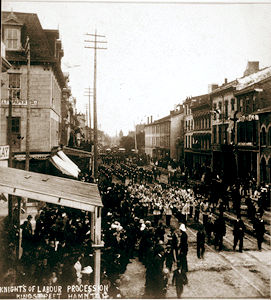
-
Article
Trans Mountain Pipeline Expansion Project
The Trans Mountain Expansion is a project to build about 980 km of new pipe, most of which will run parallel to the existing Trans Mountain oil pipeline. The new line will carry diluted bitumen, or “dilbit,” from Edmonton, Alberta to Burnaby, British Columbia. The expansion will increase the pipeline route’s overall capacity from 300,000 barrels per day to 890,000 barrels per day. The project’s first owner, Kinder Morgan Canada, sold it to the Government of Canada in 2018. The Trans Mountain Expansion has been a focus of environmental and economic debates, as well as political conflicts. The $12.6 billion project is now under construction.
"https://d3d0lqu00lnqvz.cloudfront.net/media/new_article_images/TransMountainPipelineExpansionProject/Trans_Mountain_Spread_1_Dec2019.jpg" // resources/views/front/categories/view.blade.php
https://d3d0lqu00lnqvz.cloudfront.net/media/new_article_images/TransMountainPipelineExpansionProject/Trans_Mountain_Spread_1_Dec2019.jpg
-
Article
TC Energy (formerly TransCanada)
TC Energy Corporation (formerly TransCanada Corporation) is a natural gas, oil and power-generation company headquartered in Calgary, Alberta. TC Energy owns more than 92,600 km of natural gas pipeline in North America and transports more than 25 per cent of the gas consumed on the continent. It also operates power plants and gas storage facilities. A public company, it trades on the Toronto Stock Exchange and the New York Stock Exchange under the symbol TRP. In 2018, TC Energy registered $13.7 billion in revenue and $3.5 billion in profit and held $98.9 billion in assets. The company employs about 7,300 people, more than half of them in Canada.
"https://d3d0lqu00lnqvz.cloudfront.net/media/new_article_images/TCEnergy/dreamstimeextralarge_147038817.jpg" // resources/views/front/categories/view.blade.php
https://d3d0lqu00lnqvz.cloudfront.net/media/new_article_images/TCEnergy/dreamstimeextralarge_147038817.jpg
-
Article
Triangular Trade
The triangular trade was a trade route connecting France, New France and the West Indies. It was established by France’s comptroller general of finance, Jean-Baptiste Colbert, and applied in Canada in 1667 by Jean Talon, the intendant of New France. The triangular trade enabled New France to diversify its economy and establish its position on the international trade networks.
"https://d3d0lqu00lnqvz.cloudfront.net/media/media/e010947298-v8.jpg" // resources/views/front/categories/view.blade.php
https://d3d0lqu00lnqvz.cloudfront.net/media/media/e010947298-v8.jpg
-
Article
Underground Economy in Canada
The underground economy is defined by the Canada Revenue Agency as “economic transactions in goods or services which are unreported, resulting in failure to comply with tax laws administered by the Canada Revenue Agency.” (See also Taxation in Canada.) Statistics Canada reported that the annual 2021 estimate for the underground economy was $68.5 billion. This accounted for 2.7 per cent of Canada’s total Gross Domestic Product (GDP) in 2021. (See also Economy.)
"https://d3d0lqu00lnqvz.cloudfront.net/media/media/fe9a7876-aee1-4ecb-865f-03fa3233f06e.jpg" // resources/views/front/categories/view.blade.php
https://d3d0lqu00lnqvz.cloudfront.net/media/media/fe9a7876-aee1-4ecb-865f-03fa3233f06e.jpg
-
Article
Unemployment in Canada
Unemployment is the unused supply of labour in the labour force. The unemployment rate measures unemployment and is expressed as a percentage of the total labour force, which is the total number of people who are 15 years of age and over who are either employed or unemployed. The unemployment rate is calculated by dividing the number of unemployed people by the number of people in the labour force. The unemployment rate is considered an economic indicator, an economic statistic that is used to interpret or understand the health of an economy. There are several types of unemployment and their causes are often debated by economists. The unemployed are not a fixed collection of individuals but an ever-changing group, most of whom might be unemployed only briefly.
"https://d3d0lqu00lnqvz.cloudfront.net/media/media/5a1e6ede-7028-4e1c-9d00-891cd27cd579.jpg" // resources/views/front/categories/view.blade.php
https://d3d0lqu00lnqvz.cloudfront.net/media/media/5a1e6ede-7028-4e1c-9d00-891cd27cd579.jpg
-
Article
United Automobile Workers of Canada
United Automobile Workers of Canada Founded in 1937 as an affiliate of the UAW in the US, it won its first major victory in the famous OSHAWA STRIKE of 1937 and went on to become one of Canada's largest and most dynamic unions. Its leaders since 1937, Charles H.
"https://thecanadianencyclopedia.ca/images/tce_placeholder.jpg?v=e9dca980c9bdb3aa11e832e7ea94f5d9" // resources/views/front/categories/view.blade.php
https://thecanadianencyclopedia.ca/images/tce_placeholder.jpg?v=e9dca980c9bdb3aa11e832e7ea94f5d9
-
Article
United Farm Women of Alberta
The United Farm Women of Alberta (UFWA) was the first provincial organization of farm women in Alberta. Originally an auxiliary of the United Farmers of Alberta (UFA), the UFWA became a separate organization in 1916. The organization became the Farm Women’s Union of Alberta (FWUA) in 1949 and the Women of Unifarm in 1970. The organization dissolved in 2000.
"https://d3d0lqu00lnqvz.cloudfront.net/UnitedFarmersAlberta/UF_2004_0037_0157.jpg" // resources/views/front/categories/view.blade.php
https://d3d0lqu00lnqvz.cloudfront.net/UnitedFarmersAlberta/UF_2004_0037_0157.jpg