
Browse "Business & Economics"
-
Article
Radical Economics
Originally the word "radical" meant relentlessly seeking the root of a problem and not shrinking from the action that follows as a logical consequence of its findings. More popularly, it denotes a sharp departure from conventional, orthodox interpretations of reality.
"https://thecanadianencyclopedia.ca/images/tce_placeholder.jpg?v=e9dca980c9bdb3aa11e832e7ea94f5d9" // resources/views/front/categories/view.blade.php
https://thecanadianencyclopedia.ca/images/tce_placeholder.jpg?v=e9dca980c9bdb3aa11e832e7ea94f5d9
-
Macleans
Random House/Doubleday Merger
David Kent is in a combative mood. Seated at the desk in his book-lined corner office, the 48-year-old president of Random House Canada, a Toronto-based publisher, is taking calls and returning messages from business associates and journalists.This article was originally published in Maclean's Magazine on February 1, 1999
"https://thecanadianencyclopedia.ca/images/tce_placeholder.jpg?v=e9dca980c9bdb3aa11e832e7ea94f5d9" // resources/views/front/categories/view.blade.php
https://thecanadianencyclopedia.ca/images/tce_placeholder.jpg?v=e9dca980c9bdb3aa11e832e7ea94f5d9
-
Article
Recession in Canada
A recession is a temporary period of time when the overall economy declines; it is an expected part of the business cycle. This period usually includes declines in industrial and agricultural production, trade, incomes, stock markets, consumer spending, and levels of employment. In purely technical terms, a recession occurs when two or more successive quarters (six months) show a drop in real gross domestic product (GDP), i.e., the measure of total economic output in the economy after accounting for inflation. In this sense, recessions are broad and can be particularly painful and challenging times for a country. This is the full-length entry about Recession in Canada. For a plain-language summary, please see Recession in Canada (Plain-Language Summary).
"https://d3d0lqu00lnqvz.cloudfront.net/media/media/df43d50d-712c-449e-9d95-d9b386ed67aa.jpg" // resources/views/front/categories/view.blade.php
https://d3d0lqu00lnqvz.cloudfront.net/media/media/df43d50d-712c-449e-9d95-d9b386ed67aa.jpg
-
Article
Recession in Canada (Plain-Language Summary)
A recession can mean “going down.” The word “recession” is often used when talking about the economy. An economic recession is a time when the economy is going down. Production goes down. Spending goes down. Stock markets go down. Overall, the gross domestic product (GDP) goes down. GDP is the amount of goods and services produced in a country. A recession happens when the economy goes down for more than a few months. Recessions occur often, and they cause many problems for individuals and businesses. This article is a plain-language summary of Recession in Canada. If you are interested in reading about this topic in more depth, please see our full-length entry, Recession in Canada.
"https://d3d0lqu00lnqvz.cloudfront.net/media/media/fe9a7876-aee1-4ecb-865f-03fa3233f06e.jpg" // resources/views/front/categories/view.blade.php
https://d3d0lqu00lnqvz.cloudfront.net/media/media/fe9a7876-aee1-4ecb-865f-03fa3233f06e.jpg
-
Article
Recession of 2008–09 in Canada
The global financial crisis that began in 2007 dragged much of the world economy into recession, and Canada was not spared. Although the effects on Canada were milder than on the United States and in Europe, the Canadian recession of 2008–09 was still severe enough to generate sharp declines in output and employment and to require significant responses by Canadian policy-makers.
"https://d3d0lqu00lnqvz.cloudfront.net/media/media/df43d50d-712c-449e-9d95-d9b386ed67aa.jpg" // resources/views/front/categories/view.blade.php
https://d3d0lqu00lnqvz.cloudfront.net/media/media/df43d50d-712c-449e-9d95-d9b386ed67aa.jpg
-
Article
Reciprocity
Reciprocity was a free trade agreement between the United States and Canada. It mutually reduced import duties and protective tariffs on certain goods exchanged between the two countries. It was in effect from 1854 to 1866 and was controversial at times on both sides of the border. It was replaced in 1878 by the Conservative Party’s protectionist National Policy. It involved levying tariffs on imported goods to shield Canadian manufacturers from American competition. A narrower reciprocity agreement was introduced in 1935 and expanded in 1938. However, it was suspended in 1948 after both countries signed the General Agreement on Tariffs and Trade (GATT).
"https://d3d0lqu00lnqvz.cloudfront.net/media/media/f8f2bab3-d387-4165-9fbc-617c30019b95.jpg" // resources/views/front/categories/view.blade.php
https://d3d0lqu00lnqvz.cloudfront.net/media/media/f8f2bab3-d387-4165-9fbc-617c30019b95.jpg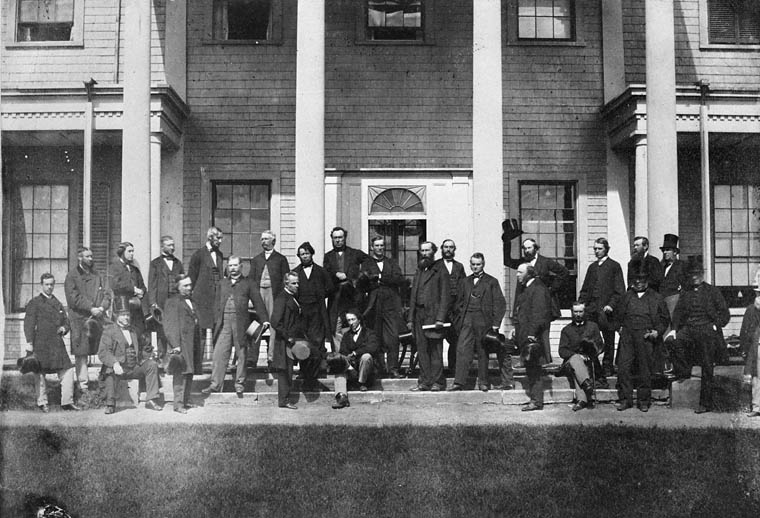
-
Article
Reciprocity (Plain-Language Summary)
Reciprocity was a free trade deal between the United States and Canada. (Reciprocity is when both sides give and receive.) The deal reduced import duties and tariffs on certain goods traded between the two countries. It was in effect from 1854 to 1866. It was at times a source of great controversy in both countries. It was replaced in 1878 by the National Policy. It was a more protectionist policy. It imposed tariffs on imported goods. This shielded manufacturers in Canada from US competition. A more limited reciprocity deal was reached in 1935. It ended in 1948 after both countries signed the General Agreement on Tariffs and Trade (GATT). This article is a plain-language summary of Reciprocity. If you would like to read about this topic in more depth, please see our full-length entry: Reciprocity.
"https://thecanadianencyclopedia.ca/images/tce_placeholder.jpg?v=e9dca980c9bdb3aa11e832e7ea94f5d9" // resources/views/front/categories/view.blade.php
https://thecanadianencyclopedia.ca/images/tce_placeholder.jpg?v=e9dca980c9bdb3aa11e832e7ea94f5d9
-
Article
Regional Economics in Canada
There are major economic differences among Canada’s main geographic regions — Ontario, Quebec, the North, the West and Atlantic Canada — each are affected by its own history of economic development, industrial location, urbanization, land use and migration. This is the full-length entry about regional economics in Canada. For a plain-language summary, please see Regional Economics in Canada (Plain-Language Summary).
"https://d3d0lqu00lnqvz.cloudfront.net/media/media/c4b962ad-3b05-4cc7-a6c1-e725894f9d6d.jpg" // resources/views/front/categories/view.blade.php
https://d3d0lqu00lnqvz.cloudfront.net/media/media/c4b962ad-3b05-4cc7-a6c1-e725894f9d6d.jpg
-
Article
Regional Economics in Canada (Plain-Language Summary)
A region is a place. Canada has many regions. Regions have different geographic qualities, natural resources, markets and populations. These differences affect the economy of a region. (See also Regionalism.) This article is a plain-language summary of Regional Economics in Canada. If you are interested in reading about this topic in more depth, please see our full-length entry, Regional Economics in Canada.
"https://d3d0lqu00lnqvz.cloudfront.net/media/media/c4b962ad-3b05-4cc7-a6c1-e725894f9d6d.jpg" // resources/views/front/categories/view.blade.php
https://d3d0lqu00lnqvz.cloudfront.net/media/media/c4b962ad-3b05-4cc7-a6c1-e725894f9d6d.jpg
-
Article
Retail Trade
There are 2 broad categories of retail-trade organization: retail chains, which operate 4 or more stores in the same kind of business under the same ownership, and independent retailers operating 1 to 3 stores.
"https://d3d0lqu00lnqvz.cloudfront.net/media/media/c67d1a3a-4e62-48d1-a97b-43f4c5a230e1.jpg" // resources/views/front/categories/view.blade.php
https://d3d0lqu00lnqvz.cloudfront.net/media/media/c67d1a3a-4e62-48d1-a97b-43f4c5a230e1.jpg
-
Article
Rodeo Records Ltd.
Rodeo Records Ltd. Parent company to several labels producing country and folk music and Melbourne, in the classical genre. It was founded in 1949 in Montreal by Don Johnson and George Taylor. Taylor (b 8 Sept 1911, d Peterborough, Ont, 12 Sept 1986). Taylor soon assumed sole control.
"https://thecanadianencyclopedia.ca/images/tce_placeholder.jpg?v=e9dca980c9bdb3aa11e832e7ea94f5d9" // resources/views/front/categories/view.blade.php
https://thecanadianencyclopedia.ca/images/tce_placeholder.jpg?v=e9dca980c9bdb3aa11e832e7ea94f5d9
-
Macleans
Rogers Buys Vidéotron
This article was originally published in Maclean’s magazine on February 21, 2000. Partner content is not updated. On Bay Street they call him the king of cable, but Ted Rogers' ambitions have always extended far beyond the television set. For years, the founder and chief executive officer of Rogers Communications Inc.
"https://thecanadianencyclopedia.ca/images/tce_placeholder.jpg?v=e9dca980c9bdb3aa11e832e7ea94f5d9" // resources/views/front/categories/view.blade.php
https://thecanadianencyclopedia.ca/images/tce_placeholder.jpg?v=e9dca980c9bdb3aa11e832e7ea94f5d9
-
Macleans
Rogers Cable Apologizes
This article was originally published in Maclean’s magazine on January 16, 1995. Partner content is not updated. It may well go down as one of the rockiest product launches in the history of Canadian television. On Jan. 1, cable companies across the country began offering their 7.5 million subscribers seven new Canadian-owned specialty channels.
"https://thecanadianencyclopedia.ca/images/tce_placeholder.jpg?v=e9dca980c9bdb3aa11e832e7ea94f5d9" // resources/views/front/categories/view.blade.php
https://thecanadianencyclopedia.ca/images/tce_placeholder.jpg?v=e9dca980c9bdb3aa11e832e7ea94f5d9
-
Article
Rogers Communications
Rogers Communications Inc. is a diversified communications and media company that operates almost entirely in Canada. Founded in 1960 with a single FM radio station in Toronto, it is now the country’s largest provider of wireless services as well as a leading cable company and a major player in broadcasting and sports entertainment. Among its many brands are Citytv and the Toronto Blue Jays.
"https://d3d0lqu00lnqvz.cloudfront.net/media/media/8b41a0c7-daf5-4c5d-825d-4888c0026c42.jpg" // resources/views/front/categories/view.blade.php
https://d3d0lqu00lnqvz.cloudfront.net/media/media/8b41a0c7-daf5-4c5d-825d-4888c0026c42.jpg
-
Macleans
Roots Canada
The press clippings are piled three inches high on a table in Michael Budman's Toronto office. The co-owner of Roots Canada Ltd. strides into the sunny room, stops to survey the pile, plucks out a picture that features Prince William wearing the red Roots Olympic hat.This article was originally published in Maclean's Magazine on April 13, 1998
"https://thecanadianencyclopedia.ca/images/tce_placeholder.jpg?v=e9dca980c9bdb3aa11e832e7ea94f5d9" // resources/views/front/categories/view.blade.php
https://thecanadianencyclopedia.ca/images/tce_placeholder.jpg?v=e9dca980c9bdb3aa11e832e7ea94f5d9