Browse "Business & Economics"
-
Macleans
CN's Tellier Takes over Bombardier
SO THE MAN who made CN's trains run on time will now try to move corporate jets, Sea-Doos and subway cars faster off the assembly lines. As the Learjet flies, Paul Tellier will move just a few hundred metres north on Jan. 13; his new office as CEO of BOMBARDIER INC.This article was originally published in Maclean's Magazine on December 23, 2002
"https://thecanadianencyclopedia.ca/images/tce_placeholder.jpg?v=e9dca980c9bdb3aa11e832e7ea94f5d9" // resources/views/front/categories/view.blade.php
https://thecanadianencyclopedia.ca/images/tce_placeholder.jpg?v=e9dca980c9bdb3aa11e832e7ea94f5d9
-
Macleans
Coach House Press Closes
For months, the rumors had haunted literary circles.This article was originally published in Maclean's Magazine on July 29, 1996
"https://thecanadianencyclopedia.ca/images/tce_placeholder.jpg?v=e9dca980c9bdb3aa11e832e7ea94f5d9" // resources/views/front/categories/view.blade.php
https://thecanadianencyclopedia.ca/images/tce_placeholder.jpg?v=e9dca980c9bdb3aa11e832e7ea94f5d9
-
Article
Coal Mining
A carbonaceous fossil fuel, coal has a long history as the key energy source in the transition to industrialization, beginning in 17th-century Europe.
"https://d3d0lqu00lnqvz.cloudfront.net/media/media/0b6c36b6-4c5a-4a08-b2dd-78723d6b2e54.jpg" // resources/views/front/categories/view.blade.php
https://d3d0lqu00lnqvz.cloudfront.net/media/media/0b6c36b6-4c5a-4a08-b2dd-78723d6b2e54.jpg
-
Article
Cobourg and Peterborough Railway
One of the 2 earliest railway charters granted in Canada, the Cobourg Rail Road Co was incorporated in 1834 to build a railway from Cobourg northward to Peterborough across Rice Lake. The project was shelved until 1846, when it was revived as the Cobourg and Rice Lake Plank Road and Ferry Co. Samuel Gore built his plank road the 17 km to the lake, but it barely survived the first 2 winters.
"https://thecanadianencyclopedia.ca/images/tce_placeholder.jpg?v=e9dca980c9bdb3aa11e832e7ea94f5d9" // resources/views/front/categories/view.blade.php
https://thecanadianencyclopedia.ca/images/tce_placeholder.jpg?v=e9dca980c9bdb3aa11e832e7ea94f5d9
-
"https://thecanadianencyclopedia.ca/images/tce_placeholder.jpg?v=e9dca980c9bdb3aa11e832e7ea94f5d9" // resources/views/front/categories/view.blade.php
https://thecanadianencyclopedia.ca/images/tce_placeholder.jpg?v=e9dca980c9bdb3aa11e832e7ea94f5d9
-
Article
Cod Moratorium of 1992
On 2 July 1992, the federal government banned cod fishing along Canada’s east coast. This moratorium ended nearly five centuries of cod fishing in Newfoundland and Labrador. Cod had played a central role in the province’s economy and culture. The aim of the policy was to help restore cod stocks that had been depleted due to overfishing. (See also Fisheries.) Click here for definitions of key terms used in this article.
"https://d3d0lqu00lnqvz.cloudfront.net/media/new_article_images/CodMoratoriumof1992/Harbour_Grace_Douglas_Sprott_flickr.jpg" // resources/views/front/categories/view.blade.php
https://d3d0lqu00lnqvz.cloudfront.net/media/new_article_images/CodMoratoriumof1992/Harbour_Grace_Douglas_Sprott_flickr.jpg
-
Article
Coins and Tokens
Coins are issued by governments for use as money. A quantity of coins issued at one time, or a series of coins issued under one authority, is called a coinage. Tokens are issued as a substitute for coinage, usually by private individuals or organizations such as merchants and banks. Canada’s complex political history has meant that Canadian numismatists have an astonishing variety of coins, coinages and tokens to collect and study.
"https://d3d0lqu00lnqvz.cloudfront.net/media/media/72a073bd-feef-4b66-90bd-02a278da1929.jpg" // resources/views/front/categories/view.blade.php
https://d3d0lqu00lnqvz.cloudfront.net/media/media/72a073bd-feef-4b66-90bd-02a278da1929.jpg
-
Article
Collective Bargaining
Collective bargaining is a method of jointly determining working conditions between one or more employers on one side and organized employees on the other.
"https://thecanadianencyclopedia.ca/images/tce_placeholder.jpg?v=e9dca980c9bdb3aa11e832e7ea94f5d9" // resources/views/front/categories/view.blade.php
https://thecanadianencyclopedia.ca/images/tce_placeholder.jpg?v=e9dca980c9bdb3aa11e832e7ea94f5d9
-
Article
Collectivism
As the social evils of industrialization and urbanization unfolded in the later 19th century, many Canadians saw the basic problem as an excess of individualism.
"https://d3d0lqu00lnqvz.cloudfront.net/media/media/abbfb032-ed66-462e-a59f-9f2a91759898.jpg" // resources/views/front/categories/view.blade.php
https://d3d0lqu00lnqvz.cloudfront.net/media/media/abbfb032-ed66-462e-a59f-9f2a91759898.jpg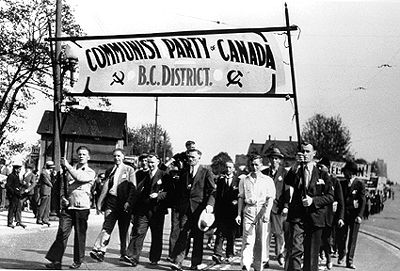
-
Article
Commercial Law
Commercial law is that branch of private law concerned primarily with the supply of goods or services by merchants and other businesses for profit. Textbooks on commercial law frequently differ on the range of topics treated in them.
"https://thecanadianencyclopedia.ca/images/tce_placeholder.jpg?v=e9dca980c9bdb3aa11e832e7ea94f5d9" // resources/views/front/categories/view.blade.php
https://thecanadianencyclopedia.ca/images/tce_placeholder.jpg?v=e9dca980c9bdb3aa11e832e7ea94f5d9
-
Article
Committee for an Independent Canada
The Committee for an Independent Canada (CIC) was conceived by Walter GORDON, Peter NEWMAN and Abraham Rotstein as a citizens' committee to promote Canadian economic and cultural independence. They recruited Jack MCCLELLAND and Claude RYAN as cochairmen and launched the CIC on 17 September 1970.
"https://d3d0lqu00lnqvz.cloudfront.net/media/media/346651f7-0648-43dc-b40f-649d2e4a6e84.jpg" // resources/views/front/categories/view.blade.php
https://d3d0lqu00lnqvz.cloudfront.net/media/media/346651f7-0648-43dc-b40f-649d2e4a6e84.jpg
-
Article
Commodities in Canada
In commerce, commodities are interchangeable goods or services. Many natural resources in Canada are viewed as commodities. They are a major source of the country’s wealth. Examples of commodities include a barrel of crude oil, an ounce of gold, or a contract to clear snow during the winter. Commodity products often supply the production of other goods or services. Many are widely traded in futures exchanges (see Commodity Trading).
"https://d3d0lqu00lnqvz.cloudfront.net/media/new_article_images/EconomicsSummaries/dreamstimeextralarge_35143531.jpg" // resources/views/front/categories/view.blade.php
https://d3d0lqu00lnqvz.cloudfront.net/media/new_article_images/EconomicsSummaries/dreamstimeextralarge_35143531.jpg
-
Article
Commodity Inspection and Grading
Commodity Inspection and GradingCanada's AGRICULTURE AND FOOD inspection and grading system has 2 major goals: first, it endeavours to provide standards of quality and grades that are readily recognizable and acceptable in domestic and international commodity and food markets; second, it attempts to encourage concern for safety and nutrition in the processing, distribution and retailing of food products. Both of these objectives contribute to consumer protection. Commodity inspection and grading have a long history in...
"https://thecanadianencyclopedia.ca/images/tce_placeholder.jpg?v=e9dca980c9bdb3aa11e832e7ea94f5d9" // resources/views/front/categories/view.blade.php
https://thecanadianencyclopedia.ca/images/tce_placeholder.jpg?v=e9dca980c9bdb3aa11e832e7ea94f5d9
-
Article
Commodity Trading
Commodity futures markets provide a means for the organized trading of contracts for the delivery of goods at a later date. Today, these include agricultural products, metals, forest products, petroleum products, interest rates and stocks.
"https://thecanadianencyclopedia.ca/images/tce_placeholder.jpg?v=e9dca980c9bdb3aa11e832e7ea94f5d9" // resources/views/front/categories/view.blade.php
https://thecanadianencyclopedia.ca/images/tce_placeholder.jpg?v=e9dca980c9bdb3aa11e832e7ea94f5d9
-
Article
Company of One Hundred Associates
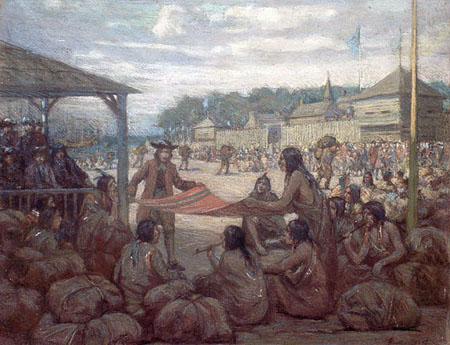
The Company of New France, or Company of One Hundred Associates (Compagnie des Cent-Associés) as it was more commonly known, was formed in France in 1627. Its purpose was to increase New France’s population while enjoying a monopoly on almost all colonial trade. It took bold steps but suffered many setbacks. The company folded in 1663. It earned little return on its investment, though it helped establish New France as a viable colony.
"https://d3d0lqu00lnqvz.cloudfront.net/media/media/e4ec1e55-01c2-4b77-a220-f05a84fd4c9c.jpg" // resources/views/front/categories/view.blade.php
https://d3d0lqu00lnqvz.cloudfront.net/media/media/e4ec1e55-01c2-4b77-a220-f05a84fd4c9c.jpg