
Browse "Military"
-
Memory Project Archive
John Liss (Primary Source)
See below for John Liss's entire testimony. Please be advised that Memory Project primary sources may deal with personal testimony that reflect the speaker’s recollections and interpretations of events. Individual testimony does not necessarily reflect the views of the Memory Project and Historica Canada.
"https://d3d0lqu00lnqvz.cloudfront.net/The-Memory-Project/image/14960_600.jpg" // resources/views/front/categories/view.blade.php
https://d3d0lqu00lnqvz.cloudfront.net/The-Memory-Project/image/14960_600.jpg
-
Memory Project Archive
Kenneth McClure Asham (Primary Source)
See below for Mr. Asham's entire testimony. Please be advised that Memory Project primary sources may deal with personal testimony that reflect the speaker’s recollections and interpretations of events. Individual testimony does not necessarily reflect the views of the Memory Project and Historica Canada.
"https://d3d0lqu00lnqvz.cloudfront.net/MemoryProject/KennethMcClureAsham/15631_538.jpg" // resources/views/front/categories/view.blade.php
https://d3d0lqu00lnqvz.cloudfront.net/MemoryProject/KennethMcClureAsham/15631_538.jpg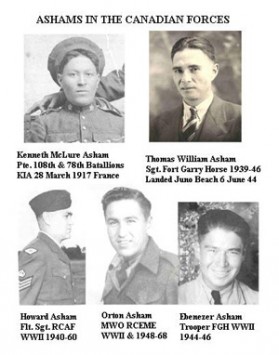
-
Memory Project Archive
Laurence Jesse William Morgan (Primary Source)
Lawrence Morgan served in the British Navy during the Second World War. Please be advised that Memory Project primary sources may deal with personal testimony that reflect the speaker’s recollections and interpretations of events. Individual testimony does not necessarily reflect the views of the Memory Project and Historica Canada.
"https://d3d0lqu00lnqvz.cloudfront.net/The-Memory-Project/image/2002_original.jpg" // resources/views/front/categories/view.blade.php
https://d3d0lqu00lnqvz.cloudfront.net/The-Memory-Project/image/2002_original.jpg
-
Memory Project Archive
Ray Priddle (Primary Source)
Ray Priddle was conscripted into the Royal Navy in 1942. Trained as a signalman, he was then assigned to Combined Operations – Royal Navy Deep Signal Section No. 6, which was attached to units conducting amphibious landings in the invasions of Sicily and Italy (1943) and Normandy (1944). On D-Day, his unit was attached to the Canadians going ashore at Juno Beach. With respect to D-Day, Mr. Priddle remembers going ashore to establish communications with ships offshore and also the rough combat conditions for Canadian troops. His story contributes to a better understanding of how various Allied units worked together during the most famous day of the Second World War.Please be advised that Memory Project primary sources may deal with personal testimony that reflect the speaker’s recollections and interpretations of events. Individual testimony does not necessarily reflect the views of the Memory Project and Historica Canada.
"https://d3d0lqu00lnqvz.cloudfront.net/The-Memory-Project/image/13773_original.jpg" // resources/views/front/categories/view.blade.php
https://d3d0lqu00lnqvz.cloudfront.net/The-Memory-Project/image/13773_original.jpg
-
Memory Project Archive
Sandford Tuey (Primary Source)
Interview with Sandford Tuey.Please be advised that Memory Project primary sources may deal with personal testimony that reflect the speaker’s recollections and interpretations of events. Individual testimony does not necessarily reflect the views of the Memory Project and Historica Canada.
"https://d3d0lqu00lnqvz.cloudfront.net/The-Memory-Project/image/15251_600.jpg" // resources/views/front/categories/view.blade.php
https://d3d0lqu00lnqvz.cloudfront.net/The-Memory-Project/image/15251_600.jpg
-
Memory Project Archive
Tadeusz "Tad" Szablewski (Primary Source)
Tad Szablewski was a member of the Polish Air Force during the Second World War.Please be advised that Memory Project primary sources may deal with personal testimony that reflect the speaker’s recollections and interpretations of events. Individual testimony does not necessarily reflect the views of the Memory Project and Historica Canada.Content warning: This article contains content which some may find offensive or disturbing.
"https://d3d0lqu00lnqvz.cloudfront.net/The-Memory-Project/image/7036_original.jpg" // resources/views/front/categories/view.blade.php
https://d3d0lqu00lnqvz.cloudfront.net/The-Memory-Project/image/7036_original.jpg
-
Memory Project Archive
William Roy Hindle (Primary Source)
William Roy Hindle served in the Royal Canadian Air Force during the Second World War. Towards the end of the war he joined the Royal Naval Canadian Volunteer Reserve.Please be advised that Memory Project primary sources may deal with personal testimony that reflect the speaker’s recollections and interpretations of events. Individual testimony does not necessarily reflect the views of the Memory Project and Historica Canada.
"https://d3d0lqu00lnqvz.cloudfront.net/The-Memory-Project/image/13636_original.jpg" // resources/views/front/categories/view.blade.php
https://d3d0lqu00lnqvz.cloudfront.net/The-Memory-Project/image/13636_original.jpg
-
Article
Rebellion in Lower Canada (The Patriots' War)
In 1837 and 1838, French Canadian militants in Lower Canada took up arms against the British Crown in a pair of insurrections. The twin rebellions killed more than 300 people. They followed years of tensions between the colony’s anglophone minority and the growing, nationalistic aspirations of its francophone majority. The rebels failed in their campaign against British rule. However, their revolt led to political reform, including the unified Province of Canada and the introduction of responsible government. The rebellion in Lower Canada, which is also known as the Patriots' War (la Guerre des patriotes), also gave French Canadians one of their first nationalist heroes in Louis-Joseph Papineau.
"https://d3d0lqu00lnqvz.cloudfront.net/media/media/37aadc48-3f88-4946-a9aa-0d2ad30495cd.jpg" // resources/views/front/categories/view.blade.php
https://d3d0lqu00lnqvz.cloudfront.net/media/media/37aadc48-3f88-4946-a9aa-0d2ad30495cd.jpg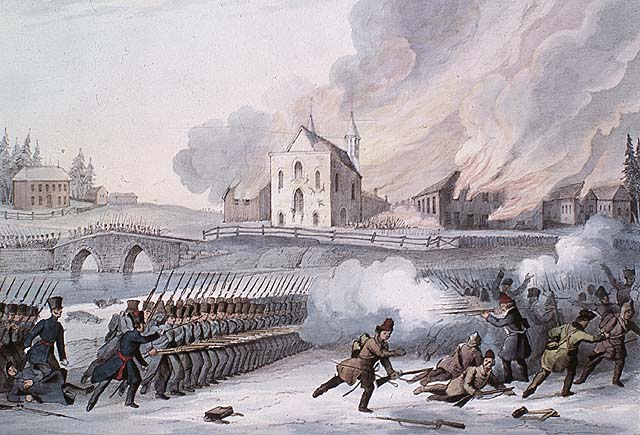
-
Article
Battle of Vimy Ridge
The Battle of Vimy Ridge was fought during the First World War from 9 to 12 April 1917. It is Canada’s most celebrated military victory — an often mythologized symbol of the birth of Canadian national pride and awareness. The battle took place on the Western Front, in northern France. The four divisions of the Canadian Corps, fighting together for the first time, attacked the ridge from 9 to 12 April 1917 and captured it from the German army. It was the largest territorial advance of any Allied force to that point in the war — but it would mean little to the outcome of the conflict. More than 10,600 Canadians were killed and wounded in the assault. Today an iconic memorial atop the ridge honours the 11,285 Canadians killed in France throughout the war who have no known graves. This is the full-length entry about the Battle of Vimy Ridge. For a plain-language summary, please see Battle of Vimy Ridge (Plain-Language Summary).
"https://d3d0lqu00lnqvz.cloudfront.net/media/media/a9aa6aaf-406d-4a4d-89a3-95d86d7359ca.jpg" // resources/views/front/categories/view.blade.php
https://d3d0lqu00lnqvz.cloudfront.net/media/media/a9aa6aaf-406d-4a4d-89a3-95d86d7359ca.jpg