
Browse "Historic Sites"
-
Article
Québec Citadel National Historic Site of Canada
The Citadel has been an active military base since 1920. The Historic Sites and Monuments Board of Canada designated the uneven star-shaped Citadel as a national historic site in 1946 but its importance was recognized much earlier, and it was one of Canada's first heritage conservation projects.
"https://d3d0lqu00lnqvz.cloudfront.net/media/media/a7702171-fde4-4dd7-b794-ee21a1f28b6e.jpg" // resources/views/front/categories/view.blade.php
https://d3d0lqu00lnqvz.cloudfront.net/media/media/a7702171-fde4-4dd7-b794-ee21a1f28b6e.jpg
-
Article
Quidi Vidi Battery
The Quidi Vidi Battery was built in 1762 by the French. The French attacked the ST JOHN'S, Nfld, area in one of the last campaigns of the SEVEN YEARS' WAR, capturing and burning many settlements around Trinity and Conception bays. They then erected the battery to defend their newly won territory.
"https://thecanadianencyclopedia.ca/images/tce_placeholder.jpg?v=e9dca980c9bdb3aa11e832e7ea94f5d9" // resources/views/front/categories/view.blade.php
https://thecanadianencyclopedia.ca/images/tce_placeholder.jpg?v=e9dca980c9bdb3aa11e832e7ea94f5d9
-
Article
Rainy River Burial Mounds
The Rainy River Burial Mounds archaeological sites are located on the Canadian bank of the Rainy River in Ontario.
"https://thecanadianencyclopedia.ca/images/tce_placeholder.jpg?v=e9dca980c9bdb3aa11e832e7ea94f5d9" // resources/views/front/categories/view.blade.php
https://thecanadianencyclopedia.ca/images/tce_placeholder.jpg?v=e9dca980c9bdb3aa11e832e7ea94f5d9
-
Article
Rat Indian Creek Archaeological Site
The Rat Indian Creek site is located above the Arctic Circle, on the Porcupine River, 60 km east of the Vuntut Gwitchin village of Old Crow, Yukon.
"https://d3d0lqu00lnqvz.cloudfront.net/media/media/891e3d37-3191-4b19-900a-76e3eb2be918.jpg" // resources/views/front/categories/view.blade.php
https://d3d0lqu00lnqvz.cloudfront.net/media/media/891e3d37-3191-4b19-900a-76e3eb2be918.jpg
-
Article
Rebellion in Lower Canada (The Patriots' War)
In 1837 and 1838, French Canadian militants in Lower Canada took up arms against the British Crown in a pair of insurrections. The twin rebellions killed more than 300 people. They followed years of tensions between the colony’s anglophone minority and the growing, nationalistic aspirations of its francophone majority. The rebels failed in their campaign against British rule. However, their revolt led to political reform, including the unified Province of Canada and the introduction of responsible government. The rebellion in Lower Canada, which is also known as the Patriots' War (la Guerre des patriotes), also gave French Canadians one of their first nationalist heroes in Louis-Joseph Papineau.
"https://d3d0lqu00lnqvz.cloudfront.net/media/media/37aadc48-3f88-4946-a9aa-0d2ad30495cd.jpg" // resources/views/front/categories/view.blade.php
https://d3d0lqu00lnqvz.cloudfront.net/media/media/37aadc48-3f88-4946-a9aa-0d2ad30495cd.jpg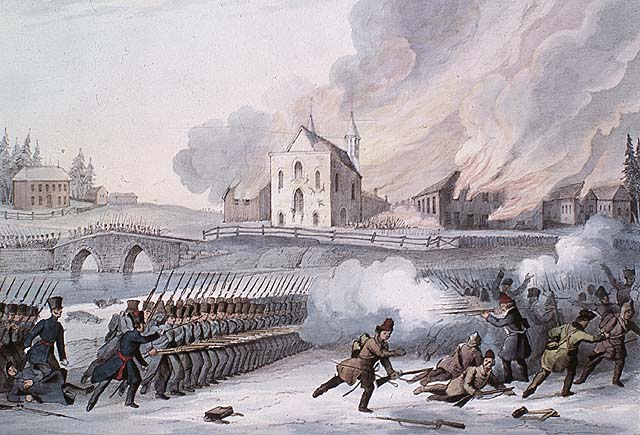
-
Article
Red Bay Archaeological Site
Red Bay, located on the north shore of the Strait of Belle Isle, Labrador, is an archaeological reference for the 16th-century transatlantic fishery, particularly for Basque whaling activities. After research into Spanish documents and archaeological finds on Saddle Island and under water, Red Bay was designated a historical site in 1978-79. In 2013, the whaling station at Red Bay was designated a UNESCO World Heritage Site.
"https://d3d0lqu00lnqvz.cloudfront.net/media/media/2d045c80-3539-44a1-a87c-7b1a734b8c91.jpg" // resources/views/front/categories/view.blade.php
https://d3d0lqu00lnqvz.cloudfront.net/media/media/2d045c80-3539-44a1-a87c-7b1a734b8c91.jpg
-
Article
Red River Resistance
The Red River Resistance (also known as the Red River Rebellion) was an uprising in 1869–70 in the Red River Colony. The resistance was sparked by the transfer of the vast territory of Rupert’s Land to the new Dominion of Canada. The colony of farmers and hunters, many of them Métis, occupied a corner of Rupert’s Land and feared for their culture and land rights under Canadian control. The Métis mounted a resistance and declared a provisional government to negotiate terms for entering Confederation. The uprising led to the creation of the province of Manitoba, and the emergence of Métis leader Louis Riel — a hero to his people and many in Quebec, but an outlaw in the eyes of the Canadian government.
"https://d3d0lqu00lnqvz.cloudfront.net/media/media/f0a1f84f-c420-4038-8815-42587e295b75.jpg" // resources/views/front/categories/view.blade.php
https://d3d0lqu00lnqvz.cloudfront.net/media/media/f0a1f84f-c420-4038-8815-42587e295b75.jpg
-
Article
Rocky Mountain House National Historic Site
Rocky Mountain House National Historic Site, near Rocky Mountain House, Alberta, commemorates a series of fur-trade posts built between 1799 and 1864 by the North West Co and the Hudson's Bay Co (HBC) near the junction of the North Saskatchewan and Clearwater rivers.
"https://thecanadianencyclopedia.ca/images/tce_placeholder.jpg?v=e9dca980c9bdb3aa11e832e7ea94f5d9" // resources/views/front/categories/view.blade.php
https://thecanadianencyclopedia.ca/images/tce_placeholder.jpg?v=e9dca980c9bdb3aa11e832e7ea94f5d9
-
Article
Ross Farm
Ross Farm, at New Ross, NS, 28 km north of Chester, dates from 1816, when Captain William Ross led 172 disbanded soldiers into the Nova Scotia interior to establish an agricultural settlement.
"https://thecanadianencyclopedia.ca/images/tce_placeholder.jpg?v=e9dca980c9bdb3aa11e832e7ea94f5d9" // resources/views/front/categories/view.blade.php
https://thecanadianencyclopedia.ca/images/tce_placeholder.jpg?v=e9dca980c9bdb3aa11e832e7ea94f5d9
-
Article
Ross-Thomson House
The Ross-Thomson House is located in SHELBURNE, NS. At the end of the American Revolution, thousands of LOYALISTS arrived in Shelburne. Many quickly left, but others, like George and Robert Ross, settled and began businesses in the new town.
"https://thecanadianencyclopedia.ca/images/tce_placeholder.jpg?v=e9dca980c9bdb3aa11e832e7ea94f5d9" // resources/views/front/categories/view.blade.php
https://thecanadianencyclopedia.ca/images/tce_placeholder.jpg?v=e9dca980c9bdb3aa11e832e7ea94f5d9
-
Article
Rutherford House
Rutherford House is an elegant Edwardian house built in 1909 for Alexander Cameron RUTHERFORD, the first premier of Alberta and chancellor of the UNIVERSITY OF ALBERTA (1927-41).
"https://thecanadianencyclopedia.ca/images/tce_placeholder.jpg?v=e9dca980c9bdb3aa11e832e7ea94f5d9" // resources/views/front/categories/view.blade.php
https://thecanadianencyclopedia.ca/images/tce_placeholder.jpg?v=e9dca980c9bdb3aa11e832e7ea94f5d9
-
Article
Saint-Louis Forts and Châteaux Archaeological Site
The Saint-Louis Forts and Châteaux archaeological site is located on top of a cliff overlooking the lower part of Quebec City, close to the Château Frontenac Hotel, under the Dufferin Terrace.
"https://d3d0lqu00lnqvz.cloudfront.net/media/media/3198c511-bb10-4183-acac-164a9c95e9eb.jpg" // resources/views/front/categories/view.blade.php
https://d3d0lqu00lnqvz.cloudfront.net/media/media/3198c511-bb10-4183-acac-164a9c95e9eb.jpg
-
Article
Shand House
Shand House in WINDSOR, NS, is an ornate Victorian residence built by Clifford and Henrie Shand in 1890 as a family home. Clifford Shand was a noted bicycle racer and the son of a Windsor furniture manufacturer, and the interior of the house reflects this association with fine woodworking.
"https://thecanadianencyclopedia.ca/images/tce_placeholder.jpg?v=e9dca980c9bdb3aa11e832e7ea94f5d9" // resources/views/front/categories/view.blade.php
https://thecanadianencyclopedia.ca/images/tce_placeholder.jpg?v=e9dca980c9bdb3aa11e832e7ea94f5d9
-
Article
Sherbrooke Village
Sherbrooke Village in Sherbrooke, NS, is unusual in that it is not a collection of historic buildings moved into a reconstructed townsite, but rather the older portion of the actual village of Sherbrooke.
"https://thecanadianencyclopedia.ca/images/tce_placeholder.jpg?v=e9dca980c9bdb3aa11e832e7ea94f5d9" // resources/views/front/categories/view.blade.php
https://thecanadianencyclopedia.ca/images/tce_placeholder.jpg?v=e9dca980c9bdb3aa11e832e7ea94f5d9
-
Article
Sheriff Andrews House Historic Site
Located in the historic Loyalist town of St Andrew's, NB, Elisha Andrews built this house in 1820. Andrews was the son of a prominent Loyalist, the Reverend Samuel Andrews, and served himself as Sheriff of Charlotte County.
"https://thecanadianencyclopedia.ca/images/tce_placeholder.jpg?v=e9dca980c9bdb3aa11e832e7ea94f5d9" // resources/views/front/categories/view.blade.php
https://thecanadianencyclopedia.ca/images/tce_placeholder.jpg?v=e9dca980c9bdb3aa11e832e7ea94f5d9