
Browse "Buildings & Monuments"
-
Article
Vancouver Special
The Vancouver Special took form largely between 1965 and 1985 due to new possibilities in the mass production of cheap and accessible housing. It is the primary form of architecture unique to Vancouver.
"https://d3d0lqu00lnqvz.cloudfront.net/media/media/43bc3258-a62a-46ff-a001-38c9c2e59cfd.jpg" // resources/views/front/categories/view.blade.php
https://d3d0lqu00lnqvz.cloudfront.net/media/media/43bc3258-a62a-46ff-a001-38c9c2e59cfd.jpg
-
Article
West Edmonton Mall
The WEM remains the largest shopping centre in North America. It was among the first shopping centres to offer a wide range of amenities, from water parks to themed streets - attractive at any time of year but particularly during winter.
"https://d3d0lqu00lnqvz.cloudfront.net/media/media/8e1f10ac-8e39-4565-bdbc-70eba80e243a.jpg" // resources/views/front/categories/view.blade.php
https://d3d0lqu00lnqvz.cloudfront.net/media/media/8e1f10ac-8e39-4565-bdbc-70eba80e243a.jpg
-
Article
Woodland Cultural Centre
The Association of Iroquois and Allied Indians (AIAI), a provincial/territorial First Nations organization in Ontario, founded the Woodland Indian Cultural Education Centre (now Woodland Cultural Centre [WCC]) in 1972. The WCC works “to preserve, promote and strengthen Indigenous language, culture, art and history; bringing the story of the Hodinohsho:ni people of the Eastern Woodlands to life through innovative exhibitions and programs.” The WCC’s board of directors includes community members from the Six Nations of the Grand River First Nation, Mohawks of the Bay of Quinte (Tyendinaga Mohawk Territory) and Wahta Mohawks. The WCC was established by repurposing the Mohawk Institute, Canada’s first Indian residential school, following its closure. In 2014, the WCC launched its Save the Evidence campaign to restore the Mohawk Institute. This effort culminated in the substantial renovation and unveiling of the Mohawk Institute on 30 September 2025, Canada’s National Day for Truth and Reconciliation.
"https://d3d0lqu00lnqvz.cloudfront.net/WoodlandCulturalCentre/Woodland-Cultural-Centre_resized.jpg" // resources/views/front/categories/view.blade.php
https://d3d0lqu00lnqvz.cloudfront.net/WoodlandCulturalCentre/Woodland-Cultural-Centre_resized.jpg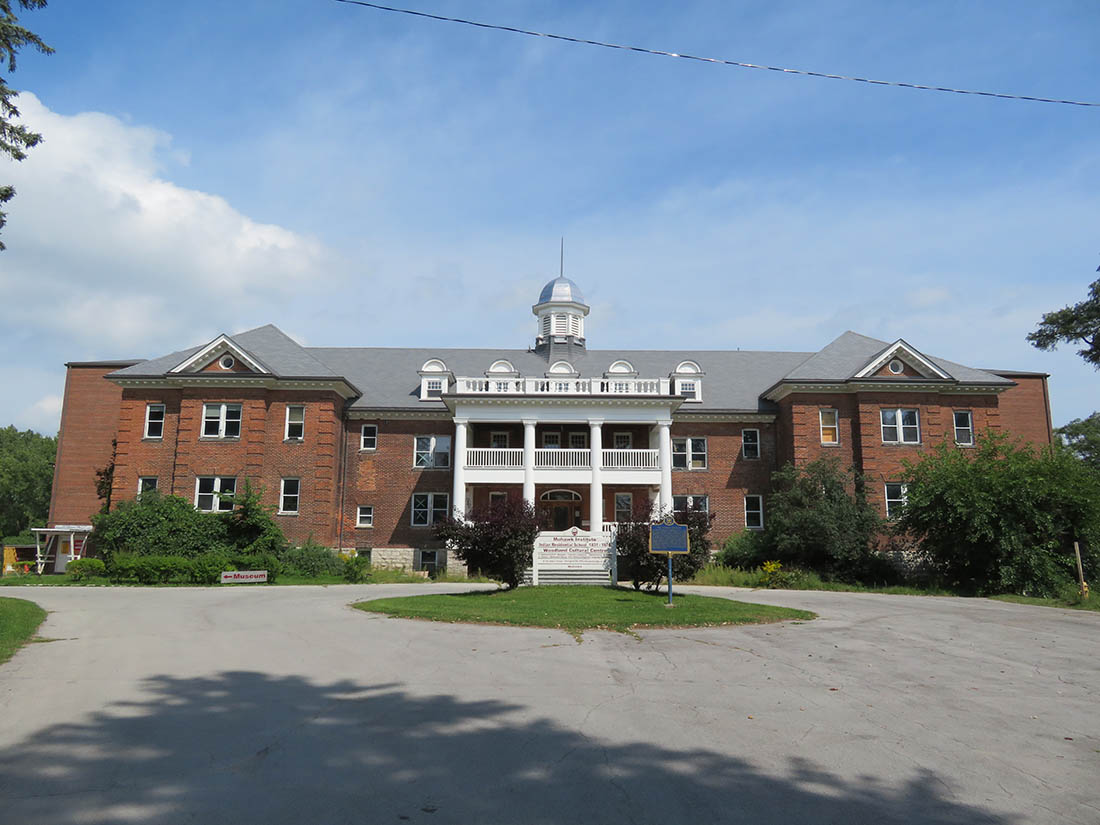
-
Article
York Factory
York Factory, also known as York Fort, Fort Bourbon by the French, and Kischewaskaheegan by some Indigenous people, was a trading post on the Hayes River near its outlet to Hudson Bay, in what is now Manitoba. During its life, it served as a post and later as a major administrative centre in the Hudson’s Bay Company’s fur trade network. It also bore witness to the largest naval battle to take place in Arctic Canada, the Battle of Hudson Bay in 1697.
"https://d3d0lqu00lnqvz.cloudfront.net/YorkFactory1853.jpg" // resources/views/front/categories/view.blade.php
https://d3d0lqu00lnqvz.cloudfront.net/YorkFactory1853.jpg