Share on Facebook
 Share on X
 Share by Email
 Share on Google Classroom
Treaty 8 was signed on 21 June 1899 by the Crown and First Nations of the Lesser Slave Lake area. The treaty covers roughly 841,487.137 km2 of what was formerly the North-West Territories and British Columbia, and now includes northern Alberta, northwest Saskatchewan, and portions of the modern Northwest Territoriesand BC, making it the largest treaty by area in the history of Canada. Prompted by the discovery of valuable resources in Canada’s north, particularly the Klondike gold rush, the treaty involved First Nations whose social organization was different than those of the Indigenous peoples the government had previously encountered in Numbered Treaties negotiations. As a result of this and other factors endemic to the North, the terms and implementation of Treaty 8 differ importantly from those of previous Numbered Treaties, with long-lasting consequences for the governance and peoples of that area.
This article is a full-length entry about Treaty 8. For a plain-language summary, please see Treaty 8 (Plain-Language Summary).
Historical Context
During the late 1800s and early 1900s, the Canadian government negotiated treaties with Indigenous peoples as a means of “extinguishing” (surrendering) Aboriginal title to traditional territories. The government wanted these lands for use in settlement and development projects. Vast portions of the North, however, were not considered as valuable as other regions, such as the Plains, because they were not generally suitable for farming or settlement. The government was therefore reluctant to make treaties with northern Indigenous groups. As Superintendent General of Indian Affairs Thomas White remarked in 1887, “Within this vast region the Indians are not very numerous… the parts that have been explored are reported to be for the most part unsuitable for agriculture.”
Indigenous people of this area were faced with periods of starvation in the 19th century in part because of decreased animal populations, particularly during hard winters in the late 1880s that impacted both Indigenous people and non-Indigenous Hudson’s Bay Company (HBC) employees and missionaries. Consequently, some groups expressed interest in negotiating a treaty with the government that would protect their people and livelihood. Despite requests for assistance from local missionaries, representatives of the HBC, and the Indigenous people themselves, the government refused to enter into treaty negotiations. Limited assistance was offered starting in 1888, as ammunition, fishing supplies and rations were distributed through the HBC and missions using government funds. By 1891, after exploration had revealed potential oil reserves and other minerals throughout the Athabasca-Mackenzie area, the government began to plan seriously for a treaty. However, nothing came of it then; it is possible that the political instability following John A. Macdonald’s death in June 1891 prevented the government from reaching a decision about making another treaty.
In 1897, the Klondike gold rush — and the influx of white people into the North — prompted renewed interest in a treaty. There were also reports of gold around the Great Slave Lake region. Accounts of miners stealing and treating Indigenous people with violence and contempt proliferated, raising concerns about increased violence and demonstrating the necessity of bringing order to the region. It is also possible that the government was motivated to sign treaties before the Indigenous peoples discovered the monetary value of their land. As retired Indian agent James Walker wrote to Clifford Sifton, superintendent general of Indian Affairs, in November 1897, “They will be more easily dealt with now than they would be when their country is overrun with prospectors and valuable mines be discovered. They would then place a higher value on their rights.” The Department of Indian Affairs was additionally concerned that, if they waited too long, contact between the northern and southern Cree-speaking peoples and Métis would lead to the northern peoples’ understanding that what was promised orally was not necessarily embodied in the written text.
After much discussion about the virtues of annual payments versus lump sums and what kind of reserves would be appropriate for northerners, who tended to live in small family groups rather than communally in large tribes, a party of treaty commissioners consisting of former lieutenant governor David Laird, civil servant James Andrew Joseph McKenna and politician James Hamilton Ross set out in the summer of 1899 to negotiate Treaty 8 with the Cree, Denesuline (Chipewyan), Dane-zaa (Beaver) and other inhabitants of the territory.
Negotiations and Signings, 1899


The three treaty commissioners left Athabasca Landing on 3 June 1899 for a territory that was not well-known to settlers. The first signing of Treaty 8 occurred at Lesser Slave Lake on 21 June 1899, and it included representatives of the Cree.
The commissioners believed that it would be easy to sign other groups once some had already joined, and missionaries — including Father Lacombe, an influential priest who travelled with the treaty party itself — encouraged Indigenous people to sign. However, the initial negotiations did not go well according to observer James K. Cornwall: “The treaty, as presented by the Commissioners to the Indians…did not contain many things that they held to be of vital importance to their future existence as hunters and trappers and fishermen… They refused to sign the treaty as read to them.” A long discussion ensued; the commissioners had little experience with the ways of life of northern people, and were mocked for using the Prairie nations as a reference.
Eventually, the signatories agreed to the treaty based on a number of oral promises, according to both oral testimony and the commissioners’ report. These promises included care for the old and poor, provision of medical care as needed and possible, and — most importantly — a promise that that nothing would be done to interfere with their way of life. The need to guarantee that the Indigenous people would be able to hunt, trap and fish as they had always done emerged at every location that the commissioners visited. However, the extent and interpretation of these promises differed between the treaty commissioners and Indigenous signatories.
Following Lesser Slave Lake, the commissioners split up in order to cover more ground. James Ross and James McKenna arrived at Fort Chipewyan on 13 July, where similar issues arose; according to Pierre Mercredi, an interpreter for the Denesuline, the treaty that he read to them and that they signed did not include a clause on hunting regulations, which he maintained was added later.
David Laird proceeded that summer to Peace River Landing, Fort Vermilion and Fond du Lac. Ross and McKenna also went to Fort Dunvegan, Fort Smith, Fort McMurray and Wabasca. At these locations, representatives of the Denesuline, Cree and Dane-zaa adhered to the Lesser Slave Lake treaty.
The commissioners reported that their trip was successful, though there were groups they had not been able to reach. Some of these would be included starting in 1900.
Terms of the Treaty
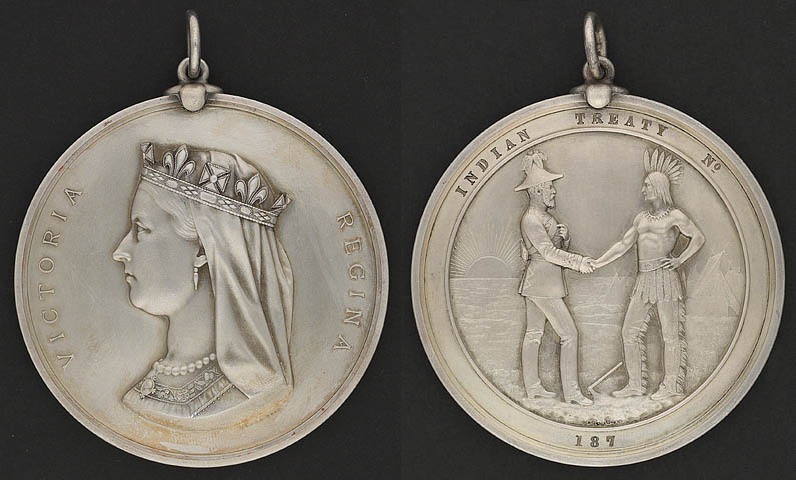
The eventual boundaries of the proposed treaty were based on mining areas, the presence of prospectors, transportation corridors to the Klondike and the need to create peace between the few existing settlers and First Nations. The terms were drawn up prior to the actual negotiations, but finalized during negotiations at Lesser Slave Lake, and were similar to those written down in previous treaties, in that they provided reserves, annual cash payments (annuities), and other promises in exchange for the surrender of the land. The written terms also included the right to pursue hunting, trapping and fishing, subject to certain regulations, and excluding tracts that might be required for settlement, mining, lumbering, trading or other initiatives.
Reserves were to be granted based on the arithmetic of one square mile (about 2.6 km2) for each family of five, and in that proportion for larger or smaller families. However, in an acknowledgement that the social structures of the northern peoples were different, and that, in general, they preferred to live in smaller groups, families or individuals could also be granted 160 acres of land “in severalty” (separately), on which they could live apart from the reserves.
Immediate cash payments for everyone were to be followed by smaller annual payments, with larger amounts going to chiefs and headmen. Initial payments were set at $32 for chiefs, $22 for headmen and $12 for others, while annuities were set at $25 for chiefs, $15 for headmen and $5 for others. The treaty promised the government would pay salaries for teachers to instruct the children.
Under terms of the treaty, the government agreed to provide agricultural implements and livestock for groups that took reserves and were interested in cultivating the land; the government also agreed to provide extra cattle for those who wanted to ranch. For groups that wanted to continue hunting and fishing, they were annually to receive ammunition and fishing twine to equal the value of $1 per head of each family.
Adhesions, Post-1899
Further adhesions to the treaty (additional signings) took place after 1899. It is important to note, however, that incomplete and inconsistent reports of the commissioners have led to a muddled understanding of Treaty 8 adhesions and admittances. As a result, gaps in the knowledge may exist.
In February 1900, Indian Affairs Department inspector J.A. Macrae was appointed to obtain the adhesions of the Indigenous peoples at Fort St. John and Fort Resolution. He then signed these adhesions with part of the Dane-zaa band at Fort St. John (more members of the band joined the treaty in later years), the Fort Resolution bands (made up of the Tlicho, T’atsaot’ine, Denesuline and Deh Cho), the Sturgeon Lake Cree and the Upper Hay River Deh Cho. He also included some Denesuline (from east of Smith’s Landing on Great Slave River) to the treaty, as part of the band from Smith’s Landing.
In December 1909, commissioner H.A. Conroy was appointed to negotiate an adhesion by the Fort Nelson bands, made up mostly of Deh Cho and some Tsek’ehne (Sekani). After the elections of representatives, the Indigenous peoples signed the adhesion on 15 August 1910.
Harold Laird, clerk and Indian agent assistant, revisited the Fort Nelson bands in May 1911 to gain the adhesions of those who did not sign the year prior. After much discussion and debate over leadership, 98 Tsek’ehne people signed the treaty on 4 August 1911.
In 1913, government officials noted that there were more bands that had not signed the treaty, including people at Fort Grahame, Moberly Lake, Fort St. John and Hudson’s Hope. In the summer of 1914, the peoples at Moberly Lake were brought into treaty. Evidence suggests that Indigenous peoples who were previously entitled to enter the treaty but hadn’t done so were admitted around this time, including those at Hudson’s Hope.
In 1915, one person from Whitefish Lake entered treaty; there were further entries from Whitefish Lake peoples in subsequent years.
Several Métis were also admitted to treaty in the 1930s, including 42 Métis from Fort Resolution (1930).
Some bands within the Treaty 8 boundaries in British Columbia did not sign adhesions, including the bands of Liard River, Fort Grahame and Finlay River. Bands in other provinces were also passed over by the commissioners, including those in Lubicon Lake in Alberta.
In 2000, the Tsek’ehne of McLeod Lake were officially brought into Treaty 8.
Scrip Commission

Negotiations for Treaty 8 occurred concurrently with the activities of a Scrip Commission, headed by Major James Walker, formerly of the North-West Mounted Police, and J.A. Coté of the Land Department. The commission was tasked with extinguishing Métis title. There were concerns that the Métis, who were relatively numerous in the North, would agitate against the government’s activities and discourage First Nations from signing the treaty if their needs were not also addressed. Métis had the option of being treated as Indians and joining the treaty process. The remaining Métis were offered scrip (certificates given to individual Métis people by the government that extinguished Aboriginal title in exchange for land or one-time cash payments) in the amount of $240 or 240 acres of land. The government had previously considered making this scrip non-transferable in order to prevent speculators from purchasing the scrip off of the Métis, as had frequently happened in Manitoba. In the end, however, they decided not to — largely due to the objections of the Métis themselves — and many Métis did in fact sell their scrip to speculators.
Commissioners investigated Métis claims at locations including Lesser Slave Lake, Peace River Crossing, Fort Dunvegan, Wolverine Point, Fort Vermilion, Fort Chipewyan, Smith’s Landing, Fort McMurray, Wabasca, Pelican Portage, Grand Rapids, Calling River Portage, Athabasca Landing and Wapiscan.
In Alberta, the scrip option was removed in 1912 for the boundaries of Treaty 8; Métis claims were subsequently dealt with by admission to treaty.
In total, 1,195 money scrips (a value of $286,800) and 48 land scrips (covering an area of 4461.97 hectares) were issued throughout the Treaty 8 lands in 1899, more than half of which went to the Lesser Slave Lake Métis.
Problems Administering the Treaty
Almost immediately, issues arose with the treaty. Although money and supplies were supposed to be delivered every summer, the government fell behind on payments, and owed money to some groups for several years. According to scholar René Fumoleau, there are varying reasons why these payments were not made, including the challenges government officials faced in accessing the annual meeting sites on time, such as heavy ice. Additionally, treaty supplies were sometimes damaged in transit to annual meetings. Indigenous leaders, including the chief at Fond du Lac, notified government officials about their concerns regarding delayed or missing treaty payments. When Assistant Deputy and Secretary of Indian Affairs John McLean learned of the amount of money owed to Indigenous peoples in the territory, he told Indian agents to pay two years’ arrears in addition to the current year’s annuity, while recording the remaining arrears in an internal document.
“It is not intended,” he wrote, “that you should show this list to the Indians or traders and lead them to understand that all these arrears are due and will be paid, but the list should be treated as a confidential official document.”
Interpretations and Implications
Many of the oral promises made during negotiations for the treaty, such as medical care, and hunting, trapping and fishing rights, were interpreted differently by the treaty commissioners and Indigenous signatories.
Medical Care
In their report to the government, the treaty commissioners acknowledged that during negotiations, Indigenous signatories requested that the government provide care for the elderly and those who were ill or impoverished. They also requested that the government provide medicine and a doctor to help care for the ill.
In response, the commissioners informed Indigenous leaders that “the Government was always ready to give relief in cases of actual destitution…we stated that the attention of the Government would be called to the need of some special provision being made for assisting the old and indigent who were unable to work and dependent on charity for the means of sustaining life.” They also promised that
supplies of medicines would be put in charge of persons selected by the Government at different points, and would be distributed free to those of the Indians who might require them. We explained that it would be practically impossible for the Government to arrange for regular medical attendance upon Indians so widely scattered.… We assured them, however, that the Government would always be ready to avail itself of any opportunity of affording medical service.
Beginning in 1900, a doctor was part of the annual treaty party. In 1910, a permanent doctor arrived in Fort Smith, and in 1914, a hospital was established there by the Catholic Church and run by the Grey Nuns. However, many other communities throughout Treaty 8 territory did not receive medical care outside of the annual treaty party visit.
Contemporary arguments for a treaty right to health are based on a clause written into Treaty 6 known as the medicine chest clause, as well as on oral negotiations for other treaties, including Treaty 8.
Hunting and Trapping Rights
Most problematic, however, were a series of laws passed by the government that regulated hunting and trapping.
According to the treaty commissioners, Indigenous signatories were very concerned about hunting and fishing rights throughout the process. They stated in their report that “we had to solemnly assure them that only such laws as to hunting and fishing as were in the interest of the Indians and were found necessary in order to protect the fish and fur-bearing animals would be made, and that they would be as free to hunt and fish after the treaty as they would be if they never entered into it.” Further, the report states “[w]e assured them that the treaty would not lead to any forced interference with their mode of life.”
The treaty itself guaranteed the right of Indigenous signatories “to pursue their usual vocations of hunting, trapping and fishing throughout the tract surrendered as heretofore described, subject to such regulations as may from time to time be made.” According to interpreter Pierre Mercredi, however, the clause about regulations was added after the original treaty was signed.
I interpreted the words of Queen Victoria to Alexandre Laviolette, Chief of the Chipewyans and his band…. I know, because I read the Treaty to them, that there was no clause in it which said they might have to obey regulations about hunting. They left us no copy of the Treaty we signed, saying that they would have it printed and send a copy to us. When the copy came back, that second clause (that they shall promise to obey whatever hunting regulations the Dominion Government shall set) was in it. It was not there before. I never read it to the Chipewyans or explained it to them. I have no doubt that the new regulation breaks that old treaty.
In a 1937 affidavit from James K. Cornwall, a witness to the Treaty 8 process, the commissioners promised Indigenous people would “not be prevented from hunting and fishing as they had always done.” They were also, according to Cornwall, “guaranteed protection in their way of living as hunters and trappers, from white [non-Indigenous] competition.”Game laws were enacted in 1916, after overhunting had taken its toll. The 1916 Migratory Birds Act and the 1917 Game Act, which established closed seasons and prevented hunting of certain species, included exemptions for Indigenous peoples. However, officials ignored the exemptions and enforced the regulations against Indigenous hunters and trappers.
The game laws eventually led to acts of political resistance: for example, there was a boycott of the treaty at Fort Resolution in 1920 where First Nations refused to take their annual payments.
Natural Resources
The transfer of responsibility for natural resources to the western provinces after 1930 also led to conflicts, as honouring the treaties was a federal rather than provincial responsibility. Supreme Court decisions have since placed limits on the provinces’ abilities to make decisions that affect treaty signatories.
Particularly in what is now the Northwest Territories, outstanding issues of land have long gone unresolved. While some nations have settled their claims, many more — including the Akaitcho Dene First Nations and the Dehcho First Nations (see Dene Nation) — are still in the process of negotiating land, resources, and self-government agreements. The government’s failure to resolve these claims has made it difficult in some cases for it to develop resources. Some treaty signatories in northeastern British Columbia have also opposed the development of oil, gas and hydroelectric projects, saying that it violates their treaty rights (see Rights of Indigenous Peoples).