Share on Facebook
 Share on X
 Share by Email
 Share on Google Classroom
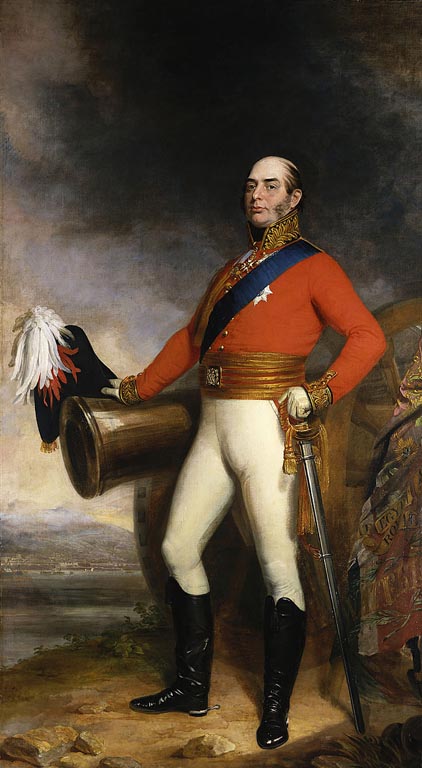
Prince Edward Augustus (born 2 November 1767 in London, United Kingdom; died 23 January 1820 in Sidmouth, United Kingdom), Duke of Kent and Strathearn 1799–1820. The fourth son of King George III and the father of Queen Victoria, Prince Edward lived in Quebec and Nova Scotia on military postings from 1791 to 1800, becoming commander-in-chief of British Forces in North America in 1799. A proponent of Canadian confederation, he was the first known public figure to describe both English and French Canadians as Canadians. Prince Edward Island and Prince Edward County in Ontario are named for him.
Early Life
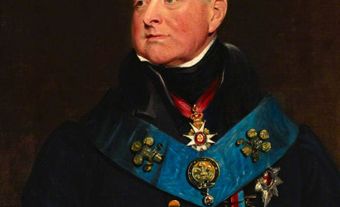
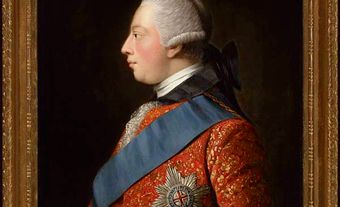
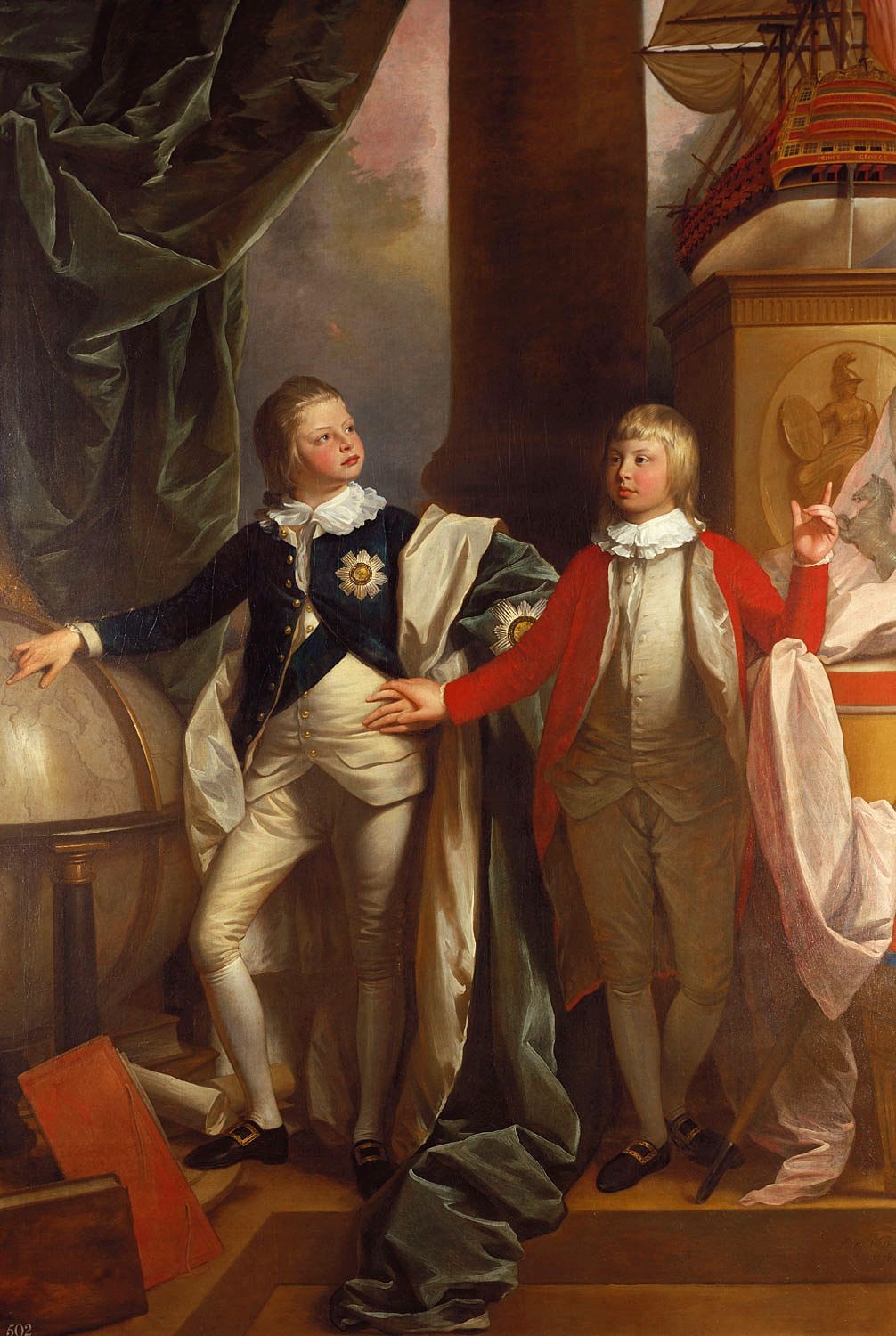
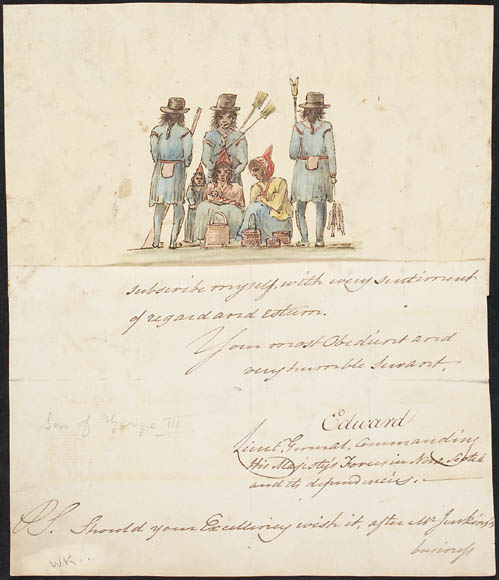
Prince Edward was born at Buckingham House (later Buckingham Palace), the fifth child and fourth son of King George III (1738–1820) and Charlotte of Mecklenburg-Strelitz (1744–1818). From the age of five, he shared a residence at Kew with his elder brother Prince William Henry (the future King William IV) and their tutors. He received art lessons from British landscape painter Alexander Cozens and painted watercolours during his military career.
Military Career
In 1785, Edward traveled to Lüneburg in Hanover, where he became a cadet in the Hanoverian foot guards. He continued his military training in Geneva from 1789 to 1790. Edward was stationed in Gibraltar in late 1790 and early 1791 as commander of the Queen’s Royal Regiment. While there, he gained a reputation as a strict disciplinarian. Edward blamed the hot climate in Gibraltar for his poor health and wrote to George III in December 1790 requesting transfer to North America, preferably Canada.
Children in Geneva
During his time in Geneva, Edward fathered two children, Adelaide Victoire Auguste (1789–c. 1832), daughter of Adelaide Dubus, and Edward Schencker Scheener (1789–1853), the son of Anne Gabrielle Alexandrine Moré.
Julie Saint-Laurent
In 1790, Edward began a relationship with a French noblewoman who had escaped to Geneva during the French Revolution. His relationship with Alphonsine-Thérèse-Bernardine-Julie de Montgenêt, known as Julie Saint-Laurent (1760–1830), lasted 27 years. She traveled with him to Gibraltar and Canada, where she acted as his hostess, receiving guests and enjoying a public role as his partner that would not have been socially acceptable in Great Britain. Julie’s Pond in Hemlock Ravine Park, Nova Scotia, is named for her. Edward and Julie separated in 1818 to allow Edward to make a royal marriage.
Many Canadian families claim descent from Edward and Julie, although there is no documentary evidence that they had children. Edward did not claim paternity of any children born in Canada, despite rumours during his lifetime that he was the father of the future General Sir William Fenwick Williams, who was born in Annapolis Royal in 1800.
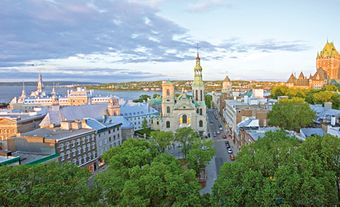
Quebec
On 11 August 1791, Edward arrived in Quebec City as colonel-in-chief of the 7th Fusiliers Regiment and received a formal welcome from the governor of Quebec, Guy Carleton, 1st Lord Dorchester. Edward was presented to a delegation of 40 Indigenous leaders led by John Johnson, who had arrived in Quebec to seek assistance repelling American incursions across the border.
In Quebec, Edward and Julie lived at Kent House on Rue Saint-Louis in Quebec (where the Articles of Capitulation of Quebec were signed in 1759 following the Battle of the Plains of Abraham) and Montmorency House near Montmorency Falls. Their social circle included prominent French-Canadians, including Ignace-Michel-Louis-Antoine d’Irumberry de Salaberry, justice of the peace for the District of Quebec. Edward and Julie were the godparents of his youngest son, the future military engineer Edouard-Alphonse d’Irumberry de Salaberry. Edward also supported the military career of his older son, Charles-Michel d’Irumberry de Salaberry, intervening in 1814 to ensure that he received recognition as “the hero who saved Lower Canada” for his service as commander of the Canadian Voltigeurs during the War of 1812.
Upper Canada
In 1792, Edward toured Upper Canada (now Ontario), visiting Cornwall, Kingston and Newark (now Niagara-on-the-Lake). Edward wrote to his father George III that he had “visited every post occupied by even the smallest detachment of your troops throughout all Canada, except Michillimakinac [sic], Detroit and Oswego” In Newark, Edward was entertained by Lieutenant Governor of Upper Canada John Graves Simcoe and his wife Elizabeth Simcoe in the three marquee tents that served as a temporary Government House. At Fort Niagara, Edward met with Indigenous peoples, watched a ceremonial war dance and received the title of “Chief-Above-All-Other-Chiefs.”
Nova Scotia
Following military service in Martinique during the French Revolutionary Wars, Edward was appointed commander of the British forces in Nova Scotia and New Brunswick in 1794. He lived in Halifax with Julie Saint-Laurent, leasing Prince’s Lodge from Sir John Wentworth, the lieutenant-governor of Nova Scotia. (Only the Rotunda music room still stands today). Edward established the first semaphore telegraph system in North America, connecting Halifax with Annapolis Royal, Fredericton and Saint John. In 1799, Edward received the first French royal visitors to North America, the future King Louis-Philippe I of France (1773–1850) and his two brothers, who were fleeing the French Revolutionary Wars.
During his time in Nova Scotia, Edward improved Halifax’s military defenses and transformed the appearance of the city, commissioning new official buildings in the classical Palladian style. Fort George on Citadel Hill was rebuilt, and Edward commissioned the old town clock on Citadel Hill, which was installed in 1803. Edward sponsored the construction of St. George’s Round Church and may have been the architect. The Halifax parade grounds were expanded for military maneuvers and made level with Barrington Street, and a new Martello tower was constructed at Point Pleasant. Edward purchased Navy Island, established an infectious disease hospital there and ordered the construction of Fort Charlotte on Navy Island. Edward welcomed more than 500 Jamaican Maroons (descendants of Africans who had escaped slavery) to work on these building projects and ensured they received equal pay with British troops for their labour.
Commander-in-Chief
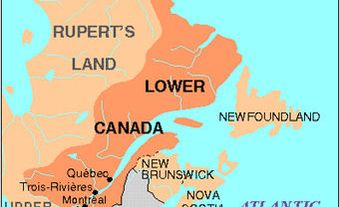
In 1799, Edward was created Duke of Kent and Strathearn and Earl of Dublin and made commander-in-chief of the British forces in North America. Edward planned tours of Upper and Lower Canada, Prince Edward Island, Cape Breton Island and Newfoundland for the summer of 1800 but instead returned to Britain on 3 August 1800 following a period of ill health after falling from his horse in Halifax. At first, Edward planned to return to British North America and officially held the post of commander-in-chief until 1802.
Prince Edward Island
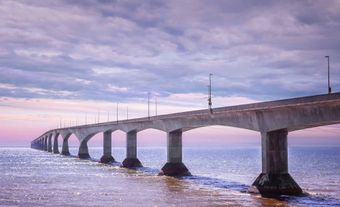
On 29 November 1798, the legislature on the Island of St. John voted to change its name to Prince Edward Island in honour of Prince Edward. The new name received royal assent from George III on 2 February 1799 and came into effect on 3 June that same year. The new name reflected both increased loyalist settlement in the region and concerns that the island would be confused with Saint John, New Brunswick and St. John’s, Newfoundland. Prince Edward never visited Prince Edward Island.
Later Career
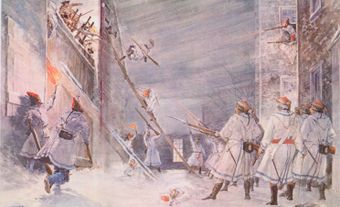
In 1802, Edward became governor of Gibraltar, imposing strict military discipline on the troops stationed there. He was recalled to Britain in 1803 following the storming of his residence by mutinous soldiers who demanded his resignation and his brutal suppression of the mutiny. On 5 September 1805, he was promoted to field marshall, but his active military career came to an end. He became keeper of Hampton Court Palace and lived at Castle Hill Lodge in Ealing.
Canadian Confederation
Edward encouraged Canadian confederation both during his time in North America and after his return to Great Britain. He was the first public figure known to have used the term Canadians to describe both English and French Canadians (rather than French Canadians alone). In response to unrest following the 1792 elections to the Lower Canadian legislative assembly, he stated in a speech to demonstrators in Charlesbourg, “I urge you to unanimity and concord. Let me hear no more of the odious distinctions between French and English. You are all his Britannic Majesty’s Canadian subjects.”
In 1814, Edward corresponded with John Sewell, secretary of the Executive Council of Lower Canada, supporting a federal union of British North American provinces. Lord Durham consulted this correspondence when compiling the 1839 Durham Report in the aftermath of the 1837 rebellions in Upper and Lower Canada, writing to Queen Victoria, “No one better understood the interests and character of these Colonies than His Royal Highness.”
Marriage
On 11 July 1818, 51-year-old Edward married 32-year-old Princess Victoire of Saxe-Coburg-Saalfeld (1786–1861) in a double wedding ceremony with his elder brother, the future King William IV (1765–1837) and Adelaide of Saxe-Meiningen (1792–1849). The royal marriages were intended to ensure the succession, since George III’s only legitimate grandchild, Princess Charlotte of Wales, had died in 1817. Victoire was the widow of Emich Karl, Prince of Leiningen (1763–1814) and the mother of two children, Charles (1804–56) and Feodora (1807–72). Edward and Victoire spent the first months of their marriage in Leiningen, returning to England for the birth of their child.
Queen Victoria
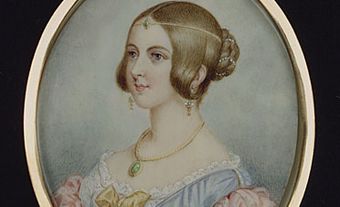
On 24 May 1819, Princess Alexandrina Victoria was born at Kensington Palace in London. Edward was proud of his daughter, presenting her to the public at military reviews. When the infant princess was nine months old, Edward died of pneumonia. Victoria inherited his place in the line of succession and became Queen Victoria upon the death of her uncle King William IV in 1837.
Legacy
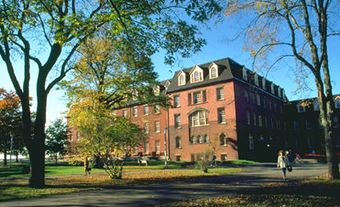
There are many places named after Prince Edward, Duke of Kent in Canada. In addition to Prince Edward Island, Edward gave his name to Prince Edward County in Ontario. In Quebec, there is a Rue du Duc-de-Kent or a Rue Kent in Quebec City, Beauport, Gatineau, Longueuil and Sainte-Anne-de-Bellevue. In 1879, Queen Victoria sponsored the reconstruction of Kent Gate on Rue Dauphine in Quebec City; her daughter Princess Louise laid the foundation stone. Kent Avenue, Kent Park and Kent Street in Halifax are all named for Edward, as are Point Edward and Edwardsville on Cape Breton Island. In the late 19th century, the name of Hugh Street in Ottawa was changed to Kent Street in his honour. In Saint John, New Brunswick, Prince Edward Street and Prince Edward Square are named for Edward. Kent College, founded by Lieutenant Governor Edmund Fanning, is now the University of Prince Edward Island.