Share on Facebook
 Share on X
 Share by Email
 Share on Google Classroom
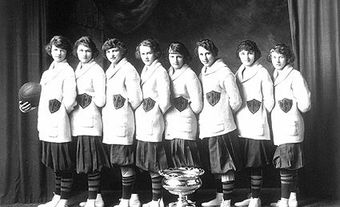
During the hard years of the Depression, one team dominated women’s amateur ice hockey and captured the imagination of Canadians. Led by star right winger and captain Hilda Ranscombe — widely regarded as the best female hockey player in the world at the time — the Preston Rivulettes won provincial, regional and national championships. Of the estimated 350 games the Rivulettes played, they only lost between three and five (records vary). The Rivulettes were the most successful women’s ice hockey team in the history of Canadian sports. They have been inducted into the Cambridge Sports Hall of Fame and Canada’s Sports Hall of Fame.

Forging a Team
The Rivulettes began as a girls’ softball team in Preston, Ontario (now part of the city of Cambridge). At the end of the 1930 season, the players decided to form a hockey team so they would have a winter sport to play. Some of them had played hockey with boys on the frozen-over Grand River. They received support from MP Karl Homuth. On the advice of Toronto Daily Star sportswriter Alexandrine Gibb, they joined the Ontario Ladies Hockey Association (OLHA). Herb Fach, manager of Preston’s Lowther Street Arena, became the team’s coach. Roy Osgood was the manager.
The original Rivulettes team members were sisters Hilda and Eleanor “Nellie” Ranscombe, Grace “Toddy” Webb, Margaret Gabbitas, sisters Helen and Marm Schmuck, Myrtle Parr, Helen Sault, Pat Marriot, Winnie Mackrow and Sheila Leahy. They were all teenagers between 13 and 19 years old.
The others who played for the team over the decade were Violet Hall, Gladys Hawkins, Norma Hipel, Ruth Dargel, Elvis Williams, Dot Raffey, Fay Hilborn, Eleanor Fairgrieves, Marion Reed, Midge Robertson and Marie Bielstein.
“Not a Game for Girls”
In the early 20th century, women’s hockey games were social affairs. They played exhibition matches as charity fundraisers. Women and girls were discouraged from engaging in rough sports. The Rivulettes faced a public attitude that women and girls lacked the physical strength and stamina to play a full-contact sport. Some doctors claimed that the exertion of sports like hockey would harm a woman’s ability to bear children. Since community arenas gave priority for ice time to male teams, female teams had to practice at odd hours.

A Dramatic Start
The Rivulettes played for the first time in February 1931, winning a two-game series against the Grimsby Peaches. They then won a two-game series against the defending Ontario intermediate champions, the Port Dover Sailorettes. The Rivulettes played so skilfully, the Port Dover coach wanted to see their goalie undressed to prove she wasn’t a boy. The Rivulettes defeated the London Silverwoods in two games to qualify for a single-game Ontario championship match against the Pembroke Ladies. The Rivulettes won the game to claim their first title.
A Decade of Domination
Throughout the 1930s, the Preston Rivulettes were virtually unbeatable. They were fast and played a tough, hard-hitting style. A newspaper article said one of their games “was no pink tea affair, as members of both teams mixed things up.” The Rivulettes won 10 Ontario championships. In 1933, in the debut of a national championship series presented by the Dominion Women’s Amateur Hockey Association (DWAHA), the Rivulettes represented Eastern Canada against the Edmonton Rustlers. The Preston players were tired after a three-day trip by rail to Edmonton and had to start game one just five hours after getting off the train. They lost the two-game series by a total score of 4–2.
In 1934, the Rivulettes defeated the Montreal Maroons for the first of their six Eastern Canadian Championships and the Elmer Doust Cup.
In 1935, Preston hosted the Winnipeg Eatons in a two-game national championship series. The Rivulettes won by a total score of 10–2, claiming the Lady Bessborough Trophy. They went on to win three more national championships.
End of an Era
Financial difficulties during the Depression made the operation of amateur hockey teams difficult. In 1936, the Rivulettes couldn’t play in a championship series with Winnipeg due to prohibitive travel costs and were forced to default.
The Rivulettes were also victims of their own success. Other teams did not want to play them. Hometown attendance declined because their games were seldom competitive. Press coverage fell off. In 1939, the Rivulettes were not among the Canadian teams invited to a tournament in the United States, ostensibly because they were too good. The Rivulettes expected to play in a tournament in Europe, but the outbreak of the Second World War ended those plans. As Hilda Ranscombe later reflected, “We were supposed to go to Europe to play, but then the war came and our boat was sunk. We never went.” The Rivulettes played a few exhibition games before disbanding in 1942.
Legacy
The Preston Rivulettes have been inducted into the Cambridge Sports Hall of Fame and Canada’s Sports Hall of Fame. Parks Canada has recognized their historic significance with a plaque in Cambridge. The Rivulettes have been honoured in the Hockey Hall of Fame, though neither the team nor any of its members has been inducted into the Hall.
Playwright Tracey Power’s play Glory, which tells the Rivulettes’ story, was produced by Alberta Theatre Projects in 2018.