Share on Facebook
 Share on X
 Share by Email
 Share on Google Classroom
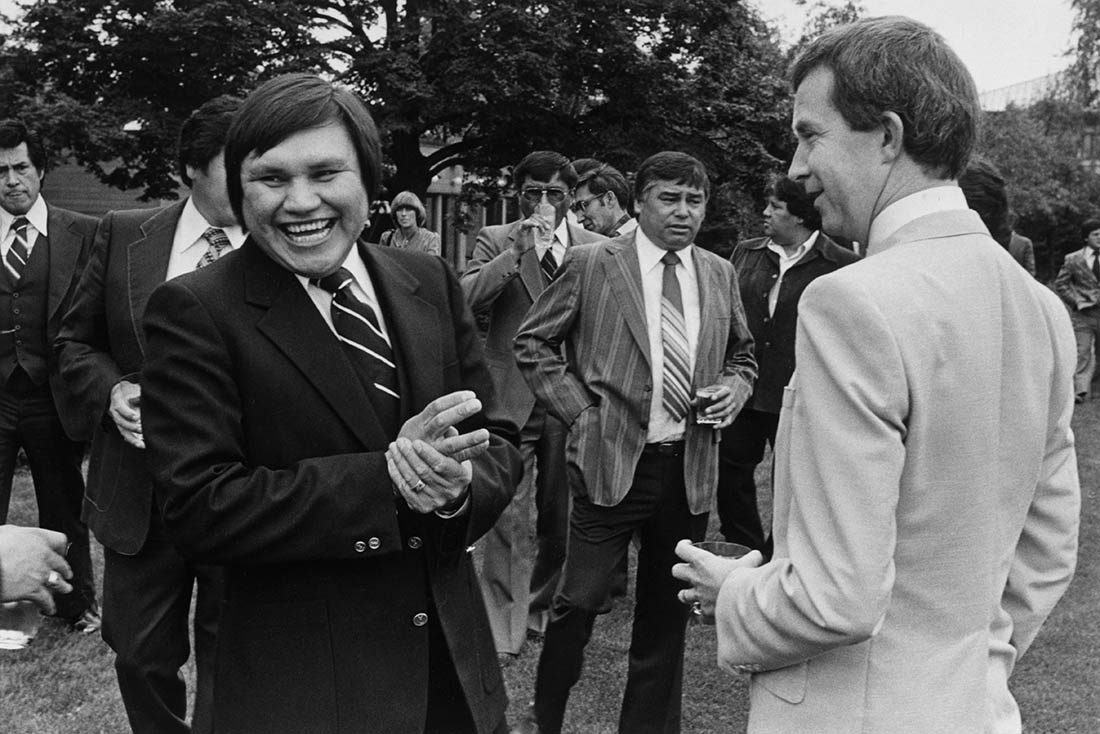
Noel Victor Starblanket, Kisikaw Piyesiwewin (Where the Thunderbirds Live), Pahpahtaywak Kihew (Spotted Eagle), Cree Elder, First Nation and national chief, Knowledge Keeper, Life Speaker (born 26 September 1946 in Fort Qu’Appelle, SK; died 15 April 2019 in Regina, SK). A residential school survivor, Elder Noel Starblanket went on to senior positions in Indigenous organizations and became a strong and outspoken Indigenous leader and activist (see also Indigenous Political Organization and Activism in Canada).
Early Life and Education
Elder Noel Starblanket was raised by his grandparents and participated in traditional ceremonies and practices with them (see also Religion and Spirituality of Indigenous Peoples in Canada). When he was quite young, he also learned to work on their farm. On reaching school age, Starblanket attended the Lebret (Qu’Appelle) Indian Industrial Residential School for the next 11 years (see Residential Schools in Canada).
The school was a Roman Catholic facility operated by the Missionary Oblates of Mary Immaculate and the Grey Nuns from 1884 to 1973 (see also Catholicism in Canada). It was located on the White Calf Reserve on Treaty 4 land.
Although Starblanket had never been hit by his parents or grandparents, he recalled being constantly “slapped on the side of the head” at the school, where he also experienced bullying from a fellow student. He also remembered prayer and other aspects of religion being central to school life.
Starblanket did have some positive experiences at school, particularly in sports, since he was quite athletic. He felt that sports kept him going and were the only reason he returned to school after holidays.
Starblanket later married Reona Brass and had a son and five daughters. Together, they adopted another eight children.
Activism
Elder Noel Starblanket was well-respected in the community and was widely known for his leadership capabilities. In 1968, the National Film Board (NFB) created the Indian Film Crew (IFC) to make films about Indigenous peoples from their viewpoint. Starblanket was one of seven crew members recruited from across Canada. As such, he was associate editor of You Are on Indian Land.
This 36-minute documentary is about the 1969 protest by the Mohawks of Akwesasne against the federal government that was denying their right to duty-free cross-border passage of personal purchases — a right established by the Jay Treaty of 1794. The film became one of the IFC’s most influential and widely distributed productions. The IFC disbanded in 1970.
In 1971, at age 24, Starblanket was elected chief of his community, the Star Blanket First Nation. That made him the youngest chief in Canada at the time. As a result, he was the subject of a National Film Board documentary titled Starblanket.
In 1976, Starblanket was elected national chief of the National Indian Brotherhood (NIB), now known as the Assembly of First Nations. He subsequently served a second term as national chief from 1978 to 1980 (see also National Chiefs of the Assembly of First Nations).
While head of the NIB, Starblanket increased public awareness of the issues and needs of First Nations and also contributed to building the organization into a strong political lobby group.
Starblanket also served as third vice-chief of the executive of the Federation of Saskatchewan Indian Nations (later the Federation of Sovereign Indigenous Nations). He was the director of treaty rights and research for the group and attended law school at the University of Saskatchewan.
In 1976, Starblanket was a co-founder of the Saskatchewan Indian Federated College, renamed the First Nations University of Canada in 2003. It is an affiliated college of the University of Regina and operates four campuses.
Starblanket later devoted his time to providing spiritual guidance, teaching, advice and insight as the Elder-in-Residence at Regina’s Scott Collegiate, the Regina public school board and the University of Regina’s Faculty of Education, where he served from September 2016 to April 2017.