Share on Facebook
 Share on X
 Share by Email
 Share on Google Classroom
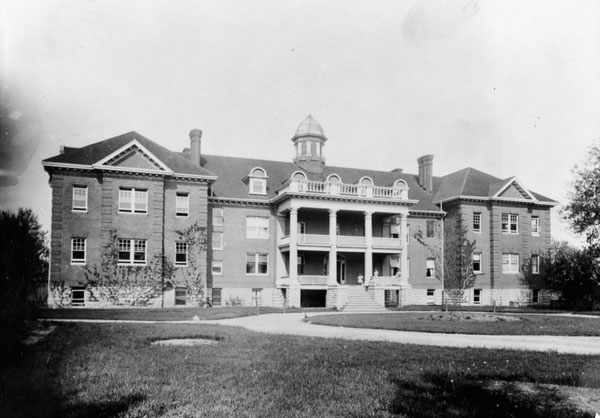
The Mohawk Institute was established in 1828 near Brantford, Ontario. It was one of the earliest and longest-running Indian residential schools. It was initially founded by Reverend Robert Lugger, a missionary of a Puritan Protestant organization. The Mohawk Institute evolved from a Kanyen’kehá:ka (Mohawk) Indian day school and was a model for other residential schools. The people involved intended to assimilate First Nations children into Euro-Canadian society. They did this through converting children and, as adults, having them do the same within their communities. The Mohawk Institute operated for 141 years, closing in 1970.
Origins and Founding
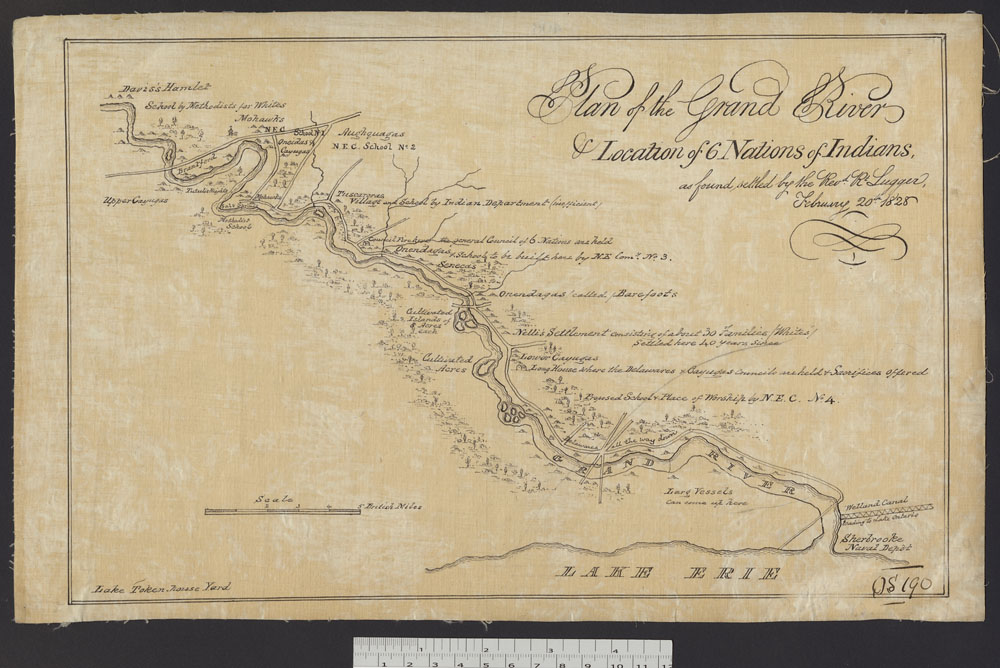
The Mohawk Institute was founded by Reverend Robert Lugger of the Society for the Propagation of the Gospel in New England and Parts Adjacent (SPGNE). Puritans founded the SPGNE in England amidst great religious tension. The SPGNE initially operated in New England and New York, later shifting to New Brunswick after the American Revolution and to Upper Canada (now Ontario) in 1822. The SPGNE began funding Indian day schools in the Haldimand Tract in 1822 (see Haldimand Proclamation). By 1828, Lugger was permitted by the Society for the Propagation of the Gospel in Foreign Parts (SPG), the missionary arm of the Church of England, to continue SPGNE operations at the Chapel of the Mohawks. By 1830, Lugger started a mechanics’ institute near the chapel without the knowledge or approval of the SPGNE. These institutes were popularized in Scotland.
In 1832, around the time of Captain John Brant’s death, the SPGNE supported seven Indian day schools in First Nations settlements in the Haldimand Tract. In addition, a portion of the Mechanics’ Institute's infrastructure was converted into a central institute within the local Indian day school system. Initially, plans were for students to be admitted to the central institute from other Indian day schools through an application and competition process. The SPGNE envisioned the entire project as a tool for conversion and assimilation, describing its mission as “the instruction of a number of the youth of both sexes in the arts, habits and customs of civilized life.” By 1873, this was done through industrial, moral and religious education. The SPGNE planned for students to be instruments for the assimilation of the rest of the local First Nations people.
Institutional Development
In 1836, Reverend Abraham Nelles assumed the role of principal at the Mohawk Institute. By 1847, settler expansion had significantly reduced Six Nations’ control over the northern portions of the Haldimand Tract, despite the promises of the Haldimand Proclamation. The Six Nations resettled on land south of the river, several kilometres from the institute and chapel. In 1856, Nelles reported that the institute was in a state of disrepair and recommended constructing a new, larger building on a 10-acre lot near the parsonage. A fire destroyed the institute in 1858, and a new, three-storey brick building was completed in 1859, accommodating up to 90 students. The curriculum included vocational training in blacksmithing and carpentry. Student labour and farm products offset some operating costs.
In 1860, the name “Mohawk Institute” was formally adopted. Also in that year, a manual labour farm was established with the goal of providing boys with knowledge of the operations of the farm and to instill “habits of industry.” Mechanical arts instruction was initially provided at the institute. However, in 1860 it was no longer offered, though it later returned. According to a report issued by the United States Consul to the SPGNE, his removal was not due to a lack of ability among First Nations students, but rather because First Nations people preferred independent lives over the lives of “systematic mechanics.”
Did you know?
Governor General Sir Edmund Walker Head, instead of the Commissioner of Crown Lands, issued a license of occupation to principal Abraham Nelles in trust for the SPGNE for land within the Eagles’ Nest / Haldimand Tract, to operate a manual labour school at the Mohawk Institute. The Governor General’s actions ultimately resulted in a court case surrounding principal Abraham Nelles’ estate. After Nelles died, the Exchequer Court (now the Federal Court) confirmed, in a 1922 case, that the license was not provided in accordance with legal requirements at that time. The court invalidated the permit and returned the land to the federal government in trust for Six Nations.
Expansion and Educational Approach
Reverend Robert Ashton’s tenure saw further institutional growth. During the four years ending 31 December 1881, approximately 156 students had passed through the institute. Between 1882 and 1891, the continued support from the SPGNE, Six Nations and the federal government enabled the operation of 7–11 Indian day schools, in addition to the institute, within the Haldimand Tract (see Haldimand Proclamation). In total, 477 students were enrolled in these day schools and the institute in 1882. The curriculum was not conducive to the desires of some children or youth, who would return to their lives at Six Nations. An undated report of one of the SPGNE Commissioners states that the “mode of teaching is the same as that among Common Schools for [non-First Nations students], and the Text-Books…are those recommended by the Provincial Board of Education.”
By at least 1885, the desires of First Nations children were being shaped by the institute, distancing them from traditional lives, beliefs and practices, including through the use of competition among current and future students. In 1885, the government provided a grant to the SPGNE to accept students from other reserves. In 1891, the government began providing per capita grants. In 1894, orphaned First Nations children, as well as some non-First Nations children or youth, were “taken in,” and a large three-storey wing was added. In that same year, an amendment to the Indian Act made education compulsory for First Nations children.
By 1887, the institute’s reputation as a desirable boarding institution masked the underlying goal of cultural erasure, particularly as applications for admission increased to the point of exclusion. By 1898, Ashton’s reports acknowledged the death of children in the Mohawk Institute, noting five children died over the preceding 25 years there. In 2012, research indicated that at least 15 children died at the institute by 1898, and at least 48 children have been identified as having died while at the Mohawk Institute. Between 2021 and 2025, the Survivor’s Secretariat identified an additional 57 known child deaths, increasing the total to 105 children who perished while associated with the institute.
In 1903, three fires devastated the Mohawk Institute, destroying the main building, nearby barns and temporary dormitories. Reconstruction began promptly, resulting in a new main building, farm buildings, a gymnasium and accommodations for 125 students opening in October 1904. A small hospital was added to the institute in 1908.
Legal and Social Challenges
Robert Ashton’s son, A. Nelles Ashton, assumed the role of principal at the Mohawk Institute in 1911. He was the defendant in a widely publicized trial in 1914. The trial concerned four Haudenosaunee girls who fled the institute and its principal because they did not like the food there, only to face harsh punishments upon return. The leader, Ruth Miller, was confined in a small dark cell located on the third floor of the institute for three days with only water and some bread to eat. Her hair was cut short after her release, and she was whipped on her bare back. Her father, George Miller, was able to file a personal claim, but the Department of Indian Affairs prevented the Six Nations’ traditional council from providing financial support to hire a lawyer (see also Federal Departments of Indigenous and Northern Affairs). George Miller received damages for imprisonment ($100) and physical punishment ($390–$400), and the case drew significant media attention and student testimony (see also Resistance and Residential Schools). Later that year, Nelles Ashton was removed from his position, and a Department of Indian Affairs official stated students at the institute were “disciplined to death.” Still, it did not result in systemic change. Canadian politicians used policies, like the Indian Act, to block First Nations people from the right of seeking justice through the courts and protected residential school operators from legal accountability. Most residential school survivors carried their trauma in silence, unable to seek justice or have their suffering publicly recognized.
Prior to 1922, the institute was a non-denominational institution, but between 1922 and 1923, it became affiliated with the Church of England. In 1922, the federal government assumed management of the Mohawk Institute. The SPGNE still owned the buildings and held the lease to the land. By 1923, RCMP officers were stationed at the Mohawk Institute.
In 1934, new dormitories were added at the institute, increasing enrollment to 150. In 1947, a new lease was negotiated. However, the SPGNE was unable to continue providing financial support. In 1948, buildings from the Canadian Army Training Centre (Camp No. 20) were moved onto the property of the institute. Between 1948 and 1958, the Mohawk Institute was renovated, and a new classroom block was constructed. By 1955, the capacity had increased to 185 students.
Shift and Decline (1940s–70s)
Reverend Canon W. John Zimmerman led the Mohawk Institute from 1945 until its closure in 1970, with oversight shared by the Anglican Diocese of Huron, SPGNE and federal and provincial authorities.
By the 1960s, the institute operated as a group home for children with special needs, those from unstable family environments, or those from distant reserves without Indian day schools. In 1963, farming activities ceased, and the land was returned to the Six Nations. In 1965, the SPGNE sold its interest in the Mohawk Institute’s buildings to the federal government for $100,000. On 1 April 1969, the federal government assumed complete control of the institute. On 30 June 1970, most of the residents were from northern communities, with only 23 students from Six Nations. By arrangement with the Six Nations council, the government maintained a small staff to care for the few remaining children until foster care became available. The institute was vacated on 31 March 1971, and the building was offered to the Six Nations. The remainder of the institute’s lands were subsequently returned to Six Nations.
Legacy and Impact
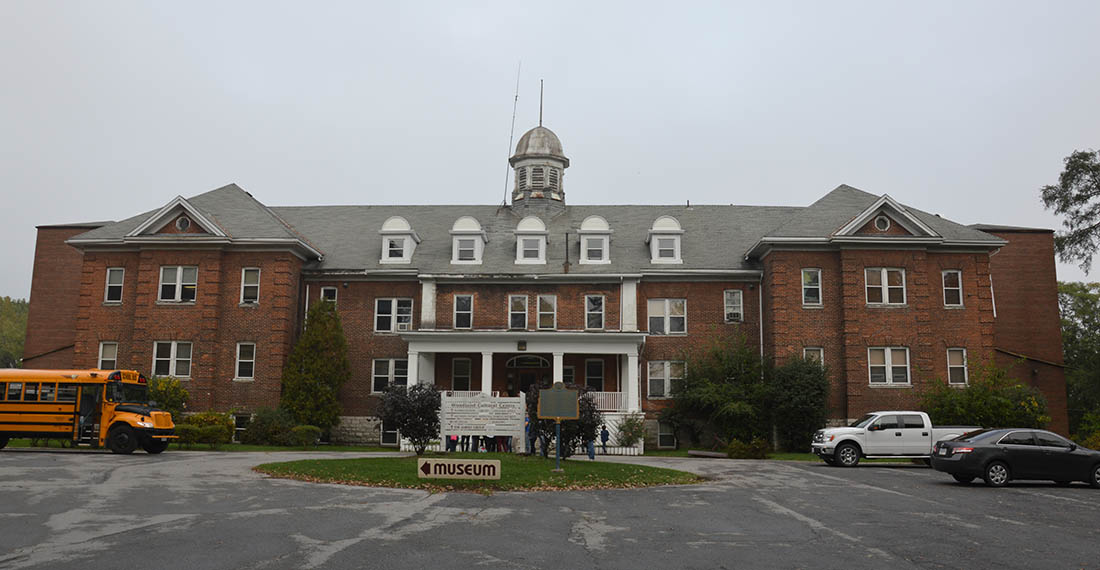
The Mohawk Institute has a complicated legacy as Canada's first residential school, establishing the foundation for a system that separated First Nations, Métis and Inuit children from their families, limited the use of their languages and cultures and exposed many to adverse childhood experiences. The Mohawk Institute’s history, including cultural suppression and vocational and religious instruction, was part of larger colonial policies of assimilation and control.
The First Nations people at Six Nations of the Grand River chose to memorialize it by planning for the conservation of the former residential school. In 1972, the Woodland Cultural Centre was established on the grounds of this former Indian residential school.