Share on Facebook
 Share on X
 Share by Email
 Share on Google Classroom
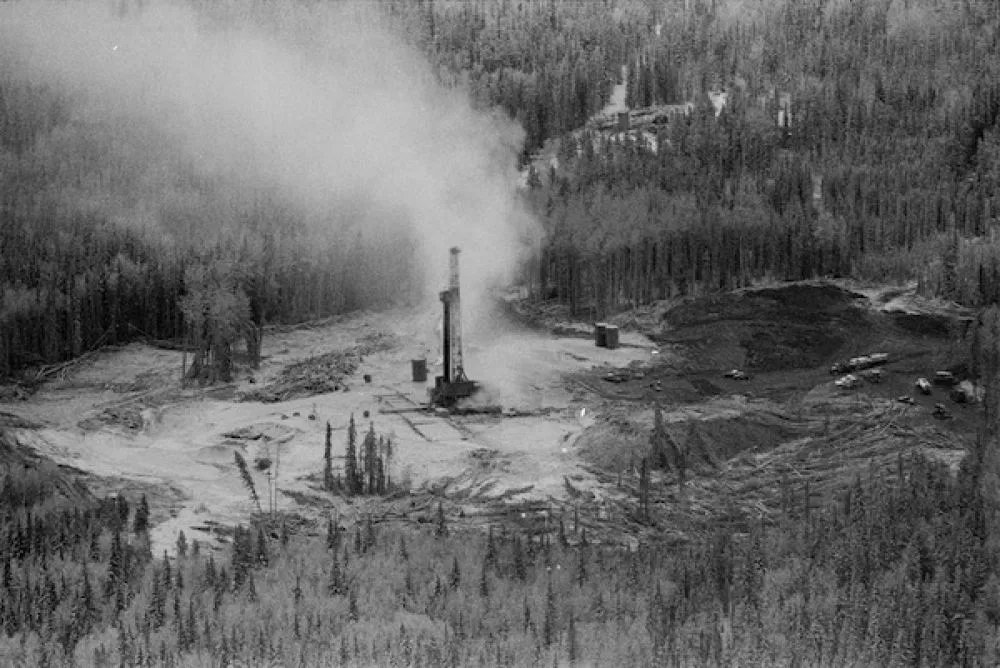
The Lodgepole Blowout was an industrial disaster that occurred from October to December 1982 in Alberta. The sour gas well blew out and released an estimated 5.66 million cubic meters per day of poisonous and carcinogenic hydrogen sulfide sour gas, along with other toxins, for 68 days. Contamination spread as far as Saskatchewan. It is considered the worst sour gas blowout in Alberta’s history and one of the worst industrial accidents in Canadian history. The blowout was determined to be the consequence of poor regulation of the fossil fuel industry. Two people were killed trying to cap the blowout, 16 others were hospitalized and thousands more became ill.
Origins of the Disaster
The disaster began on 17 October 1982 at a wildcat well (exploratory oil or gas well) owned by Amoco Canada Petroleum. It was caused by the drilling of the well, which was being dug about 18 km west of the hamlet of Lodgepole, Alberta, itself about 131 km southwest of Edmonton. The well was located in the Pembina oil field. Throughout the preceding decades, there had been numerous other accidents throughout Alberta, and there was little environmental oversight and no unions to pressure the fossil fuel industry to take action. Accidents and incidents leading up to the Lodgepole disaster included collapsing derricks, serious injuries to workers, hydrochloric acid from fracking seeping into waterways and other accidents similar to the blowout.
Sour Gas
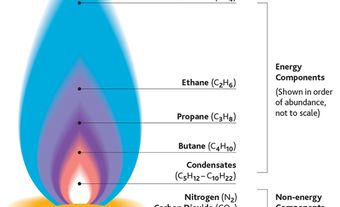
Sour gas is natural gas containing more than one percent hydrogen sulfide (H2S). At low concentrations, it is primarily identifiable by its distinctive rotten-egg odour. It is toxic to humans and animals at very low concentrations. It is found deep underground in high-concentration natural gas deposits such as those in the foothills of Alberta and the Montney Formation. As such, sour gas can be released during natural gas exploration, and fossil fuel companies need to exercise caution to prevent accidental releases. Hydrogen sulfide gas is carcinogenic and lethal in high doses. Because it is heavier than air, it stays close to the ground rather than quickly dissipating like other gases. In cases where humans accidentally breathe sour gas, it attacks the body’s organs, can lead to convulsions, coma and, eventually, death.

(© Canadian Center for Energy Information, 2013)
Containment
The blowout was capped on 23 December 1982, when a 12-tonne blowout preventer was placed by the Texas-based Boots and Coots capping team. The blowout preventer was placed over the burning well, effectively shutting off the escaping gas. At the time, it was believed to have been only the fourth or fifth time in history that the manoeuvre had succeeded in capping a blowout. Another Texan, Joe Bob Bowden, had been trying to cap the well before Asgar (Boots) Hansen's successful effort. During that effort, the well erupted twice, with flames rising some 40 m. Two other Texans were killed during the capping effort. The blowout also destroyed a rig valued at $6.5 million. The Edmonton Journal reported that a conservative estimate of the cost to Amoco from the blowout was roughly $10 million in damaged and destroyed equipment, plus another $100,000 per day for the specialists required to contain it.
Conclusions of ERCB Inquiry
The conclusion of an official inquiry held by Alberta’s Energy Resources Conservation Board (ERCB, today called the Alberta Energy Regulator) indicated that the disaster was caused by human error. The six-member inquiry panel consisted of a physicist, medical doctors and engineers employed by the ERCB. The panel consulted some 300 technical documents and heard witness testimony for several months. The ERCB’s report was issued in 1984 and blamed human error for the blowout. Notably, it found that Amoco used poor drilling practices and failed to adequately maintain its equipment.
The ERCB made 39 recommendations to prevent future sour gas blowouts. This included new safety training, requirements for specialized equipment and stricter drilling regulations. The ERCB also proposed emergency and evacuation training plans. The recommendations were adopted by the industry, the provincial government and the ERCB. In 2000, the issue was revisited by a Provincial Advisory Committee on Public Safety and Sour Gas, which involved a larger number of stakeholders and produced 87 additional recommendations for improvement. At the time, environmental activist Wiebo Ludwig was leading a campaign to raise awareness about the negative health impacts of sour gas, which he blamed both for human and animal stillbirths on his farm.
Legacy
The rotten-egg smell of the sour gas escaping from the well was reported as far away as Winnipeg. Residents living near the blowout demanded compensation in addition to a mandatory evacuation in the event of a future blowout. Subsequent investigation determined that the blowout actually released significantly more poisonous gas into the atmosphere than the 1.4 million cubic meters per day that was estimated at the time.
Initially, both Amoco and the government of Alberta denied any responsibility for the disaster. They also downplayed the impact of the disaster on human and animal health, even though people and animals were evacuated from the area.
The disaster led to the creation of the Pembina Area Sour Gas Exposures Committee, which, in turn, prompted the public inquiry into the disaster. In 1984, this committee became the Pembina Institute for Appropriate Development, one of the first environmental watchdog groups focused on the Alberta fossil fuel industry. It is known today as the Pembina Institute.
The government of Alberta claims the province has strong regulations governing the oil and gas industry. Various journalists, climate scientists and other experts contradict these statements with evidence showing that regulations are not always enforced. News reports indicate that the Alberta Energy Regulator (AER) stopped enforcing some regulations — such as those related to gas flaring — at the behest of the Alberta government.
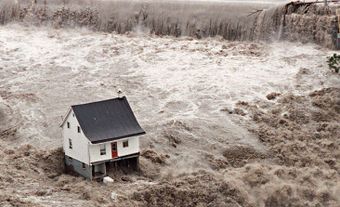
The threat of sour gas is a major concern for people in Alberta. A flood in 2013 caused a sour gas leak after a pipeline ruptured after being struck by debris.
In 2025, the AER fined a company $15,000 for failing to report a three-hour release of sour gas at lethal concentrations. The AER noted that the company also failed to activate its emergency response plan; as a result, nearby residents weren’t warned.