Share on Facebook
 Share on X
 Share by Email
 Share on Google Classroom
Franklin Carmichael, painter (born 4 May 1890 in Orillia, ON; died 24 October 1945 in Toronto, ON). A founding member of the Group of Seven, Franklin Carmichael was active and influential as a painter, industrial designer and teacher. He was a founding member of both the Canadian Society of Painters in Water Colour and the Canadian Group of Painters. Carmichael taught at the Ontario College of Art (now the Ontario College of Art and Design University) as head of Graphic and Commercial Art from 1932 until his death in 1945.


Early Life and Family
Franklin Carmichael was born and raised in Orillia, Ontario, by his parents David and Susannah (née Smith) Carmichael. Artistically inclined from a young age, he was enrolled in music and art classes and worked as a striper in his father’s carriage-making business, where he honed his design and drawing skills.
Education and Early Career
In 1911, Franklin Carmichael entered the Ontario College of Art (now the Ontario College of Art and Design University), where he studied with William Cruickshank and George Reid. He also took classes with Gustav Hahn, a German-born muralist and interior decorator who brought Art Nouveau to Canada, at the Toronto Technical School.
In 1911, Carmichael apprenticed with the Toronto commercial-art firm Grip Limited. He met several artists there who later formed the Group of Seven, as well as Tom Thomson. Carmichael joined Thomson and others on weekend sketching trips. He studied at the Academie Royale des Beaux-Arts in Antwerp, Belgium, from 1913 to 1914, but he had to move back to Canada at the onset of the First World War.
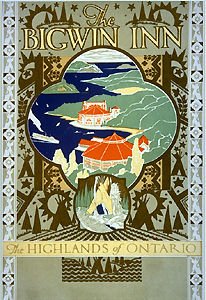
Sharing studio space with Thomson, Carmichael worked as a commercial graphic designer in Toronto. At the same time, he painted watercolours and oils of the northern Ontario landscape. Along with Lawren Harris, A.Y. Jackson, Frank Johnston, Arthur Lismer, J.E.H. MacDonald, and Frederick Varley, he co-founded the Group of Seven in 1920.
Characteristic Style
Best known for his influential work with watercolours, Carmichael had a softer palette and more decorative sensibility than other members of the Group of Seven. Autumn Hillside (1920), for instance, has flat yellow trees rising in the middle ground like a kind of Japanese screen, the sky soft lavender. Mirror Lake (1929), on the other hand, is more austere but equally sensuous. The undulating treeless hills, mirrored in a lake, are rendered in soft, edible purple, lavender and green.
Beyond the Group of Seven
With A.J. Casson and F. H. Brigden, Franklin Carmichael was a founding member in 1925 (and president from 1932 to 1934) of the Canadian Society of Painters in Water Colour. He was also a founding member in 1933 of the Canadian Group of Painters. The group’s original members included Emily Carr, A.J. Casson, Lawren Harris, Edwin Holgate, Arthur Lismer, Anne Savage, and F.H. Varley, among others.
Carmichael taught at the Ontario College of Art from 1932 to 1945 as head of Graphic and Commercial Art.
(See also Painting: Modern Movements; McMichael Canadian Art Collection.)