Share on Facebook
 Share on X
 Share by Email
 Share on Google Classroom
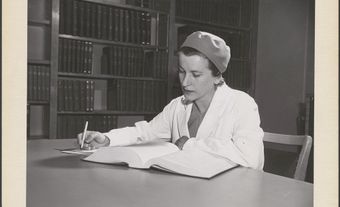
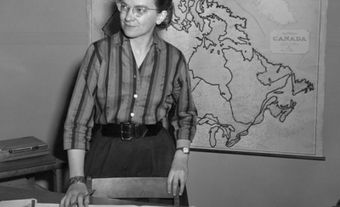
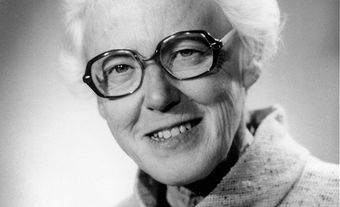
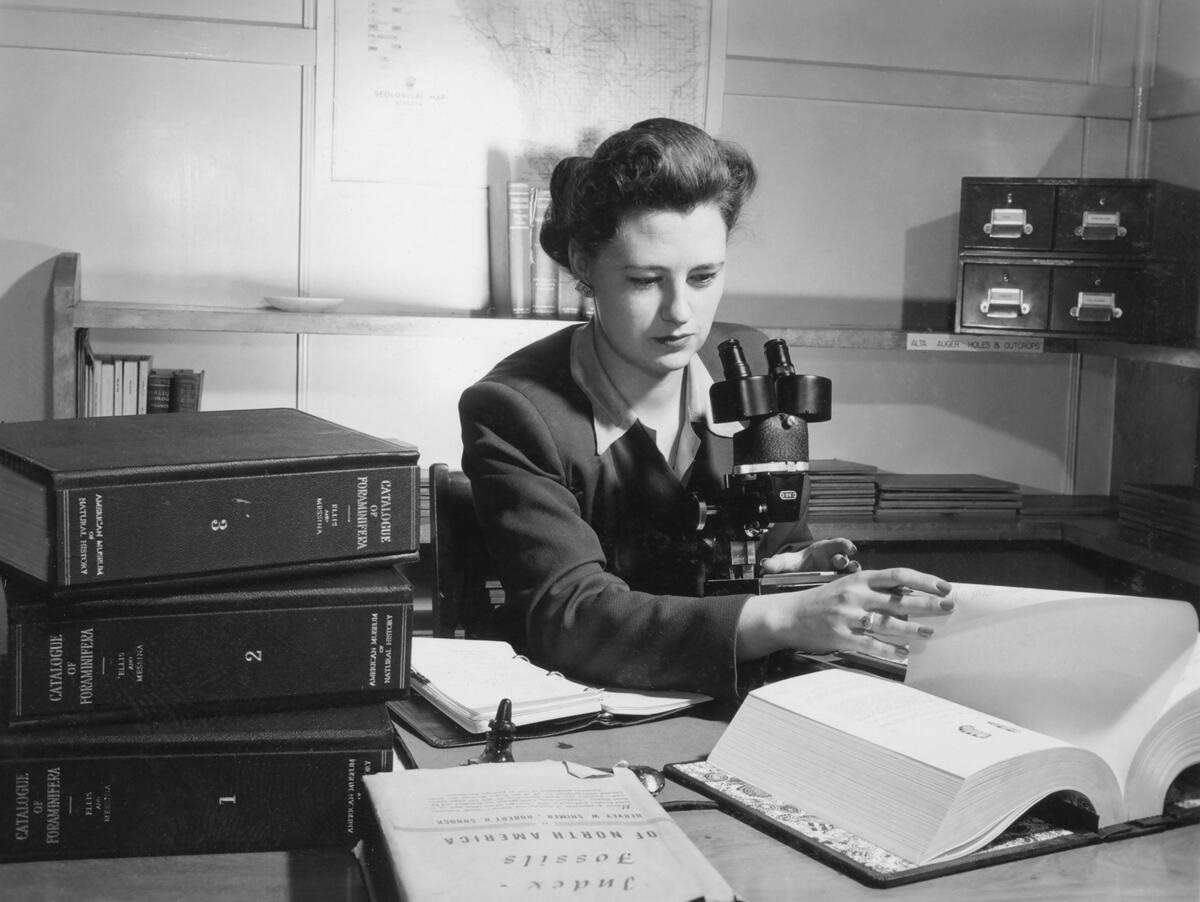
Diana “Diane” Mary (May) Lally Loranger, FGS, geologist, micropaleontologist (born 1920 in Edmonton, AB; died 9 October 2004 in Calgary, AB). After earning a Bachelor of Science in geology, Diane Loranger began her career in the male-dominated field of petroleum geology as a field worker for Imperial Oil. She was one of the first women in Canada to conduct geological fieldwork alongside male colleagues in the 1940s. One of the first women in the country to work in micropaleontology, her work studying microfossils was instrumental in locating oil fields in Canada.
Early Life and Education
Diane Loranger was born in Edmonton and lived near Red Lake in northwestern Ontario as a child. Red Lake was a boom town with gold mining activity and settlement starting in 1925. Loranger was the first person to graduate from high school in Red Lake, in 1939.
Attending the University of Manitoba, Loranger was active in a range of sports and held positions on the Women’s Athletic Directorate. She was also a member of the Victory Club, a student group furthering the war effort. Loranger earned a Bachelor of Science in geology in 1942. She was reportedly the first woman to earn a geology degree from the University of Manitoba and one of just ten women to graduate in science in her year.
Career in the Field
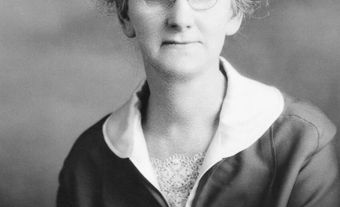
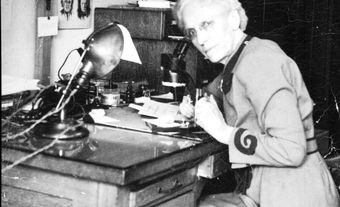
The year after she graduated with her bachelor’s degree, Diane Loranger was hired as a field geologist for Royalite Oil, a division of Imperial Oil. Loranger entered the male-dominated field, despite academics at the University of Manitoba casting doubts about the suitability of women working in petroleum geology. It was uncommon for women to carry out field work at that time, and Loranger was the first woman geologist to work alongside men in the field in Canada’s oil industry. Pioneering geologist Alice Wilson had conducted solo field work trips for the Geological Survey of Canada but had not been permitted to join her male colleagues in the field.
Loranger conducted fieldwork in Alberta and Saskatchewan, including at the Turner Valley Oilfield, about 40 km south of Calgary. Loranger and her colleagues collected core samples from oil well sites for analysis. Working in the field meant staying in remote camps and transporting gear from site to site. As Imperial Oil reported in a story in 1947, “Miss Loranger has shirked none of the tasks assigned to geologists who are men, and as a member of a field geological party has walked as much as fourteen miles in a day.”
Did you know?
The first oil field in Canada was established in 1851 in what is now southwestern Ontario. The petroleum industry emerged in Alberta with the discovery of oil in Medicine Hat in 1904. A decade later, oil was discovered in Turner Valley and became the site of Alberta’s first natural gas plant. The site was a significant producer of petroleum products in the early 20th century and is now a National Historic Site.
Micropaleontology Work
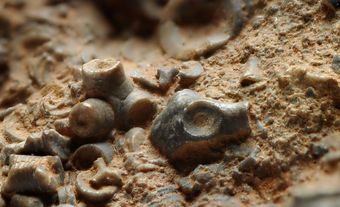
By 1947, Diane Loranger had been promoted to a supervisory position in Imperial Oil’s new micropaleontology lab in Calgary. Micropaleontology is the study of fossils that are so small, they can only be viewed through a microscope. Loranger was one of the first women to work in the emerging field of micropaleontology in Canada.
Her work involved studying the fossils, fauna and foraminifera (very simple micro-organisms) found in soil core samples. She used these microfossils to date sedimentary rock to try to determine where oil deposits would be located. This work also helped further the understanding of the prehistoric sea that once covered the Canadian Prairie (see Western Interior Seaway). Loranger faced skepticism from other Imperial Oil staff about the usefulness of micropaleontology in locating fault zones. Of the challenge of working in this emerging field, Loranger said, “The real fun was doing something for the first time because there were no books to help you. You had to sort of scratch your head and say well now.”
The techniques and work she undertook aided the company’s exploration efforts, including the discovery of the Leduc oilfield. Leduc was one of Alberta’s most significant oilfields, and the ensuing boom after the discovery in 1947 shifted petroleum production from Turner Valley to Leduc.
By the 1950s, Loranger had been promoted to Imperial Oil’s directorate. She published papers in the American Association of Petroleum Geologists in the 1950s detailing the microfossils found in geological formations in Alberta and the Canadian West. She reportedly lectured widely in Europe as well.

Later Education and Career
By 1960, Diane Loranger was self-employed, running her consulting company Paleo Services Ltd. of Calgary. She returned to academia, completing a PhD in London, England around 1961 or 1962. During her PhD, Loranger was made a fellow of the Geological Society of London. After finishing her doctorate, she continued her work as paleontological oilfield consultant into the 1970s. To be at the forefront of her field, Loranger learned to write code in 1971 so that she could move her work digitally. Loranger died in Calgary in 2004 at age 83.
“...Diane Loranger, of Manitoba, one of the few women oil geologists, has invaded the he-man oil field of the west.” – 1947 newspaper article