Share on Facebook
 Share on X
 Share by Email
 Share on Google Classroom
Colonialism occurs when people from one place take control of another place. Sometimes, this includes taking control of and assimilating Indigenous peoples. It also often involves settlement by the newcomers. France began the process of colonization in Canada in 1608. Britain began colonizing Canada in 1670.
This article is a plain-language summary of Colonialism in Canada. If you are interested in reading about this topic more in depth, please see our full-length entry, Colonialism in Canada.
French Colonialism in Canada
In 1534, Jacques Cartier claimed land in Canada for the king of France. However, French colonialism in Canada fully started in 1608. This is when Samuel de Champlain founded Quebec and New France. French people began to settle in the territory and established French civil law. They tried to convert Indigenous peoples to Catholicism and assimilate them to French culture.
British Colonialism in Canada
Britain started colonizing Canada in 1670. That was the year the Hudson’s Bay Company (HBC) formed. The king of Britain gave the HBC a Royal Charter. The Royal Charter gave the HBC legal and trading rights to much of what is now Canada. This territory was named Rupert’s Land. It included parts of Quebec, Ontario, Manitoba, Saskatchewan, Alberta and Nunavut.
In 1763, Britain defeated France in the Seven Years’ War. It gained control of French territory in North America. The British moved into territory claimed by France.
After the American Revolution, Britain resettled loyalists in Canada. More non-Indigenous settlers arrived in Indigenous territories. Throughout the 18th and 19th centuries, Britain made laws that impacted Indigenous peoples. For example, the government of Upper Canada began making treaties with Indigenous peoples in order to use their land and create reserves.
In 1857, Upper Canada passed an act that defined who was Indigenous. It was called the Gradual Civilization Act. It was the first time the government controlled who could be Indigenous. It was created to assimilate Indigenous peoples.
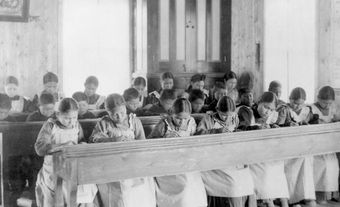
Religious groups also worked to colonize Indigenous peoples. They created day and boarding schools in the 1700s (see also Indian Day Schools in Canada; Residential Schools in Canada). These schools were the basis for residential schools. Residential schools existed from the 1830s until 1997.
Effects on Indigenous Peoples
In 1867, Canada became a country. However, many British colonial policies continued, including residential schools. The Indian Act (1876) gave the government control of Indigenous peoples and their lands (see Indigenous territories).
Treaties, which continued to be made following 1867, reduced Indigenous lands. They benefited the government. Reserves and other policies have caused poverty. These policies also contribute to poor health and violence in Indigenous communities.