Share on Facebook
 Share on X
 Share by Email
 Share on Google Classroom
Between 1775 and 1783, the American Revolutionary War took place. Thousands of Black people joined the British side. They were called the Black Loyalists. Some had been free people. Some had been previously enslaved. They hoped that fighting for the British would bring them freedom and land. When the war ended in 1783, the British lost. Many of their supporters had to leave the new United States. These included Black Loyalists. Some went to Europe, the Caribbean or British North America, especially Nova Scotia. Between 1783 and 1785, over 3,000 Black Loyalists settled in Nova Scotia. But they faced racism, low-paying jobs and broken promises.
This article is a plain-language summary of Black Loyalists in British North America. If you are interested in reading about this topic more in depth, please see our full-length entry, Black Loyalists in British North America.
Key Terms
Enslavement ― Enslavement is the practice of slavery. An enslaver keeps enslaved people like they were property or goods. Enslaved people can be bought or sold.
Indentured ― Being indentured means a person needs to keep working for someone. They can’t leave until they’ve finished their contract.
American Revolutionary War
In the 18th century, enslavement was common in Britain’s American colonies. (See also Black Enslavement in Canada (Plain-Language Summary).)
Eventually, American colonists wanted more independence from Britain. This led to the American Revolution. (See also American Revolution and Canada.)
In 1775, the British lost control of Virginia. The governor, Lord Dunmore, promised freedom to enslaved or indentured people. But they had to join the British army. About 800 Black people joined, though many more tried.
Later, in 1779, British commander Sir Henry Clinton made another promise. He promised “freedom and a farm” to any Black person who left the American side for the British. Thousands did. By the end of the war, as many as 100,000 enslaved people had sought safety with the British.
Some enslaved men joined special regiments. But most had support roles, like digging trenches or making shoes. As the war went on, more Black men received weapons and went to fight.
After the war, those who had fought for the British before 30 November 1782 were supposed to be freed. Their names were in a document called the Book of Negroes. With proof of their freedom, many headed to Nova Scotia to start new lives. Others were resettled in places like Florida, the Caribbean and other parts of British North America.
But when the British left, some Black people were left behind. Some got recaptured and forced back into enslavement.
Many white Loyalists also fled with their enslaved people.
Settlement in Nova Scotia
In 1783, about 3,000 Black Loyalists left New York for Nova Scotia. Some were free people. Some were indentured or were still enslaved, travelling with white Loyalist owners. Over 1,200 enslaved people came with their owners.
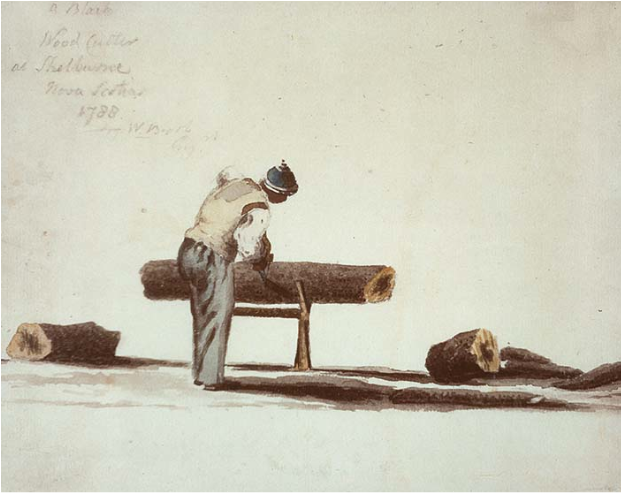
Black Loyalists settled in places like Shelburne, Birchtown, Annapolis Royal, Preston and Digby. Birchtown became one of the largest Black communities outside Africa at the time. But life was hard. Promises of land and equality were often broken. Many worked low-paying jobs or faced hunger. They also had to live with racial segregation.
Challenges and Struggles
Black Loyalists faced many challenges. The British promised them land. But Black Loyalists often received less than white Loyalists. Or, they had to wait years. In Birchtown, the first land grants for Black people came four years after arrival. Plus, the land they got was much smaller than what white people received.
In 1792, many Black Loyalists left for Sierra Leone. They hoped for a better life there. Those who stayed kept trying to build their communities. Anti-Black racism was common. In 1784, the Shelburne race riots happened. White Loyalists destroyed Black properties out of anger over jobs and land.
Religious Life
Religion was very important for Black Loyalists. They built their own schools and churches. They formed strong communities.
Leaders like William Furmage, William Ash, Moses Wilkinson, Boston King and David George helped guide these communities. David George introduced the Baptist church to several towns in Nova Scotia. He was also a former enslaved person.
Religion gave hope and comfort during hard times.
Black Loyalists in Upper Canada
Most Black Loyalists went to Nova Scotia. But several hundred settled in what became Upper Canada. Today, this is Ontario. Some were free, others enslaved.
Notable figures included Richard Pierpoint. He gained freedom by fighting for the British. He then settled in the Niagara region and received land.

Black Loyalists in Upper Canada also supported the British in later conflicts, like the War of 1812. (See The Coloured Corps: Black Canadians and the War of 1812.)
Legacy of Black Loyalists in British North America
Wherever they settled, Black Loyalists faced hardships. (See Anti-Black Racism.)
In Nova Scotia, they were given land but not legal titles. This made it hard to pass on their property to their children. In 2017, the Government of Nova Scotia began helping Black families get legal land titles.
Today, places like the Black Loyalist Heritage Centre and a Royal Canadian Mint commemorative coin honour their legacy. The story of Black Loyalists is one of courage, struggle and lasting impact on Canadian history.