Share on Facebook
 Share on X
 Share by Email
 Share on Google Classroom
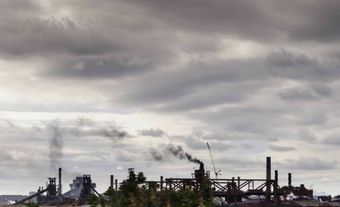
Once thought of as one of the purest and cleanest places on Earth, the Arctic now seasonally experiences a dirty blanket of reddish-brown smog. Coined in the 1950s, the Arctic haze, which arrives each fall and winter, is a totally unexpected phenomenon recorded nowhere else on Earth.
Discovery
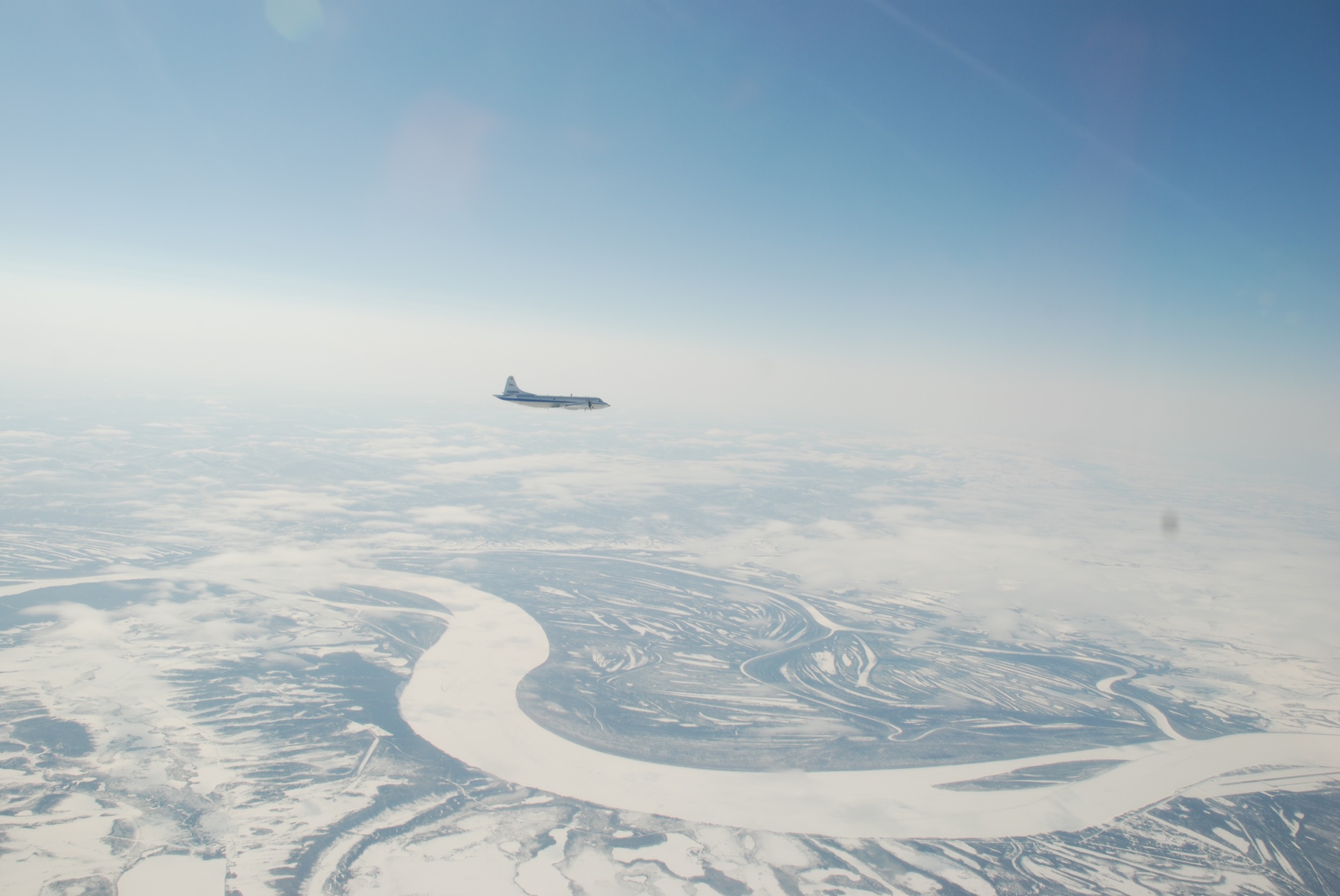
Arctic haze is not a recent discovery; only the understanding of its composition and occurrence is recent. In the 1970s, a series of air chemistry measurements conducted first at Barrow, Alaska, and then at Mould Bay, NWT, showed Arctic haze is not natural but more human in origin. Glacial cores drilled through centuries of compacted snow on Ellesmere Island show that in the first half of this century, ice acidity and sulphur emissions were roughly constant and about half the current levels. Since 1956, there has been a 75 per cent increase in Arctic air pollution, paralleling a doubling of acidic sulphur dioxide emissions worldwide.
Composition
The haze consists mainly of sulphur and nitrogen compounds (as gases, fine liquid or solid particles called aerosols), along with naturally occurring substances like sea salt, wildfire ash, and windblown soil dust. The longer sulphur and nitrogen compounds remain in the atmosphere, the greater the chance they have to transform into acids similar to acid rain. Arctic haze also carries a mess of airborne toxic contaminants (e.g., herbicides and pesticides such as lindane and DDT); heavy metals (e.g., lead, mercury and vanadium); and industrial organic compounds (e.g., solvents, dioxins and PCBs).
Extent
The haze blankets virtually the entire area north of 60° lat. Concentrations tend to reach a maximum near the top of the inversion layer (400–800 m above ground) and decrease above it. Arctic pollution levels are also generally 10–20 times higher than those over Antarctica and 10 times greater than over nonindustrial areas of North America.
Seasonality
The High Arctic is 20–40 times more polluted in winter than in summer. From February-May, enough particles are suspended in the air to become visible as a haze. During the summer, the pollution haze vanishes. There are at least three reasons why this occurs: wintertime inversions form invisible barriers through which accumulated pollution cannot escape; large weather systems that control the movement of pollutants into, through and out of the Arctic are quite vigorous in winter and usually have a northward flow; and in winter, the air passes over what is essentially a frozen desert, so there is little rain or snow to wash out pollutants.
Sources
It was not until 1980 with the use of chemical tracer methods that pollutants were followed to their sources. Different types of industry spew out pollution containing distinctive mixes of chemicals. For example, the composition of lead in emissions from oil, coal, and wood burning, and from metal-processing refineries in Eastern and Western Europe and North America, differs. A chemical fingerprint, so to speak, can be used to trace arctic haze back to its region, if not to every factory, of origin.
By applying a chemical transport model, it was determined that North America contributes relatively little (less than 4 per cent) to the atmospheric brew entering the Arctic. Two-thirds of the haze pollution has been found to arrive from upwind sources in the heavily industrialized nations of Eastern Europe; the remainder arrives from Western Europe.
Environmental Effects
Not much is known about the environmental effects of Arctic haze, but the most obvious is reduced visibility. More significantly, haze alters the energy budget and, quite possibly, the climate. The black, sooty particles in the atmosphere and on snow and ice cover absorb much more of the Sun's energy. The haze warms; as snow and ice cover diminishes, surface reflectivity is further reduced, accelerating the overall warming.
Current Trends
From 1979–95, Environment Canada routinely monitored the chemical and physical composition of the atmosphere at Alert, NWT. Recent measurements show that the trend in increasing Arctic haze, which began accelerating in the 1950s, has stopped. Also, although the sulphate content has remained roughly the same, concentrations of some toxic organic contaminants and heavy metals have fallen dramatically; lead concentrations have declined by 55 per cent since 1980. These declines are at least partly due to actions by Arctic rim countries and industries to control toxic releases and to eliminate lead in gasoline.