Share on Facebook
 Share on X
 Share by Email
 Share on Google Classroom
Indigenous self-government is the formal structure through which Indigenous communities may control the administration of their people, land, resources and related programs and policies. These structures form through agreements with federal and provincial governments. The forms of self-government are diverse. Self-government remains an evolving and contentious issue in Canadian law, policy and public life.

Canadian Law
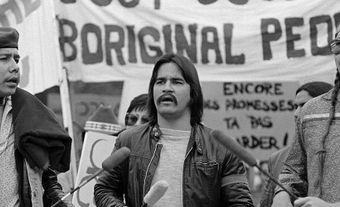
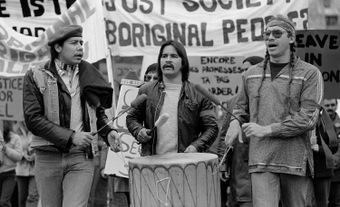
The Indian Act, 1876 dismantled traditional systems of governance and imposed external controls. These controls came in the form of local Indian agents and the Department of Indian Affairs. In the late 1960s and early 1970s, Indigenous organizations were increasingly effective and Indigenous activism intensified. Additionally, there were several high-profile disputes over development in Canada’s North. These events set Canada on a path toward acknowledging and enabling forms of Indigenous self-government. (See also Indigenous Political Organization and Activism in Canada.) This trend gained momentum in the late 20th and early 21st centuries. Indigenous peoples saw their rights to self-government affirmed in the Constitution Act, 1982 and in international documents. The right to self-government, however, is far from being enshrined in law. (See also Rights of Indigenous Peoples in Canada.)
Court Cases
At the end of the 20th century, Canadian courts made several rulings on matters regarding Indigenous rights. Matters related to self-government, such as jurisdiction over lands and peoples and regulation of traditional activities, emerged through these cases. Canadian law has taken a gradual approach to broadening law-making powers and jurisdiction through the exercise of Indigenous rights.
In the Sparrow case (1990), for example, the Supreme Court of Canada sidestepped the issue of whether the Musqueam Nation in British Columbia had jurisdiction to regulate the fishing rights of its members. In the Pamajewon case (1996), the Court was prepared to consider the possibility that a right of self-government was recognized by Section 35. However, it did not rule that the section had that effect. In the Delgamuukw case (1997), the Court declined to deal with the issue.
In general, for the Court to acknowledge jurisdiction to regulate, a group would have to establish that the activity itself is a protected right. Part of this process involves confirming that it was regulated by their ancestors prior to contact.
Committees, Commissions and Constitutional Patriation
During the 1980s and 1990s, special committees recommended that broad measures be taken in Canada to recognize and implement self-government. The issue was raised during the process of patriating the Canadian Constitution.
A Special Committee of the House of Commons on Indian Self-Government was appointed in 1982. In 1983, it produced the Penner Report. The Penner Report recommended that First Nations be recognized as a distinct order of government. It also recommended establishing processes leading to self-government.
Section 35 of the Constitution Act, 1982, recognized "existing Aboriginal and treaty rights.” However, this term was left undefined. The desirability of a constitutional amendment explicitly recognizing an inherent right to self-government was debated in the constitutional conferences of the 1980s. It was revived during the negotiation of the Charlottetown Accord in the early 1990s. The Accord proposed a constitutional amendment to explicitly recognize Indigenous peoples' "inherent right of self-government within Canada." A national referendum in 1992, however, rejected this and the other Charlottetown initiatives.
The Royal Commission on Aboriginal Peoples formed in 1991. It reported to the federal government in 1996 and proposed solutions for a new and better relationship between Indigenous peoples and the Canadian government. The Commission urged recognition of an inherent right to self-government as an "existing Aboriginal and treaty rights” under Section 35 of the Canadian Constitution.
Land Claims
Individual communities have achieved differing levels of self-government through the land claims (or comprehensive claim settlement) process. Numerous claims have been negotiated with provisions for self-government and levels of co-management with other governments. All Canadian governments, including Indigenous ones, are subject to the Constitution and the Charter of Rights and Freedoms.
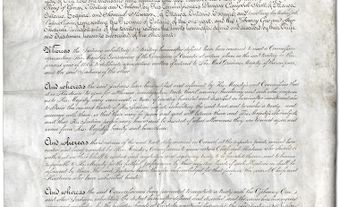
The James Bay and Northern Quebec Agreement (JBNQA) was negotiated and settled in 1975. It was created largely in response to opposition from Inuit and Cree communities to proposed hydroelectric power projects. These communities had never signed a treaty with Canada. The Innu of Northeastern Quebec joined the negotiations during the later stages. They signed a companion agreement (the Northeastern Quebec Agreement) in 1978. The JBNQA — as well as the Penner Report — resulted in the Cree-Naskapi (of Quebec) Act, 1984. It was the first piece of Indigenous self-government legislation in Canada. It replaced the Indian Act and established Indigenous communities in the region as corporate entities.
In 1984, the Inuvialuit of the Mackenzie Delta in the Northwest Territories signed the Western Arctic Claim. Also known as the Inuvialuit Final Agreement, it allowed for the participation of the Inuvialuit in a limited form of local self-government through the creation of the Western Arctic Regional Municipality.
More recent treaties enable Indigenous communities to set up municipal and corporate structures. A historic example is the Nunavut claim settlement, concluded in 1993. It resulted in the creation of the new territory of Nunavut in April 1999. Apart from its legal provisions, this created a self-government agreement because the overwhelming majority of residents of Nunavut are Inuit.
In British Columbia, the comprehensive Nisga'a Final Agreement, finalized in 2000, also made provisions for self-government within settlement lands. However, it was criticized on that basis and challenged in court. The Nisga'a treaty gave the First Nation the right to self-government within the 2,019 km2 in the Nass Valley to which the Nisga’a hold title. This includes the authority to manage their lands, assets and resources. It also recognizes the ability of the Nisga’a to make laws regarding their citizenship, language and culture. Other First Nations in British Columbia continue to negotiate their claims. The Tsawwassen First Nation and the Maa-nulth First Nations signed agreements in 2009 and 2011, respectively.
Some Métis communities have achieved, or are in the process of negotiating, self-governance agreements. The 1990 Métis Settlements Act of Alberta provided a land base for eight Métis communities in northern Alberta. It allowed for the establishment of local traditional-style government. The settlements are subject to provincial and federal law. With the Alberta government, the communities jointly manage subsurface resources on settlement territory.
In 1993, the Sahtu Dene and Métis of the Northwest Territories signed a comprehensive land claim agreement with the federal government. The claim contains a Self-government Framework Agreement, which has been, and continues to be, used in negotiations with the territorial government to establish self-government in the Sahtu Dene and Métis communities covered by the claim.
International Law
In the United States, Native American (or "Indian") tribes are recognized as "domestic, dependent, sovereign nations" with inherent rights to govern within their reservations, to make laws, to establish courts and to enjoy immunity from external lawsuits. This doctrine of domestic sovereignty has never been applied in Canada with respect to Indigenous peoples. However, many argue that under international law, the same doctrine should apply.
The United Nations Declaration on the Rights of Indigenous Peoples (UNDRIP) was adopted into international law on 13 September 2007. The UNDRIP represented two decades of work on the part of Indigenous peoples from around the world. Canada initially supported this work, but when it was adopted, Canada opposed it. The federal government indicated this was because of issues concerning land disputes and the declaration’s clauses about consent. Canada’s rejection caused a ripple of unrest. In 2010, Canada joined the other Anglo-settler countries of Australia, New Zealand and the United States in endorsing the UNDRIP as an “aspirational” document. After a change in federal government, Canada removed its objector status to the UNDRIP in 2016. On 21 June 2021, the United Nations Declaration on the Rights of Indigenous Peoples Act received Royal Assent and came into effect. This act commits the Government of Canada to implement the UNDRIP and recognizes it as a human rights instrument in Canadian law.
Ongoing Issues
The judicial approach to Indigenous self-government is methodical and incremental. Political negotiations have established some powers of self-government for individual communities of First Nations and Inuit, but have yet to fully address the claims of Métis and those of other Indigenous peoples who do not reside in Indigenous communities. All political negotiations are under increasing scrutiny by those who either oppose any degree of self-government for Indigenous peoples or who argue that constitutional amendments are required to give effect to the self-government agreements.